


 Monetization
The Government Can Order Data Centers Off the Grid in 15 Minutes. On July 2 It Almost Did.
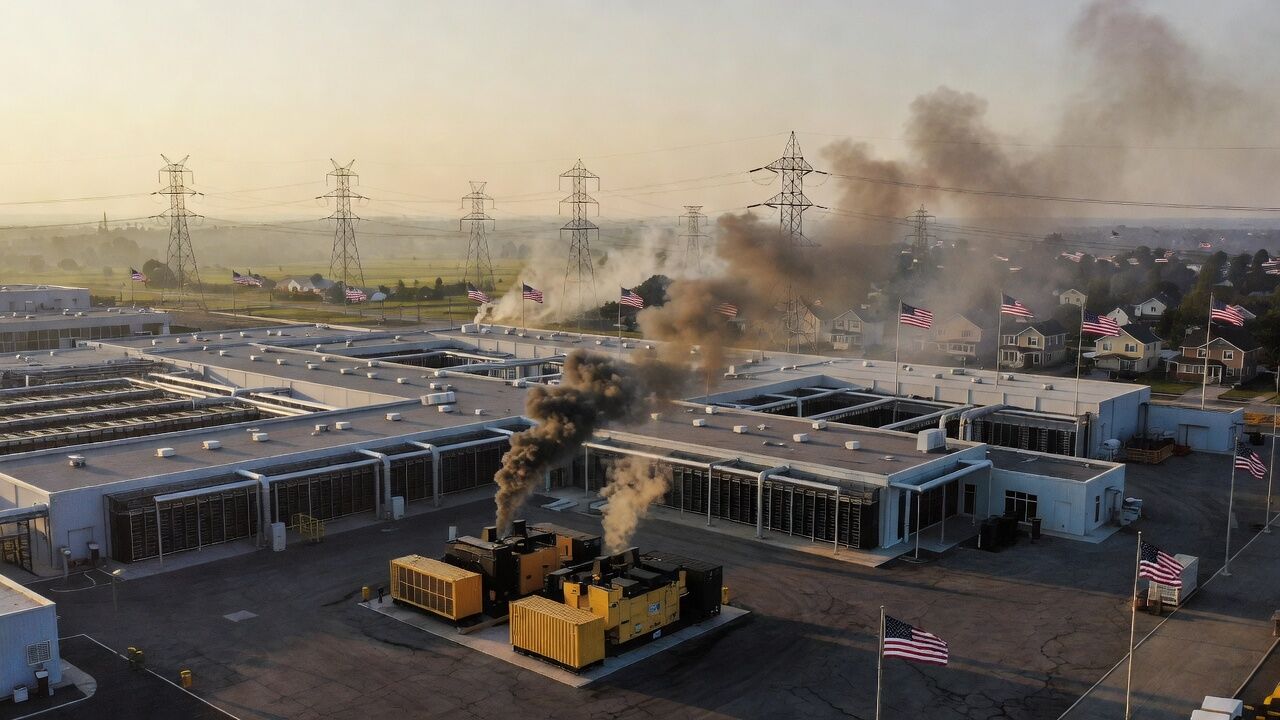
The 1935 Law That Now Controls AI Data Centers
Section 202(c) of the Federal Power Act was written in 1935, during the Great Depression, when the biggest strain on the U.S. electrical grid was a steel mill firing up at shift change. Ninety-one years later, Energy Secretary Chris Wright has signed three emergency orders under that same statute in 2026 alone — each one forcing AI data centers onto diesel backup generators because the grid cannot serve them during a heat wave.
The most recent order, signed June 30 and extended through July 6, authorized PJM Interconnection — the nation's largest grid operator, serving 67 million people across 13 states and D.C. — to direct any customer drawing at least 50 megawatts at a single delivery point to switch to onsite backup generation within 15 minutes of an emergency signal. Hospitals, 911 centers, water treatment plants, and air traffic control are exempt. Data centers are not.
This is not a regulatory curiosity. This is a Depression-era statute being used to commandeer private assets at hyperscale because the industry built faster than the infrastructure could absorb it.
Three Emergency Orders in Six Months
The first Section 202(c) order of 2026 hit PJM on January 26. The second came May 18, when PJM had less than 5,800 MW of reserves and 40,400 MW of generation offline for planned maintenance. Wright's May 18 order noted something revealing: "Currently, there are tens of gigawatts of readily available backup generation that have remained largely untapped." The third came June 30, as PJM projected an all-time peak of 166,304 MW on July 3.
That projected peak sits 741 MW above the prior record of 165,563 MW, set in 2006 — before a single significant AI data center existed in the PJM footprint. The delta between 2006 and 2026 does not come from residential air conditioning growth. It comes from AI infrastructure, concentrated overwhelmingly in Northern Virginia, which now hosts more than 600 data centers consuming over a quarter of the state's entire electrical supply.
By July 2, actual load reached approximately 162.7 GW — close enough to the record that PJM kept the emergency framework active. The NRDC's Tom Rutigliano put it bluntly: "It's the data centers that got us to that point, that we're in a place where luck matters."
The Human Toll: 44 Dead, Bills Soaring
The first heat dome of the summer killed at least 44 people between July 1 and July 4 — 29 in New Jersey, seven in Pennsylvania, four in Illinois, three in New York, and one in Mississippi. The second heat dome is now peaking across the Northeast, with more than 112 million Americans under heat alerts and heat index values above 100 degrees Fahrenheit in New York and Washington.
While families without air conditioning faced deadly conditions, the largest data centers in the country ran their diesel generators to keep AI workloads alive. In Ashburn, Virginia, dark smoke rose above a Digital Realty data center on July 3 as 20 Caterpillar diesel backup generators — each capable of producing more than 2 megawatts — switched on. A local resident who photographed the smoke told Business Insider his electricity bills have risen even though he is not using more power.
That resident is not alone. The independent market monitor Monitoring Analytics attributed 63 percent of PJM's capacity market cost increases to data center demand — a cumulative bill estimated at $9.3 billion that lands on ratepayers. Capacity market prices hit a record $333.44 per megawatt-day, up more than 11-fold from $28.92 just three auctions earlier.
Virginia's 25 Percent Rate Hike
The macro-level grid stress has already hit county budgets in Virginia. Henrico County, a community of more than 350,000 people east of Richmond, hosts 37 data centers and plans to build 17 more. Beginning July 1, the county's electricity rate rose nearly 25 percent, adding about $5 million in annual costs across county government and school facilities.
County Manager John Vithoulkas sent a June 26 email asking employees to turn off lights, shut down computers, unplug chargers, and avoid space heaters — the kind of austerity measures you expect from a small business, not a county government managing hundreds of millions in public funds. The rate increase came through VEPGA, which buys power for local governments and school systems in Dominion Energy territory. Members face a 24.9 percent overall increase beginning July 1, followed by at least another 12 percent in July 2027.
Energy analysts reviewing PJM data project that average household bills in Dominion's service territory could exceed $315 per month within 15 years. The subsidies flow from families and schools to hyperscale data centers, and the mechanism enabling it — capacity market cost socialization — receives almost no public scrutiny.
The Structural Problem Data Centers Can't Design Around
What makes this crisis structurally different from past grid stress events is that data centers are non-dispatchable loads. An AI training cluster cannot be paused the way a Bitcoin miner curtails when prices spike. A hyperscaler cannot shift inference workloads to off-peak hours because the user demand does not disappear when the thermometer hits 103. Mishal Thadani, CEO of AI infrastructure platform Rhizome, expressed it directly: data centers need the most energy exactly when the grid has the least to give.
Compounding the problem, a new study from the University of Cambridge and Nanyang Technological University analyzed 20 years of NASA satellite temperature data across more than 6,000 data center locations and found that facilities raise local land surface temperatures by an average of 2 degrees Celsius — the "data heat island effect." The effect extends up to 10 kilometers from the site and reaches as high as 9.1 degrees Celsius in extreme cases. Data centers make their surroundings hotter, which increases their own cooling demand, which pulls more from the grid exactly when it is most constrained.
The insurance industry has caught on. Zurich Insurance Group disclosed that severe weather has become the leading cause of loss in its U.S. data center builders' risk portfolio over the past three years, surpassing fire. A First Street Foundation analysis found that 79 percent of global data center capacity faces elevated acute climate hazards.
What This Means: The Grid Is the Real AI Bottleneck
The $750 billion that Moody's reports has been committed to AI infrastructure in 2026 cannot operate without a grid capable of delivering the power. PJM's base auction has now failed to meet its reliability reserve target, and independent analyst firm ICF has assessed that PJM has no spare capacity to support new demand beyond 2027.
Three Section 202(c) orders in six months is not an anomaly. It is the new operating environment. Each order builds the legal and procedural machinery for managing large loads under federal direction, and that machinery does not get dismantled between emergencies. The question is not whether a fourth order comes before summer ends — it is what happens next year when summer is longer and the data center load is larger.
The Stargate AI buildout and the grid reliability story are converging at a speed policymakers have not matched. The federal government's tool for managing the convergence is a 1935 emergency statute. That is the reality the industry needs to confront, and it is one that no amount of GPU procurement or data center leasing announcements will solve.
What Comes Next
Watch the reserve margin trend and the emergency order cadence. If PJM successfully interconnects enough new dispatchable generation to rebuild reserves above 20 percent within three years, and subsequent heat events pass without Section 202(c) orders, this is a temporary friction story. If the fourth order arrives before September, the temporary anomaly framing collapses entirely.
Watch also whether FERC produces a voluntary, market-compensated demand-response framework for large loads. If that exists, the emergency commendeering approach becomes unnecessary. If it does not materialize, every summer from now on begins with the question of which grid gets federal backup generator orders first.
The AI data center buildout is not going to slow down. The grid cannot catch up at current interconnection timelines. Something has to give, and right now, it is ratepayers and local communities who are paying the price.
The diesel generators running in Ashburn on July 3 are a preview of every hot summer ahead. We should not need a third heat-related fatality count to start treating grid capacity as the binding constraint it has already become.
— Allan Ali, Sylt.ing
 Portuguese
 English
 Arabic
 French
 Spanish
 Deutsch
 Turkish
 Dutch
Dutch
 Italiano
 Russian
 Romaian
 Portuguese (Brazil)
 Greek
Greek