


 Monetization
AI Data Centers Are Taking Your Neighbor's Land: Georgia Power Eminent Domain and the Rural America Backlash
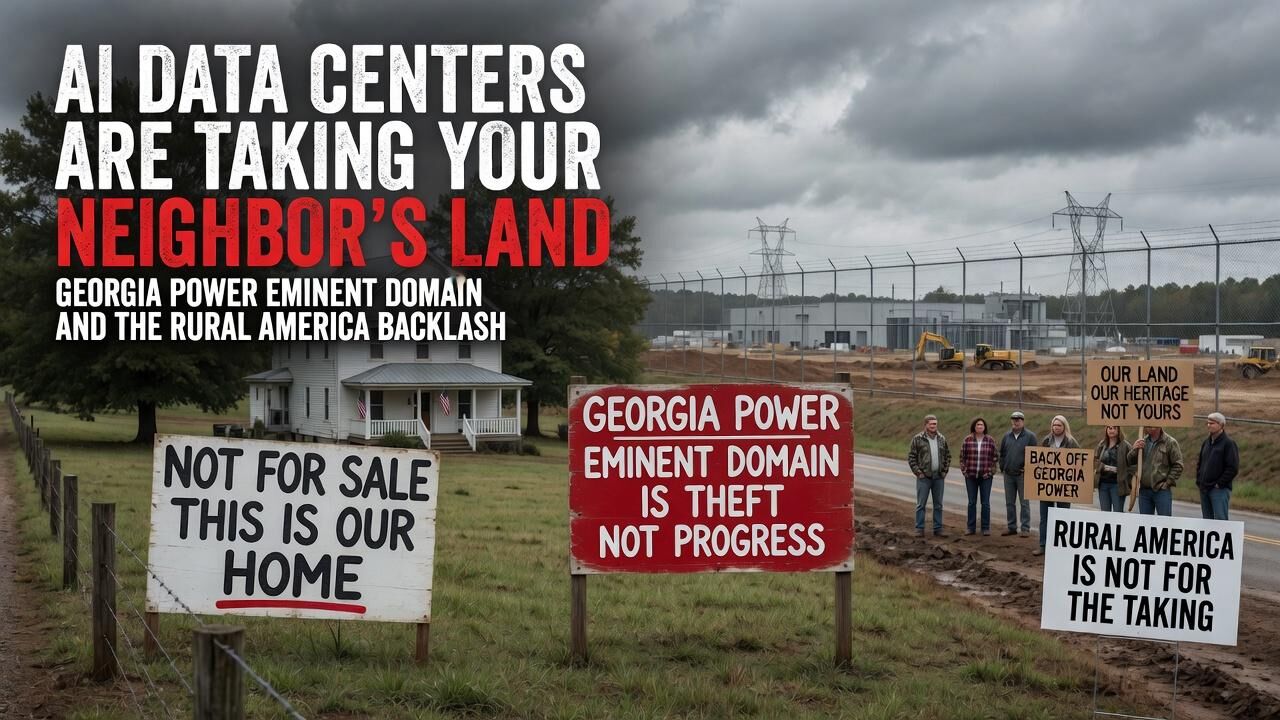
Georgia: 300 Parcels and Counting
Ansley Brown describes it as theft. The surveyors walking her mother's property in rural Georgia. The legal notices. The realization that a billion-dollar utility company was invoking eminent domain to build transmission lines — 70 to 80 percent of whose capacity will go to AI data centers, not to local residents. "It's ours," Brown told CBS News. "It's our family. It's being stripped from us."
Georgia Power is acquiring more than 300 separate parcels across Coweta and Fayette counties for a new transmission line. By the utility's own admission, the overwhelming majority of the power it carries will serve data center customers — customers it refuses to name, citing "safety and security." The families being asked to sell their land do not know which corporations benefit from the transaction. The legal asymmetry is staggering: Georgia Power holds state authority to compel sales, employs attorneys who have executed hundreds of similar acquisitions, and has the financial resources to outlast any legal challenge. The families on the other side have the right to negotiate, the option to litigate at their own expense, and, in Brown's case, a TikTok account.
Some owners have accepted the utility's offers. Others are fighting. Brown's mother, facing formal eminent domain proceedings against a company with vastly more resources, eventually accepted the terms to avoid the process entirely. "To us it's theft," Brown said. "It's literally a billion dollar company stealing land from smaller people, people who can't fight back." Georgia Power spokesperson Holly Lovett said eminent domain is "always a last resort" and that the company has "worked hard to be transparent, negotiate in good faith." No apology has been issued.
The broader question being tested in cases like this is who pays the non-monetary cost of AI infrastructure. The commercial AI race has driven demand for computing power to levels that transmission grids built for earlier eras were not designed to accommodate. The solution utilities have reached is to expand those grids — and the land those grids cross belongs to someone. In rural areas, those landowners typically lack the legal resources and political connections that would make their resistance visible.
Ohio: The One That Got Away
Two states north, a different fight is unfolding — one that may serve as a warning for what comes next nationwide. Ohio farmers, through the Ohio Farm Bureau, are actively opposing a proposal from the Ohio Business Roundtable that would expand eminent domain laws to allow utility companies to seize farmland for data center-related infrastructure before compensating landowners.
The proposal would implement a "deposit and build" system similar to programs used in 45 other states. Under the current process, utility companies must offer "fair" market prices and go to court if owners refuse. Construction cannot begin while owners appeal for higher compensation. The proposed change would allow construction to start immediately after courts determine that state or utility companies can acquire the land — even while compensation disputes continue.
Evan Callicoat from the Ohio Farm Bureau put it directly: "We are aware of efforts to further erode the limited protections that landowners have, allowing for quick take of property without first paying for the property and determining a landowner's rights and compensation through a court of law." The Ohio Business Roundtable's Nick Rhodes defended the recommendation, arguing data centers alone "wouldn't really meet the threshold of public use" — a telling admission that the proposal's broad language could enable exactly the kind of private-to-public transfer that eminent domain critics have warned about.
What makes Ohio the outlier is that the opposition is organized and the fight is public. The Georgia families fought alone, case by case, parcel by parcel. The Ohio Farm Bureau is fighting as a body — and so far, the proposal has not passed. That is the one that got away, and it matters because it shows the alternative: organized resistance can actually slow this down.
The Data Center Power Crisis in Numbers
These land disputes are not isolated incidents — they are the on-the-ground consequence of a structural shift in the US power grid that the numbers make unmistakable. In the PJM region, which covers 65 million people across 13 states and D.C., capacity auction prices surged from $28.92 per megawatt-day to $329 per megawatt-day — an eleven-fold increase. Data center-driven capacity charges totaled $29.4 billion across the last four auctions, representing 46 percent of the $63.6 billion in total capacity charges in that period.
PJM's independent market monitor Joseph Bowring has been unusually blunt about the cause: data centers are driving the largest cost increases the market has ever seen. The most recent auction alone added an estimated $6.3 billion in data center-attributed costs. For ratepayers, the impact is concrete. The $2.30 per month households paid in capacity costs a few years ago is now projected to rise to $17 per month — a 640 percent increase — with data center demand identified as the primary driver.
The Federal Energy Regulatory Commission has yet to issue guidance specific to AI-driven load growth. Several state utility commissions have begun examining whether the public interest standard for eminent domain should account for the proportion of a project's capacity going to private commercial customers rather than general residential service. Georgia has not yet reached that question formally. Ohio is debating it right now. The gap between what the infrastructure requires and what the regulatory framework can handle is widening by the quarter.
What This Means: The System Is Working Exactly as Designed
Here is the uncomfortable truth that the individual stories obscure: the system is working exactly as designed. Georgia Power is following the law. The Ohio Business Roundtable is pursuing policy it believes benefits the state's economy. The data center companies are building where the power is available. Every actor is behaving rationally within the rules they have been given.
The problem is that the rules were written for a different era. Eminent domain law for transmission lines was designed when those lines served residential and commercial customers — not when 80 percent of capacity would feed private data centers that refuse to identify themselves. Capacity market rules were designed to ensure grid reliability, not to accommodate a 10x demand surge driven by three or four hyperscaler companies. The public interest standard at the heart of eminent domain has not been tested against a situation where the "public" benefiting from a transmission line is a handful of the largest technology companies in the world.
What we are watching is a regulatory framework built for 20th-century grid demand being stress-tested by 21st-century AI compute requirements. The stress fractures are visible in rural Georgia, in Ohio legislative debates, and in every PJM capacity auction that sets a new record. The system will eventually adapt — it always does — but the adaptation lag is going to leave a trail of displaced families, contested land deals, and regulatory fights that will define the politics of AI infrastructure for the next five years.
The question that no regulator has answered is the one Ansley Brown asked CBS News: at what point does the public interest standard stop applying when the primary beneficiary is a private company whose name the utility refuses to disclose?
What Comes Next
The signals to watch are not in Washington. FERC has not moved on AI-driven load growth, and Congress is unlikely to act before the next PJM auction cycle. The real action is at the state level. Georgia's Public Service Commission will eventually have to rule on whether a transmission line built 80 percent for data centers meets the public interest standard. Ohio's legislature will decide whether the Business Roundtable's eminent domain expansion passes. And in every state where PJM auctions have sent rate shockwaves — Pennsylvania, Ohio, Virginia, Maryland, Illinois, New Jersey — utility commissions will face pressure to revisit how data center costs are allocated to residential ratepayers.
For infrastructure operators who read this, the practical call is to get ahead of the regulatory curve. If you are building data centers in the PJM region or sourcing power from new transmission lines, the eminent domain question is not someone else's problem. The families fighting Georgia Power today are the plaintiffs in the class-action lawsuits of tomorrow. The Ohio Farm Bureau's opposition today is the legislative testimony that kills the fast-track permitting bill next session. The legal framework is shifting under your feet — and the moment you stop watching, a family in Coweta County signs a forced sale agreement that becomes the core of a regulatory challenge that delays your project by eighteen months.
Watch the Public Service Commission dockets. Track the eminent domain case filings. Read the PJM market monitor reports. The next phase of the AI infrastructure buildout will be fought in hearing rooms and courtrooms, not data center halls — and the question of who pays for the land is the one question nobody in the industry has a good answer for yet.
— Allan Ali, Sylt.ing
===SUMMARY===Georgia Power is seizing 300+ rural parcels via eminent domain for transmission lines feeding AI data centers. Ohio farmers are fighting similar eminent domain expansion. Meanwhile, PJM capacity prices surged 11x to $329/MW-day, with data centers driving $29.4B in costs across four auctions. The regulatory framework built for 20th-century grid demand is failing under AI compute pressure.
 Greek
Greek
 English
 Arabic
 French
 Spanish
 Portuguese
 Deutsch
 Turkish
 Dutch
Dutch
 Italiano
 Russian
 Romaian
 Portuguese (Brazil)