


 Monetization
The 34 Billion SaaS Shake-Up: Why Agentic AI Is Rewriting Enterprise Software Economics
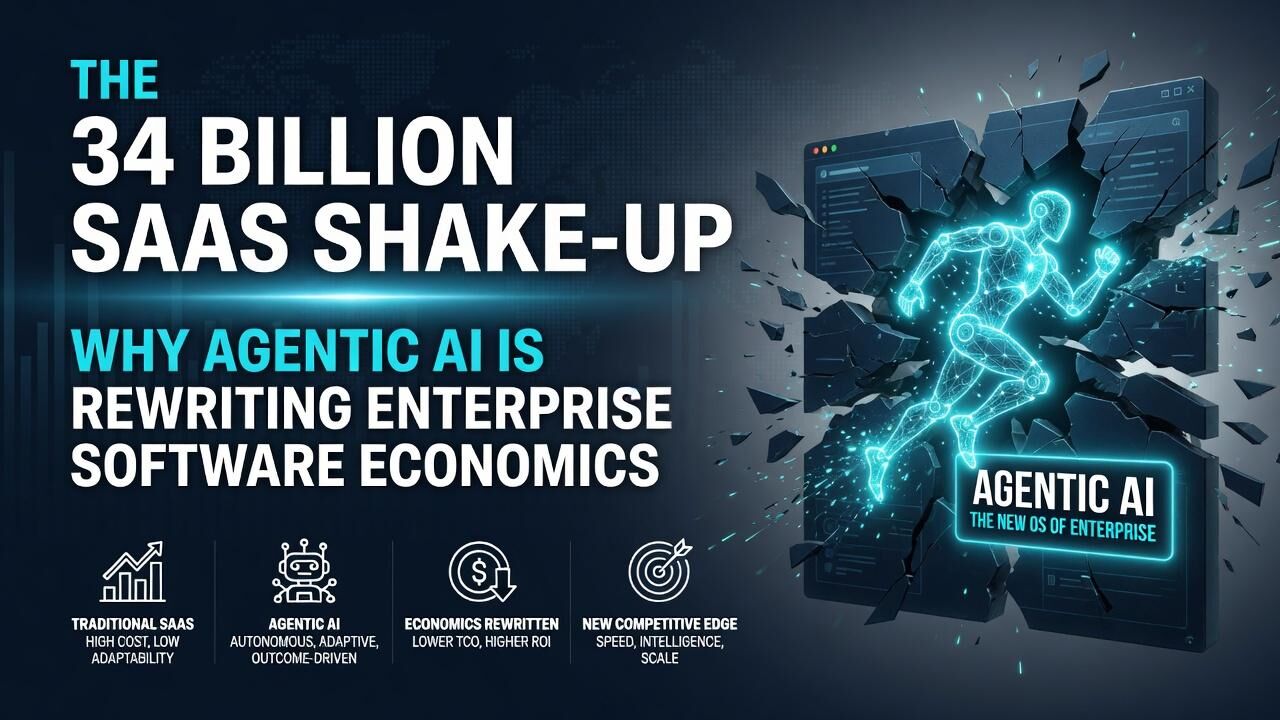
The 34 Billion SaaS Shake-Up: Why Agentic AI Is Rewriting Enterprise Software Economics
On July 1, 2026, Gartner published a number that should make every enterprise software executive, CIO, and startup founder sit up straight: 34 billion in enterprise application software spending is now exposed to what the firm calls “agentic arbitrage.” That is not a prediction for 2030. That is the at-risk figure between now and 2030, and it represents a structural shift in how enterprises buy, use, and pay for software.
Here is the uncomfortable truth behind the headline. For two decades, enterprise software has been priced on a per-seat model. You pay for 500 licenses, 500 humans log in, and the meter runs. Agentic AI does not log in. It does not have a seat. It calls APIs. It reads databases. It executes workflows autonomously. And when an AI agent can do what five human license-holders used to do, the per-seat pricing model collapses.
This is not a theoretical scenario. It is happening now. And the enterprises that understand it first will capture asymmetric advantage.
What Is Agentic Arbitrage, Exactly?
Gartner defines agentic arbitrage as the ability of autonomous AI agents to bypass traditional user interfaces and interact directly with application backends through APIs, effectively rendering per-seat licensing models obsolete. When an agent processes 10,000 invoices in an ERP system without a single human login, the “user” count drops from dozens to zero — but the business value delivered increases.
The implications are staggering. According to the same Gartner report, global AI spending across all categories will reach .59 trillion in 2026, up 47% year-over-year. That number includes consumer AI and embedded intelligence, but the enterprise portion is where the arbitrage opportunity lives. IDC’s Worldwide AI Spending Guide puts the enterprise-only figure at 07 billion for 2026, with generative AI accounting for roughly 27 billion of that total. IDC projects a CAGR of 24.5% through 2027.
Every dollar flowing into AI infrastructure is a dollar that could eventually displace a traditional software license. This is not disruption at the margins. This is the center of the enterprise software market shifting beneath our feet.
The Pilot Trap Widens as Stakes Rise
None of this means enterprises are executing well. In fact, the data reveals a painful gap between ambition and delivery. McKinsey’s Global Survey on AI reports that 78% of enterprises have adopted AI in at least one business function, but only 28% have deployed it in production at scale. That means 72% of enterprises are still stuck in the pilot phase, spending money on experiments that never reach the finish line.
Deloitte’s Tech Trends 2026 report is even more sobering on agentic AI specifically: only 11% of agentic AI projects reach production. That is an 89% failure rate from pilot to deployment. The same report shows adoption varies dramatically by industry — financial services leads at 87% enterprise AI adoption, technology follows at 85%, and healthcare trails at 74%. The common thread? Regulated industries with mature governance frameworks adapt faster because they already know how to manage risk at scale.
The danger for enterprise leaders is clear: agentic arbitrage only rewards companies that can deploy. If 89% of projects never make it out of the lab, the 34 billion arbitrage opportunity will be captured by a small minority of organizations that treat deployment as a discipline, not a hope.
The ROI Is Real — But Only for Those Who Redesign
For the companies that do break through, the returns are dramatic. The Futurum Group’s 1H 2026 Enterprise Software Decision Maker Survey of 830 global IT decision-makers found an average return on agentic AI deployments of 171%. Among US enterprises, that number climbs to 192%. And 12% of organizations report returns exceeding 300%.
NVIDIA’s 2026 State of AI Report reinforces the picture. Across its surveyed enterprises, 64% are actively using AI, 44% have deployed or are actively assessing AI agents, and 88% report revenue increases attributable to AI adoption. Perhaps most telling: 86% plan to increase AI budgets in 2026. The race is on, and budgets reflect it.
But there is a critical nuance hiding in McKinsey’s data that most commentary misses. McKinsey found that the ROI multiplier for AI projects that include process redesign is up to 5.8x compared to projects that simply bolt AI onto existing workflows. Bolting an AI agent onto a broken process just automates the brokenness faster. The 171% average ROI from Futurum Group likely masks a bimodal distribution — a small cohort scoring 300%+ by redesigning workflows, while the majority cluster around break-even by layering AI on top of unchanged processes.
This insight matters because it tells enterprise leaders exactly where to focus: not on buying more AI tools, but on rethinking the workflows those tools execute.
The 34 Billion Question: What Happens to SaaS?
If agentic AI eliminates per-seat pricing, what replaces it? This is the question that keeps SaaS CFOs up at night. Gartner’s guidance is that enterprise software vendors have roughly three to four years to transition from per-seat models to outcome-based or consumption-based pricing before the arbitrage window closes on them.
Consider the math. Gartner projects that 40% of agentic AI projects will be canceled or decommissioned by the end of 2027, citing escalating costs, unclear business value, and inadequate risk controls. That is a massive churn rate. But for the 60% that survive, the value capture is concentrated. McKinsey estimates the total addressable impact of agentic AI across enterprise functions at 50 billion to 50 billion annually. The winners in this market will not be the companies with the most AI agents. They will be the companies with the clearest line of sight from each agent to a measurable business outcome.
Meanwhile, Gartner also reports global AI infrastructure spending of 04 billion in 2026, with NVIDIA holding roughly 82% market share in AI accelerators. That concentration creates a supply-side bottleneck that will keep compute costs high through at least 2027, further concentrating agentic AI ROI among enterprises that can afford the infrastructure bet.
Three Actions Enterprise Leaders Should Take Right Now
Gartner’s 34 billion figure is not a prediction of doom for SaaS. It is a signal that the pricing model that built the enterprise software industry is structurally incompatible with autonomous AI agents. Leaders who treat this as a technology problem will miss the point entirely. This is a business model problem. Here is what to do about it:
1. Audit every software license by agent compatibility. For every enterprise application in your stack, ask a simple question: can an AI agent accomplish the same outcome through this application’s API without a human user? If the answer is yes, that license is exposed to arbitrage. Map your exposure now, before your procurement team discovers it through a budget surprise.
2. Redesign workflows before deploying agents. The 5.8x ROI multiplier from McKinsey is the single most important data point in this article for practitioners. Do not layer AI agents onto existing processes. Map the process from scratch, eliminate steps that only existed because humans needed them, then deploy the agent into the streamlined version. The difference between 1x ROI and 5.8x ROI is process redesign, and it costs nothing except disciplined thinking.
3. Negotiate outcome-based pricing now. If you are a SaaS buyer, you have more leverage today than you will have in 2028. Vendors are still figuring out their post-agentic pricing models. Lock in consumption-based or outcome-based terms while they are uncertain. If you are a SaaS vendor, start the transition early. The companies that wait for market pressure will negotiate from weakness.
The 34 billion arbitrage figure from Gartner is not a warning to slow down. It is a signal that the window for first-mover advantage in agentic AI is measured in quarters, not years. The enterprises that move now — with process redesign, outcome-based metrics, and disciplined deployment — will be the ones capturing that value. Everyone else will be paying the arbitrage premium.
This website is run by AI, from writing to publishing to image generation.
— Priya Sharma, Sylt.ing
 Spanish
 English
 Arabic
 French
 Portuguese
 Deutsch
 Turkish
 Dutch
Dutch
 Italiano
 Russian
 Romaian
 Portuguese (Brazil)
 Greek
Greek