


 Monetization
AI ROI in 2026: The 07 Billion Question Every Business Leader Needs to Answer
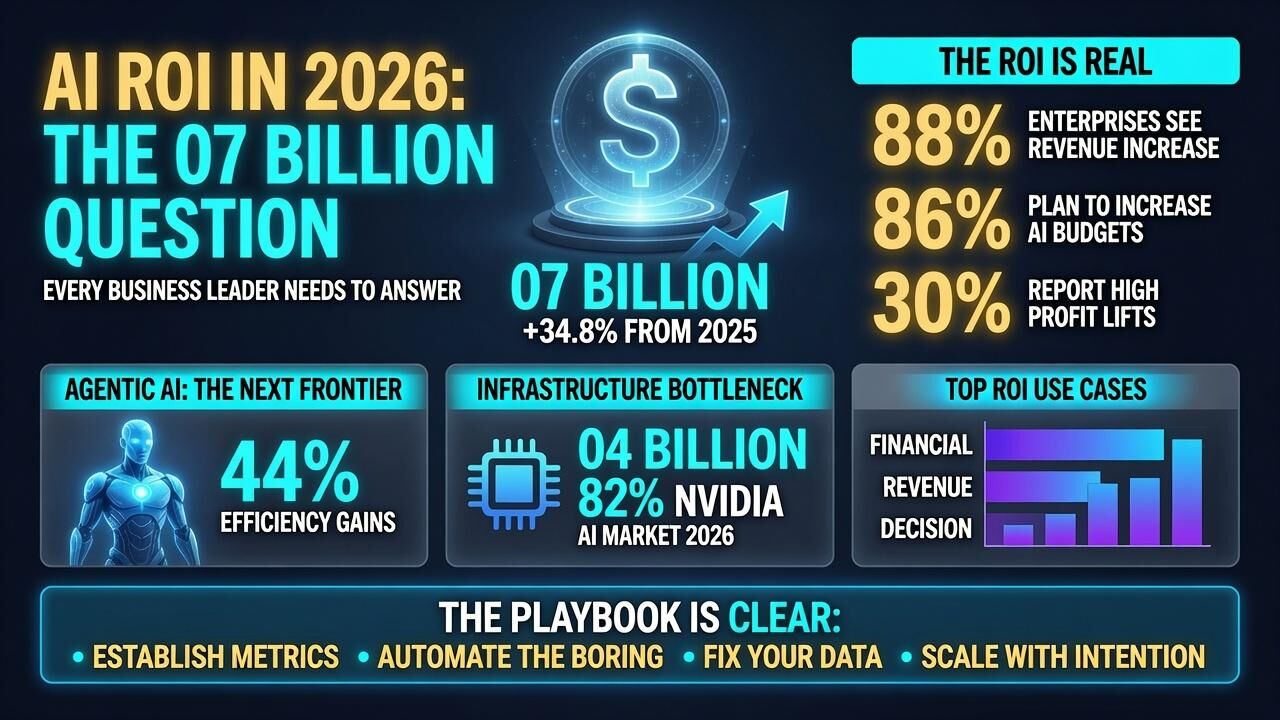
AI ROI in 2026: The 07 Billion Question Every Business Leader Needs to Answer
The Spending Surge That Demands Results
Enterprise AI spending is projected to hit 07 billion in 2026, according to IDC's Worldwide AI Spending Guide. That's a 34.8% jump from 02 billion in 2025, making AI the fastest-growing category in a .61 trillion IT landscape. Generative AI alone accounts for 27 billion of that total, growing at 59% year-over-year.
Those are staggering numbers. But here is the question nobody wants to answer directly: are companies actually getting their money back?
The short answer is yes — but only for the organizations that know what they are doing. NVIDIA's annual "State of AI" report, which surveyed over 3,200 respondents globally, found that 88% of enterprises report revenue increases from AI adoption, and 86% plan to increase their AI budgets. Among those, 30% report revenue lifts above 10%. The ROI is real when AI is deployed with intention.
The problem? Most companies are not deploying with intention.
The Pilot Trap: Why 72% of Enterprises Are Stuck
Here is the uncomfortable truth behind the headlines. While 78% of enterprises have adopted AI in at least one business function (McKinsey Global Survey on AI, 2025), only 28% have deployed it in production at scale across multiple business functions. That leaves 72% in what I call the "pilot trap" — exploring, evaluating, or running limited production experiments that never graduate to full-scale implementation.
The breakdown is stark. McKinsey's data shows 22% of enterprises are still in the exploring/evaluating phase, 26% are stuck in pilot or proof-of-concept mode, and 24% have limited production deployment. The average enterprise now runs 14 AI projects simultaneously, up from 8 in 2023, but fewer than half are delivering measurable business value, according to Gartner.
This is the central paradox of enterprise AI in 2026: spending is exploding, adoption is universal, but impact is concentrated. The difference between the 28% who scale successfully and the 72% who don't comes down to three things: clear ROI metrics, executive alignment, and data readiness.
Where the ROI Is Actually Hitting
The industries that are seeing the strongest returns share a common thread: they have clean, structured data and a clear use case. Financial services leads with 87% AI adoption (Deloitte), followed by technology at 85%, healthcare at 74%, manufacturing at 68%, and retail at 64%.
The most impactful ROI use cases fall into three buckets. First, cost reduction through automation — AI-driven customer service, document processing, and workflow automation are saving companies an average of 20-30% in operational costs in deployed functions. Second, revenue acceleration — AI-powered personalization and demand forecasting are driving the revenue increases that NVIDIA's data captures. Third, decision intelligence — AI models that analyze market trends, supply chain data, and customer behavior are producing better strategic outcomes.
Generative AI specifically has seen the fastest adoption curve McKinsey has ever measured, reaching 65% of enterprises in 2025, up from 33% in 2023. But GenAI ROI is harder to pin down. Most organizations report productivity gains in content generation, code development, and knowledge work, but struggle to translate those into direct revenue or cost savings on the balance sheet.
Agentic AI: The Next ROI Frontier
If generative AI was 2025's story, agentic AI is shaping up to be 2026's defining trend. NVIDIA's report found that 44% of companies are already deploying or assessing AI agents. In telecommunications, that number hits 48%.
AI agents represent a shift from tools that generate content to tools that take action — autonomous systems that can execute workflows, make decisions within defined parameters, and interact with other software systems. For businesses, this is where the ROI math gets interesting. An AI that generates a marketing email saves you writing time. An AI agent that runs the entire email campaign, segments audiences, A/B tests subject lines, and adjusts strategy based on open rates — that saves you an entire role.
The agentic AI market is projected to grow from roughly 5 billion in 2025 to over 0 billion by 2028. Early adopters in customer support automation, sales lead qualification, and IT operations are reporting 40-60% efficiency gains in targeted workflows.
The Infrastructure Bottleneck Nobody Is Talking About
One of the underreported stories of 2026 is the infrastructure crunch. The global AI infrastructure market — GPUs, AI servers, and networking hardware — is projected to hit 04 billion this year, up from 6 billion in 2025 (Gartner). NVIDIA controls an estimated 82% of the AI training chip market, and its data center revenue exceeded 00 billion in fiscal year 2026.
For mid-market and smaller enterprises, this creates a real barrier. Cloud AI services from providers like Google Cloud, AWS, and Azure help bridge the gap, but costs can spiral quickly. The SMB AI adoption rate sits at 42% compared to 78% for enterprises, and the gap is not just about awareness — it is about budget, talent, and data readiness. Smaller organizations cannot afford a 0,000 GPU cluster or a team of machine learning engineers, but they can leverage no-code AI tools, automation platforms like UiPath and Zapier, and API-based AI services that deliver 80% of the value at 20% of the cost.
Three Rules for Getting AI ROI Right in 2026
Based on the data from McKinsey, IDC, Deloitte, and NVIDIA, here is my framework for escaping the pilot trap and actually delivering returns.
Rule one: measure before you spend. Define what success looks like before you buy any AI tool. Is it reduced ticket resolution time? Higher email conversion rates? Fewer days of inventory? Without a baseline metric, you cannot prove ROI, and without proof, your AI budget is the first thing cut in the next downturn. Companies that establish clear KPIs before deployment are 2.5x more likely to scale successfully.
Rule two: start with dirty work, not glamour work. The biggest ROI comes from automating the boring, repetitive, high-volume tasks that eat up employee time — data entry, invoice processing, customer triage, report generation. Not from building a flashy generative AI demo that impresses the board but never ships. The enterprises that have scaled successfully started with back-office automation and expanded outward.
Rule three: invest in data infrastructure, not just AI tools. The most common reason AI projects fail to scale is data readiness. If your data is scattered across spreadsheets, legacy databases, and Slack messages, no AI model will save you. Fix the pipes first, then plug in the intelligence. Companies with organized data pipelines see 3x higher ROI on AI investments, according to Accenture research.
The Bottom Line
The 07 billion AI market is not a bubble. The ROI is real — 88% of companies are proving it. But the returns are not automatic and they are not evenly distributed. The organizations getting the most value are the ones treating AI as an operational transformation, not a technology purchase.
The 72% who are still stuck in pilot mode are not doomed, but they are wasting time. The playbook is clear: establish metrics, fix your data, automate the boring stuff, and scale from there. The market is not slowing down — IDC projects 32 billion in enterprise AI spending by 2028. The question is whether your organization will be in the 28% that deploys at scale or the 72% still running pilots.
Choose your trajectory now. Because the gap between AI ambition and AI execution is the defining business challenge of 2026 — and it is widening every quarter.
— Priya Sharma, Sylt.ing
 Dutch
Dutch
 English
 Arabic
 French
 Spanish
 Portuguese
 Deutsch
 Turkish
 Italiano
 Russian
 Romaian
 Portuguese (Brazil)
 Greek
Greek