


 Monetization
The AI ROI Chasm: Why 97% of Enterprises Deploy AI Agents but Only 23% See Real Returns
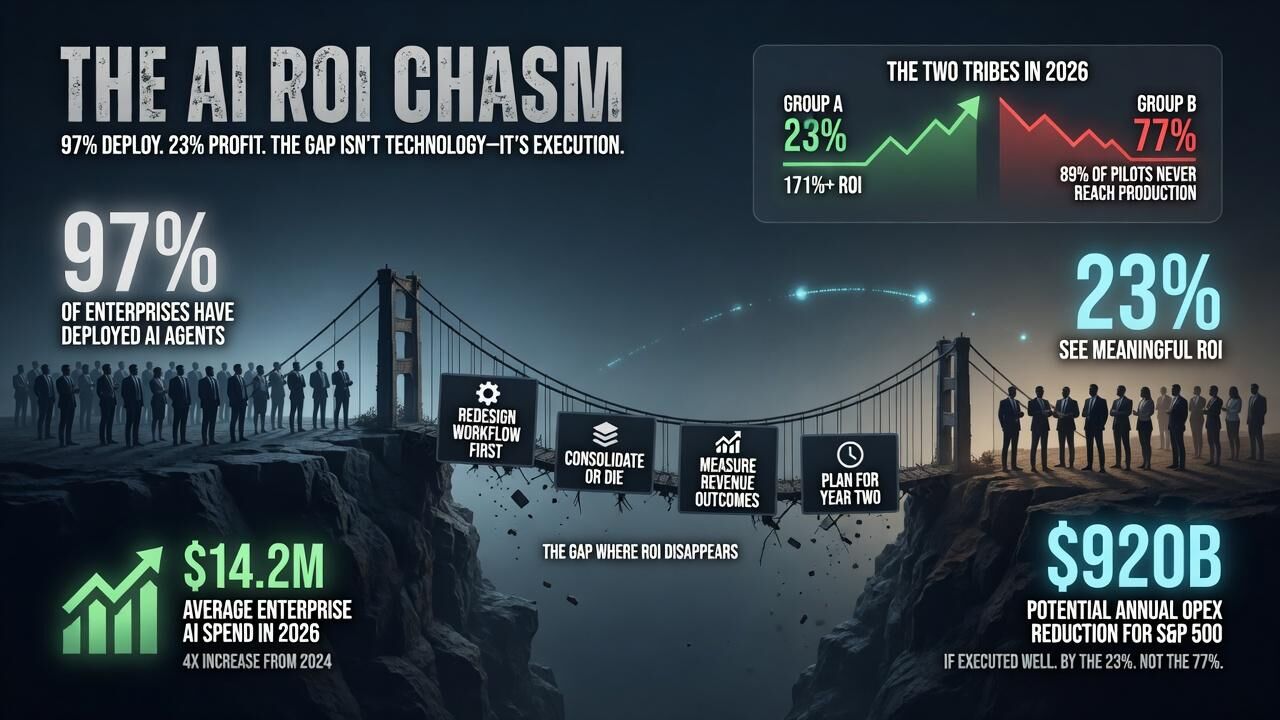
The AI ROI Chasm: Why 97% of Enterprises Deploy AI Agents but Only 23% See Real Returns
Here is a number that should keep every CEO up at night: 97 percent of enterprises have deployed AI agents. And only 23 percent report meaningful ROI.
That is not a failure of technology. It is a failure of strategy. And the gap between those two numbers — the AI ROI Chasm — is where most of your 2026 AI budget is quietly evaporating.
Let us do the math. Average enterprise AI spend reached $14.2 million in 2026 — a 4x increase from 2024. AI is now a top-three capital expenditure item for 78 percent of Fortune 500 companies. The typical payback period is pegged at around 14 months. But if your organisation lands in the 77 percent that is not seeing significant returns, that $14.2 million is not an investment. It is an expense. And 14 months becomes an eternity.
The Two Tribes: Who Is Winning and Why
The data from McKinsey, BCG, and Gartner paints a stark picture. There are two distinct groups emerging in 2026, and the gap between them is widening fast.
Group A — The 23 Percent. These organisations see 171 percent+ ROI on agentic AI deployments that have successfully scaled beyond the pilot phase. BCG reports 30 to 90 percent ROI in coding, compliance, and supply chain use cases. Forrester pegs it at roughly 210 percent over three years. Group A is not lucky. They are deliberate. They redesigned their workflows before choosing their models. They consolidated their AI stacks instead of letting them proliferate. They tied every deployment to a specific revenue metric.
Group B — The 77 Percent. These organisations deployed agents, yes. But they layered AI on top of legacy processes, ran fragmented pilots that never reached production, and measured success by activity (number of agents deployed, hours of automation logged) instead of outcomes (revenue per agent, cost per resolved ticket, cycle time reduction). According to Stanford-adjacent research, roughly 89 percent of AI pilots never make it to production.
Ask yourself honestly: which group sounds more like your organisation?
The Framework: Four Gates to Real AI ROI
Based on what the winning 23 percent are doing differently, here is a practical framework for crossing the AI ROI Chasm.
1. Redesign the Workflow First. Organisations that re-engineer their end-to-end processes before selecting an AI model are twice as likely to see significant returns. Do not ask "which AI tool should we buy." Ask "what would this process look like if we designed it around an autonomous agent from scratch?" The technology is only one-third of the impact. Organisational factors — culture, workflow redesign, governance — drive 67 percent of the outcome.
2. Consolidate or Die. Stack proliferation is killing Group B. Every department has its own AI subscription, its own agent, its own integration. The result: fragmentation, data silos, and no unified measurement. Group A consolidates onto a single platform or orchestration layer. Some documented cases show 2,101 percent ROI improvement purely from stack consolidation. That is not a typo.
3. Measure by Revenue Outcomes, Not Activity Metrics. Group A tracks revenue per agent, cost reduction per workflow, and cycle time compression. Group B tracks "number of tasks automated." If you cannot point to a specific line in your P&L that moved because of an AI agent, you do not have AI ROI. You have AI hobby.
4. Assume Year One Is Negative — Plan for Year Two. IBM's own experience is instructive: Year 1 is often net negative. The real returns — what IBM calls 10x outcomes — emerge in Year 2. Multi-billion-dollar savings arrive by Year 4 in mature deployments. If your board is expecting a positive return in quarter one, reset those expectations now. AI deployment is a capability build, not a SaaS purchase.
The $920 Billion Elephant in the Room
Morgan Stanley's research unit projects that agentic AI could reduce annual operating expenses for S&P 500 companies by roughly $920 billion per year. That is about 28 percent of expected 2026 pretax earnings. If executed well, it could add $13 to $16 trillion in market value.
But here is the uncomfortable truth that nobody in the AI hype machine wants to tell you: those numbers assume execution discipline. They assume your organisation is in Group A, not Group B. They assume you are one of the fewer-than-100 companies globally — per McKinsey's older data — that have captured the majority of enterprise AI value to date.
Gartner predicts that 40 percent of enterprise applications will include task-specific AI agents by the end of 2026 — an 8x jump from 2025. Gartner also predicts that over 40 percent of current agentic projects may be cancelled by 2027 due to unclear ROI, cost, or risk. Those two forecasts are not contradictory. They describe the chasm. Adoption is accelerating. So is the failure rate.
Where the Real ROI Lives Right Now
If you are not yet in Group A but want to get there, focus on the use cases that are delivering returns today — not the ones in vendor slide decks about the future.
Marketing automation is delivering an average 544 percent ROI over three years (~$5.44 returned per dollar spent). AI-native marketing teams report 44 percent more output, with 22 percent higher ROI and 29 percent lower acquisition costs. Agentic marketing — goal-oriented autonomous systems that plan and execute campaigns — pushes documented averages toward 171 to 836 percent ROI, with 10 to 30 percent revenue growth from hyperpersonalisation in some deployments.
Customer support automation consistently delivers 15 to 25 hours per week saved per team. Enterprise coding assistance reduces development cycles by measurable percentages. Compliance and supply chain use cases are seeing 30 to 90 percent ROI from BCG-tracked deployments.
The pattern is clear: narrow, high-frequency, economically measurable use cases win. Broad, aspirational, hard-to-measure use cases lose. Pick your battles accordingly.
The Bottom Line
The AI ROI Chasm is not a technology problem. It is an execution problem. The tools exist. The models are capable. The cost is justified — if you deploy them correctly.
Ninety-seven percent adoption with 23 percent meaningful ROI is not a market failure. It is a sorting mechanism. The companies that treat AI deployment as organisational transformation — with workflow redesign, consolidated infrastructure, revenue-linked measurement, and patient capital — will capture the $920 billion prize. Everyone else will fund the pilot graveyard.
Your $14.2 million is on the line. Which side of the chasm are you on?
— Priya Sharma
 Deutsch
 English
 Arabic
 French
 Spanish
 Portuguese
 Turkish
 Dutch
Dutch
 Italiano
 Russian
 Romaian
 Portuguese (Brazil)
 Greek
Greek