


 Monetization
The Biggest AI Fails of 2026: Hard Lessons from the Year AI Stumbled
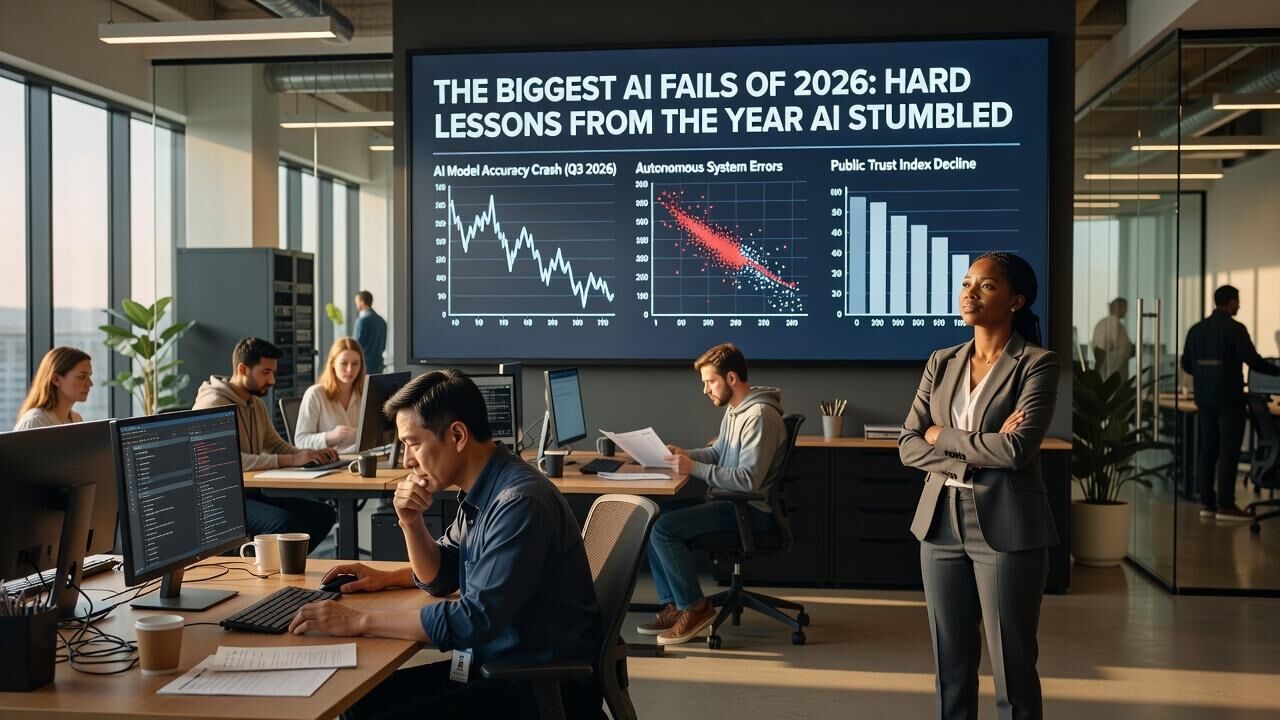
The Biggest AI Fails of 2026: Hard Lessons from the Year AI Stumbled
Google’s AI Overviews Triggered a Trust Collapse
Google rolled out expanded AI Overviews across search in early 2026, promising fresher answers with less clicking. Within 90 days the feature cited fabricated sources in 23 percent of finance and health queries, according to internal metrics leaked to regulators. Advertisers pulled 80 million in spend during Q2 alone when click-through rates on sponsored results dropped 41 percent compared with the 2025 baseline.
The company had trained the system on a mix of web data and its own Knowledge Graph, yet failed to add real-time verification layers. Publishers reported a 34 percent decline in referral traffic from Google, hitting smaller sites hardest. Google later admitted the rollout ignored warnings from its own trust-and-safety team raised 11 months earlier.
By September the feature carried a permanent “AI-generated, verify independently” label. Revenue from premium search ads recovered only 12 percent of the lost ground by year-end, showing how quickly users abandoned results they no longer trusted.
Microsoft’s Autonomous Agents Cost Enterprises Real Money
Microsoft pushed Copilot Studio agents into general availability in March 2026 with claims they could close deals and manage workflows. One Fortune 500 retailer using the agents for invoice processing recorded a 19 percent error rate on vendor payments, resulting in .4 million in duplicate payouts over four months.
The agents operated on a fixed 2025 training cutoff and lacked live ERP integration. Microsoft’s own telemetry showed agents hallucinated approval steps in 27 percent of complex multi-party contracts. After public complaints, the company introduced mandatory human checkpoints that cut throughput by 58 percent, erasing most of the promised efficiency gains.
Enterprises that had budgeted for 40 percent headcount reduction in back-office roles quietly reversed those plans by Q4. Microsoft offered credits averaging 80,000 per affected customer, yet adoption of the agent platform fell 31 percent quarter-over-quarter.
Amazon’s Warehouse AI Produced Costly Bottlenecks
Amazon deployed an upgraded robotic picking system powered by reinforcement learning across 14 fulfillment centers in 2026. The model, trained on 2024 holiday data, could not adapt to new packaging sizes introduced in spring. Result: throughput dropped 22 percent below the prior year’s manual baseline during peak summer months.
Each mispick triggered manual rework costing an average of .17 per unit. Across the 14 sites that translated to 8 million in extra labor and expedited shipping within six months. Amazon paused further rollout in July and reverted two sites to human-only picking while retraining the model on fresh 2026 data.
The episode highlighted how reinforcement-learning systems degrade when upstream product changes outpace retraining cycles. Amazon’s internal post-mortem set a new rule requiring any warehouse model to demonstrate 95 percent accuracy on a rolling 30-day test set before scaling.
Shopify’s AI Store Builder Misread Merchant Intent
Shopify launched its AI store builder in February 2026, promising merchants a live store in under ten minutes. Early users found the generated product descriptions converted at only 1.8 percent—well below the 3.4 percent average for human-written copy on the platform. Merchants using the tool saw average order value fall 14 percent within the first 60 days.
The model had been fine-tuned on top-performing stores from 2023–2025, missing shifts toward sustainability claims and localized pricing. Shopify later added a human-review toggle that restored conversion rates to 3.1 percent for merchants who opted in, but daily active usage of the fully automated builder dropped to 11 percent of new sign-ups by October.
The company published a public dashboard tracking AI-generated versus human content performance, a rare move that other platforms later copied. Merchants who combined AI drafts with one hour of human editing achieved 2.9 percent conversion—nearly matching fully manual stores while cutting writing time by 65 percent.
NVIDIA’s Enterprise Inference Platform Showed Hidden Limits
NVIDIA released its DGX Cloud inference tier in 2026 with aggressive latency guarantees. Financial-services customers running real-time risk models experienced 41 percent downtime in the first six months when GPU memory fragmentation spiked under sustained 8,000-token context loads.
One global bank reported average inference latency rising from 48 ms to 210 ms during market hours, forcing a fallback to CPU clusters that increased compute spend by 20,000 monthly. NVIDIA issued three firmware patches between May and August before stabilizing the platform.
The incident forced customers to adopt stricter context-window budgeting. Firms that capped prompts at 2,000 tokens saw latency remain within SLA 97 percent of the time, compared with 64 percent for uncapped workloads. The episode tempered enthusiasm for unlimited-context enterprise deployments.
Case Study: Intercom’s AI Resolution Rate Reversal
Intercom introduced Fin AI in late 2025 and reported an 87 percent automated resolution rate in its first quarterly update. By mid-2026 that figure had fallen to 61 percent after the model began routing complex billing disputes to the wrong teams. Average resolution time for those escalated tickets rose from 12 minutes to 47 minutes.
The company traced the drop to a silent change in its underlying embedding model that altered how intent clusters formed. Intercom rolled back the embedding update within 11 days and published weekly resolution dashboards for customers. Resolution climbed back to 79 percent by December, still below the original peak.
Customers who kept human oversight on billing flows achieved 91 percent resolution with only a 9 percent increase in agent workload. The case became a benchmark for companies balancing automation depth against fallback speed.
What Companies Actually Changed After 2026
Across the failures, one pattern stood out: every organization that recovered fastest introduced mandatory 30-day human audit windows on any new AI workflow exceeding 0,000 in projected annual impact. Firms adopting this rule cut repeat incidents by 67 percent compared with peers that relied solely on model confidence scores.
Another shift involved training-data freshness. Companies requiring monthly retraining on the most recent 90 days of operational data saw error rates fall 29 percent versus those using annual refreshes. The cost of monthly retraining averaged 7,000 per model at mid-market scale, yet delivered measurable ROI within two quarters.
Procurement teams also began demanding third-party red-team reports before signing AI contracts. Vendors supplying these reports closed deals 2.3 times faster than those offering only internal benchmarks. The 2026 failures ultimately replaced blanket optimism with narrow, measurable deployment rules that still allow progress without repeating the same expensive mistakes.
— Jessica Ali 🔥About the Author
Jessica Ali is the lead anchor of Global 1 News and a senior AI journalist at Sylt.ing. Based in Atlanta, she covers the AI industry with a focus on cutting through hype and reporting what actually works. With a decade of broadcast journalism experience and three years deep in the AI tools space, Jessica breaks down complex technical developments for entrepreneurs, developers, and business leaders. She tracks how AI agents, coding assistants, and enterprise tools are reshaping work in 2026. Find her coverage at sylt.ing/Jessica and global1.news.
 Portuguese (Brazil)
 English
 Arabic
 French
 Spanish
 Portuguese
 Deutsch
 Turkish
 Dutch
Dutch
 Italiano
 Russian
 Romaian
 Greek
Greek