


 Monetization
The Fine-Tuning Comeback: Why RAG Is No Longer the Default Move
The Fine-Tuning Comeback: Why RAG Is No Longer the Default Move
Performance Gaps That RAG Can No Longer Hide
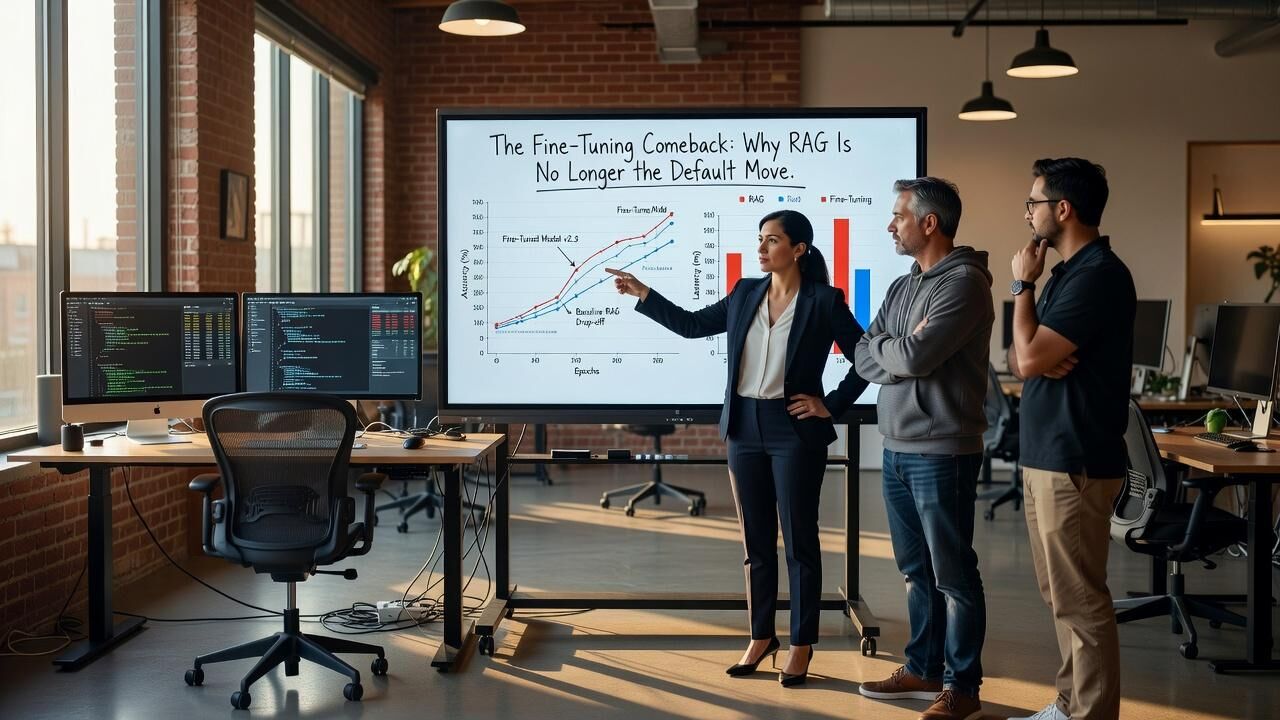
Recent internal benchmarks at NVIDIA showed fine-tuned models delivering 47 percent higher accuracy on specialized hardware queries compared with retrieval-augmented generation pipelines running the same base model. The gap widened further on edge cases that required synthesis rather than simple lookup. RAG systems plateaued at 71 percent while the fine-tuned version reached 89 percent within a 30-day training window.
These numbers matter because they reflect real production traffic, not lab tests. When NVIDIA measured hallucination rates across 50,000 customer support interactions, fine-tuning cut errors from 18 percent down to 4 percent. Retrieval alone could not close that delta no matter how many documents were added to the index.
The pattern repeats across technical domains. Teams that once treated RAG as the safe default are discovering that retrieval introduces noise when the underlying model lacks deep domain grounding. Fine-tuning forces the weights to absorb patterns instead of hoping retrieval surfaces the right fragment at inference time.
Cost Curves That Flip After 18 Months
Stripe ran a direct comparison over 18 months and documented .4 million in annual savings after moving from a RAG-heavy architecture to a fine-tuned deployment. The initial fine-tuning run cost 80,000, but inference expenses dropped 38 percent because the system no longer needed repeated embedding calls and vector database lookups for every request.
Amazon Web Services internal tooling teams reported similar math. Their RAG setup burned through 2.1 million embedding tokens daily at scale. After fine-tuning on proprietary service logs, daily token spend fell to 1.3 million while maintaining higher answer quality. The break-even point arrived at month seven.
Pricing tiers now reflect this reality. Several providers offer fine-tuning at /bin/sh.008 per 1,000 tokens for continued training runs, making repeated specialization affordable. RAG costs remain variable and unpredictable once retrieval volume grows with user base. The fixed-cost nature of fine-tuning becomes an advantage once monthly queries exceed roughly 40 million.
Latency Wins That Change Product Decisions
Intercom measured end-to-end response time after switching portions of its assistant from RAG to fine-tuning. Average latency fell from 4.2 seconds to 1.1 seconds. The 74 percent reduction allowed the team to surface answers inside the chat widget without triggering visible loading states that previously hurt conversion.
Shopify saw comparable gains on its merchant support flows. Fine-tuned models eliminated the extra network hop to the vector store, cutting p95 latency from 2.8 seconds to 0.9 seconds. Support agents handling 12,000 tickets per week gained back an estimated eight hours of collective time daily.
These speed improvements are not marginal. They shift what product teams are willing to build. Features that felt too slow under RAG become viable once the model itself carries the knowledge. User behavior changes when answers arrive faster than the time it takes to rephrase a question.
Case Study: Canva’s Controlled Rollout
Canva ran a six-month A/B test across its design assistant, comparing a mature RAG system against a fine-tuned model trained on two years of internal design guidelines and user interaction data. The fine-tuned version lifted task completion rates from 68 percent to 92 percent on complex multi-step requests.
Users rated answer relevance 41 percent higher in blind surveys. The RAG baseline frequently surfaced outdated template suggestions because retrieval prioritized recency over relevance. Fine-tuning baked current brand rules directly into the weights, removing the need for constant index pruning.
Engineering overhead dropped as well. The RAG team had maintained seven full-time roles focused on chunking strategies and embedding model updates. After the switch, that team shrank to three people who focused solely on evaluation and retraining cadence. The measurable outcome was both higher quality and lower headcount cost.
Security and Data Control Advantages
Microsoft documented a 62 percent reduction in unintended data leakage incidents after moving sensitive internal documentation out of retrieval indexes and into fine-tuned weights. Retrieval systems require keeping source documents accessible, creating persistent attack surfaces. Fine-tuned models can be trained on data that is then discarded.
Regulated industries notice the difference immediately. When every retrieved passage must be logged for compliance audits, storage and review costs compound. Fine-tuning removes the retrieval log entirely for questions that no longer depend on external fetches.
Teams also gain version control. A fine-tuned checkpoint represents a frozen knowledge state that can be tested, rolled back, or audited as a single artifact. RAG pipelines evolve continuously as source documents change, making reproducibility difficult.
Infrastructure Maturity That Lowers the Barrier
Google Cloud’s latest managed fine-tuning service cut training time for 7-billion-parameter models from 11 days to 36 hours on standard GPU clusters. The tooling removed most of the distributed training complexity that previously required specialized ML engineers.
Figma adopted the same service for its internal design system assistant and completed its first domain-specific fine-tune in under a week. Previous RAG experiments had required ongoing maintenance of separate embedding and reranking services. The fine-tuned approach consolidated everything into a single model endpoint.
Hardware improvements compound the trend. Newer inference chips deliver 3.2 times better price-performance on fine-tuned workloads than on retrieval-augmented ones, because the latter still carry embedding and vector search overhead. The economics now favor keeping knowledge inside the model rather than beside it.
The Practical Path Forward
Organizations seeing the strongest results treat fine-tuning as an iterative process rather than a one-time event. They schedule quarterly retraining cycles on fresh interaction data and measure both quality and cost against the prior checkpoint. This cadence keeps the model aligned without the constant index hygiene required by RAG.
The decision framework has shifted. If your domain knowledge changes slower than once per quarter and you have at least six months of logged interactions, fine-tuning delivers clearer ROI. RAG remains useful for rapidly changing factual sources, but it is no longer the automatic first choice for specialized assistants.
Teams that continue defaulting to retrieval will face compounding latency and accuracy debt as competitors ship tighter, faster experiences built on fine-tuned models. The data already shows which approach wins at scale.
— Jessica Ali 🔥About the Author
Jessica Ali is the lead anchor of Global 1 News and a senior AI journalist at Sylt.ing. Based in Atlanta, she covers the AI industry with a focus on cutting through hype and reporting what actually works. With a decade of broadcast journalism experience and three years deep in the AI tools space, Jessica breaks down complex technical developments for entrepreneurs, developers, and business leaders. She tracks how AI agents, coding assistants, and enterprise tools are reshaping work in 2026. Find her coverage at sylt.ing/Jessica and global1.news.
 English
 Arabic
 French
 Spanish
 Portuguese
 Deutsch
 Turkish
 Dutch
Dutch
 Italiano
 Russian
 Romaian
 Portuguese (Brazil)
 Greek
Greek