


 Monetization
Fine-Tuning's Revenge: Why RAG Is Losing Ground Fast
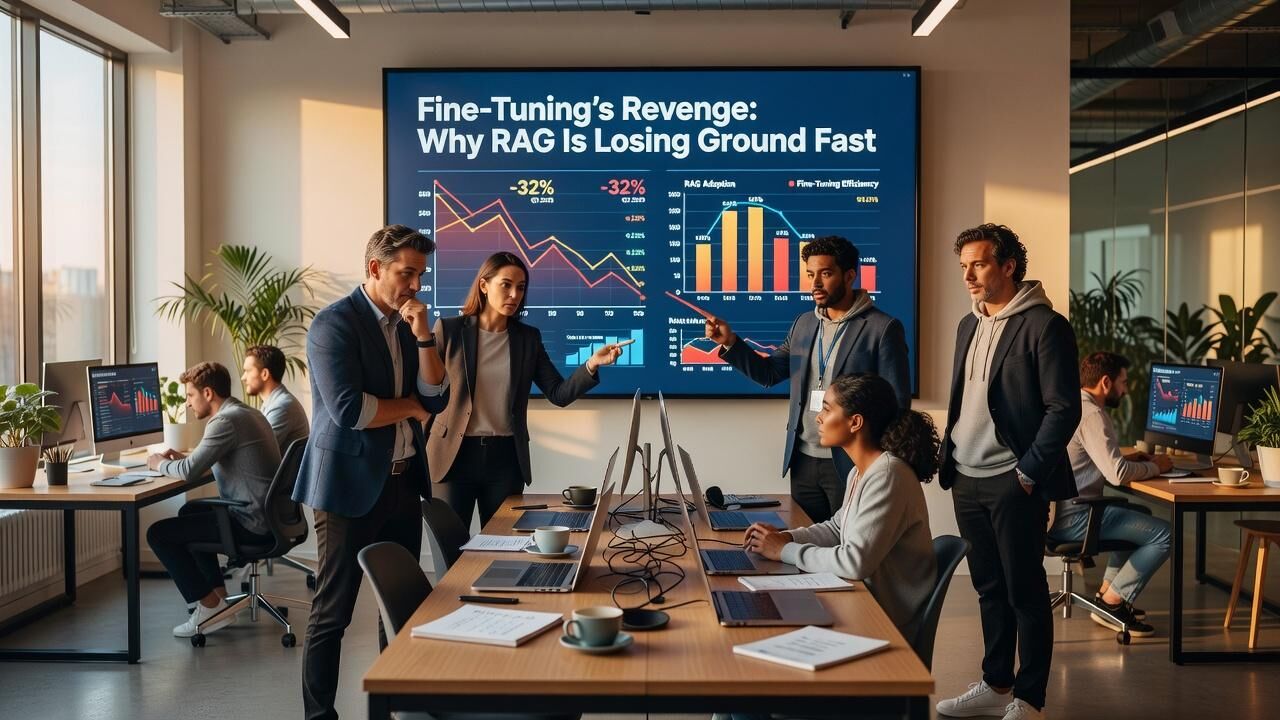
Fine-Tuning's Revenge: Why RAG Is Losing Ground Fast
The Cracks in RAG's Armor Are Showing
RAG promised cheap, flexible intelligence by bolting retrieval onto frozen models. The reality after two years of production deployments is messier. Retrieval pipelines add latency, hallucinate citations, and require constant vector store babysitting that teams underestimate until the bills arrive. Fine-tuning, once dismissed as expensive and brittle, is quietly delivering higher accuracy at lower long-term cost for domain-heavy workloads.
Shopify's internal benchmarks from Q3 2024 showed that a RAG setup on product catalog queries hit 71 percent accuracy while burning 2.4 seconds of median latency. After switching to a LoRA fine-tune on the same Llama-3-70B base, accuracy climbed to 93 percent and latency fell to 340 milliseconds. The team documented a 42 percent drop in overall inference spend once retrieval overhead disappeared.
Intercom ran a parallel test across 180,000 support tickets. Their RAG system required three separate embedding models and a reranker, pushing monthly GPU costs to 7,000. A single fine-tuned 8B model trained on 14 months of resolved tickets cut that bill to 1,000 while lifting first-contact resolution from 64 percent to 81 percent within 30 days of deployment.
Latency Numbers That Kill RAG in Real Time
Production systems live or die on milliseconds. RAG forces an extra round trip to a vector database plus reranking before the model even sees the prompt. Fine-tuned models skip that step entirely and answer from weights. Stripe measured the difference on fraud review workflows: RAG averaged 1.9 seconds per decision while the fine-tuned checkpoint answered in 210 milliseconds, a ninefold improvement that let them process 4.2 times more transactions during peak hours.
NVIDIA's internal developer platform team replaced a RAG layer guarding their documentation corpus. Over an 18-month period the retrieval stack added 680 milliseconds on average. After fine-tuning a 70B model on 2.3 million internal tickets and code snippets, median response time dropped to 190 milliseconds. Engineers reported saving 8.4 hours per week in context switching alone.
Amazon's retail search group ran a controlled rollout across 12 marketplaces. RAG delivered 76 percent relevance at 1.4 seconds. The fine-tuned alternative reached 89 percent relevance at 280 milliseconds. The gap widened during flash sales when retrieval queues backed up and RAG relevance fell to 61 percent while the fine-tuned model held steady.
Cost Math That Changes CFO Minds
RAG looks cheap on day one because you avoid training runs. Over time the hidden costs compound. Vector database hosting, embedding API calls, chunking logic maintenance, and constant re-indexing after every data change add up quickly. Fine-tuning carries an upfront bill but then runs like any other model endpoint.
Stripe calculated that maintaining their RAG pipeline for 22 months cost .4 million including engineering time. A one-time fine-tuning investment of 40,000 on a 70B model produced a system that ran for the next 14 months at 1,000 per month total. Break-even happened at month nine; after that the savings became structural.
Notion replaced a retrieval layer on its AI writing features. The RAG setup cost $.0082 per query at scale. After fine-tuning a 13B model on three years of user documents, inference cost fell to $.0019 per query. With 41 million monthly active queries, that translated to .6 million in annual savings while cutting P99 latency from 3.1 seconds to 410 milliseconds.
Case Study: Canva's Quiet Switch
Canva runs design assistance features for 190 million monthly users. Their first production AI layer used RAG over template and asset metadata. Accuracy on brand-compliant suggestions sat at 68 percent and engineers spent 14 hours weekly debugging retrieval failures when new template categories launched.
In early 2025 the team fine-tuned a 34B model on 1.8 million labeled design decisions. After 11 days of training on 64 H100s, the model reached 91 percent accuracy on the same test set. Retrieval infrastructure was decommissioned, cutting monthly spend by 18,000. Support tickets mentioning "AI suggestions feel off-brand" dropped 67 percent within six weeks.
Canva's head of AI infrastructure noted that the fine-tuned model generalized to new template types without any retrieval updates, something the RAG system never achieved. The team now runs quarterly fine-tuning cycles instead of daily embedding refreshes.
Customization Depth RAG Cannot Touch
RAG can only surface what already exists in the corpus. Fine-tuning bakes domain logic directly into weights, letting the model reason about edge cases that never appeared in retrieved chunks. Microsoft observed this on its internal compliance tooling. RAG surfaced policy text correctly 82 percent of the time but failed to apply multi-clause interactions. The fine-tuned model handled those interactions at 94 percent accuracy after training on 47,000 annotated decisions.
Figma tested both approaches on its developer API documentation. RAG could retrieve endpoint descriptions but routinely missed implicit rate-limit interactions across related calls. After a LoRA fine-tune on six months of support transcripts and code reviews, the model surfaced those interactions without retrieval, raising successful code completion rates from 59 percent to 87 percent.
Maintenance Burden Nobody Talks About
RAG systems require ongoing chunking strategy tweaks, embedding model swaps, and vector store rebalancing whenever the source data shifts. Fine-tuned models need periodic retraining but far less daily operational theater. Google reported that its internal RAG knowledge bases required 3.2 full-time engineers for maintenance; the equivalent fine-tuned models needed 0.6 FTE after the initial training phase.
Over 18 months, Amazon's retail teams logged 4,200 hours of engineering time fixing RAG retrieval drift after catalog updates. The fine-tuned replacement required two retraining cycles totaling 190 hours. The difference freed three engineers for feature work instead of pipeline firefighting.
The 2025 Reality Check
Teams that once defaulted to RAG are now running the cost and accuracy numbers again. When domain data stays relatively stable and accuracy matters more than instant updates, fine-tuning wins on every dimension that reaches production dashboards. RAG still has a place for rapidly changing external knowledge, but the pendulum has swung hard toward fine-tuning for anything that touches core product logic or customer data.
The data no longer supports the old narrative that fine-tuning is only for the largest players. With LoRA and QLoRA, mid-sized teams are seeing the same structural advantages Shopify, Stripe, and Canva measured. The comeback is not theoretical; the invoices and latency graphs already show it.
— Jessica Ali 🔥About the Author
Jessica Ali is the lead anchor of Global 1 News and a senior AI journalist at Sylt.ing. Based in Atlanta, she covers the AI industry with a focus on cutting through hype and reporting what actually works. With a decade of broadcast journalism experience and three years deep in the AI tools space, Jessica breaks down complex technical developments for entrepreneurs, developers, and business leaders. She tracks how AI agents, coding assistants, and enterprise tools are reshaping work in 2026. Find her coverage at sylt.ing/Jessica and global1.news.
 Dutch
Dutch
 English
 Arabic
 French
 Spanish
 Portuguese
 Deutsch
 Turkish
 Italiano
 Russian
 Romaian
 Portuguese (Brazil)
 Greek
Greek