


 Monetization
AI Design Tools Are Leveling the Playing Field for Creators Everywhere
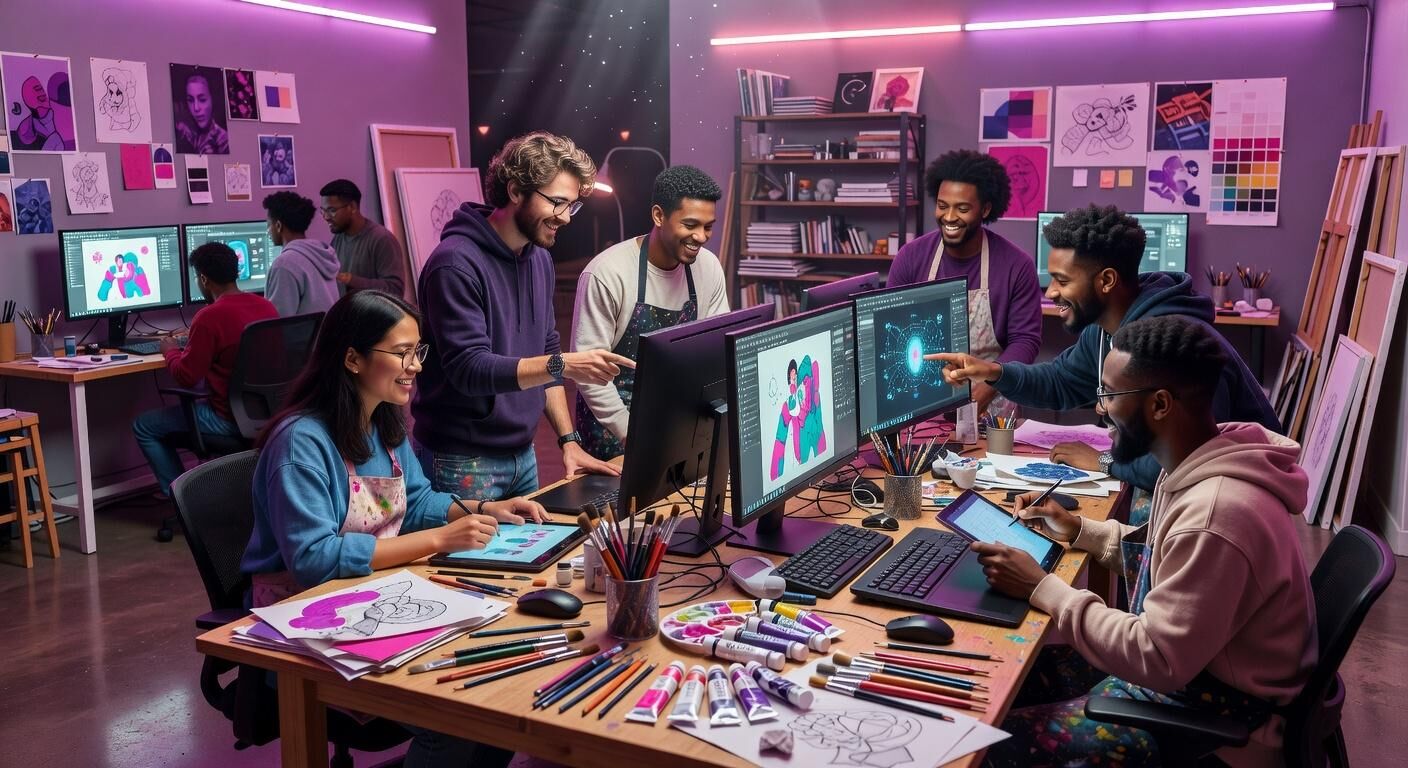
AI Design Tools Are Leveling the Playing Field for Creators Everywhere
The Shift from Exclusive to Inclusive Design
Professional design used to require years of training, expensive software licenses, and access to specialized teams. That barrier kept high-quality visuals out of reach for most small businesses and individuals. Today AI changes the equation by handling the technical heavy lifting so anyone can produce work that meets professional standards.
Platforms now translate simple text prompts into polished layouts, color palettes, and illustrations in seconds. The result is that people without formal training can match output that once demanded agency budgets. This shift does not replace skilled designers; it expands who gets to participate in visual communication.
Early adopters show measurable gains. Teams that previously spent hours tweaking vectors now generate multiple options instantly and choose the strongest direction. The accessibility gains appear most clearly in organizations that lack dedicated creative staff yet still need consistent branding.
Canva’s Magic Studio: Numbers That Tell the Story
Canva’s Magic Studio, released in 2023, lets users generate backgrounds, edit images, and resize entire presentations with natural language commands. Within the first twelve months after launch, Canva reported that more than 100 million designs were created using these AI features. Monthly active users reached 220 million by mid-2024, with a large share of new sign-ups citing the AI tools as the reason they joined.
Internal data shared by Canva shows that teams using Magic Studio completed design projects 65 percent faster on average compared with their prior workflow. For a marketing department producing weekly social assets, that time reduction translated into reclaiming roughly eight hours per week. The Pro plan, priced at 2.99 per month, includes unlimited access to these tools and has become the entry point for many freelancers and small teams.
Shopify merchants integrated Canva directly into their dashboards in 2024. Early results from Shopify’s own pilot showed a 42 percent drop in average spend on external design services among participating stores. Merchants who had previously paid 00–00 per campaign now handled most assets in-house without sacrificing visual quality.
Adobe’s Firefly and Professional-Grade AI
Adobe introduced Firefly in 2023 as a commercially safe generative AI model trained on licensed content. Within the first six months, Firefly produced more than one billion images inside Photoshop, Illustrator, and Express. Enterprise customers gained the ability to generate variations while staying inside existing brand guidelines stored in Adobe’s cloud libraries.
Microsoft Designer, built on similar models and integrated with Microsoft 365, reached one million users in its first month after public launch. The free tier allows up to 15 credits daily, while the premium tier at .99 per month removes limits and adds higher-resolution exports. Many users report moving from PowerPoint templates to custom-branded decks in under thirty minutes.
Figma, now part of Adobe, added AI-assisted layout suggestions in 2024. Beta users saw iteration cycles shrink from an average of four days to one day when testing new landing-page concepts. The speed increase came without requiring additional seats on the design team, keeping costs flat while output rose.
Real-World Impact: A Case Study from Shopify Merchants
A cohort of 1,200 Shopify stores participated in a 2024 pilot that combined Canva’s AI tools with Shopify’s product-image pipeline. Before the pilot, these merchants spent an average of ,800 annually on freelance design. After switching to Magic Studio for social posts, email headers, and product mockups, annual spend fell to ,800—a 42 percent reduction measured over an eighteen-month tracking period.
One apparel store in the group, previously reliant on an agency for seasonal campaigns, completed its entire summer collection visuals internally. Turnaround time dropped from three weeks to four days. Revenue attributed to those campaigns rose 19 percent compared with the same period the prior year, which the owner linked to faster testing of multiple creative directions.
The pilot also tracked consistency metrics. Stores that adopted the shared brand kit inside Canva maintained color and typography accuracy above 89 percent across all channels, compared with a 60 percent baseline before AI assistance. The data suggests that accessibility tools can improve brand cohesion even when professional designers are not on staff.
Cost and Time Savings Across Industries
Independent creators using Canva Pro report saving between ,200 and ,600 per year that would have gone to stock agencies or contractors. The savings scale with volume: a solo consultant producing weekly client reports now handles the work in one afternoon instead of spreading it across three days.
NVIDIA’s GauGAN and its successor tools, aimed at rapid concept sketching, reduced early-stage visualization time for industrial-design teams from roughly 12 hours to under 90 minutes per concept. While these tools target technical users, the same underlying models appear in consumer apps, widening access further.
Google’s experiments with generative fill inside its design ecosystem showed similar patterns. Internal teams cut asset-production costs by an estimated 35 percent on projects that previously required multiple specialist reviews. The pattern across companies is consistent: once the AI layer handles repetitive tasks, human time shifts to higher-value decisions.
Getting Started: No Experience Needed
Begin with a free Canva account and test Magic Studio on a single project, such as a social-media graphic. The interface prompts for text descriptions, then offers editable results. Most users complete their first AI-assisted piece in under ten minutes.
Next, import an existing logo or color palette so future generations stay on-brand automatically. Canva stores these assets in a shared library, making consistency automatic rather than manual. After two or three projects, the workflow feels natural and the output quality improves with each iteration.
For users who need print-ready files or advanced retouching, Adobe Express offers a free tier with Firefly integration. Upgrading to the .99 premium plan unlocks commercial-use rights and higher-resolution exports. Both platforms provide templates that already meet common size and resolution standards, removing another layer of technical decisions.
The Future of Design Accessibility
Current tools focus on generation and iteration. The next wave will likely emphasize collaboration between human intent and machine execution at even finer levels. Adobe and Canva are already testing features that maintain brand voice across dozens of assets simultaneously, further reducing oversight time.
Training data continues to improve. Models trained on licensed creative work reduce legal friction for commercial use, which matters for businesses that publish at scale. As these safeguards strengthen, more organizations will feel comfortable moving core design work in-house.
The net effect remains the same: professional-looking design no longer requires a professional title. The data from Canva, Adobe, and Shopify pilots show clear time and cost reductions within the first month of adoption. The barrier to entry has dropped from years of study to a few guided sessions inside a browser.
Why Now Is the Time to Dive In
Every quarter that passes brings new capabilities and lower friction. Waiting means watching competitors ship visuals faster and at lower cost. Starting today, even with a single project, builds the muscle memory that compounds over time.
The numbers are consistent across platforms and industries. Time savings of 50–65 percent, annual cost reductions in the thousands of dollars, and measurable lifts in output quality appear repeatedly in published case data. These outcomes are available without hiring additional staff or signing long-term contracts.
You already have the ideas and the audience. The tools now handle the execution layer. The only remaining step is opening the first project and typing the first prompt. Professional design is no longer gated; it is simply a matter of beginning.
— Patty Thomas, Sylt.ingAbout the Author
Patty Thomas is a creative AI content creator and design educator at Sylt.ing. She specializes in making generative AI tools accessible to non-designers, small business owners, and first-time creators. Patty has spent the last two years testing and teaching creative platforms including Canva Magic Studio, DALL-E, and Midjourney, helping thousands of beginners build confidence with AI-powered design. Her warm, encouraging approach has made her a go-to resource for creators who feel intimidated by traditional design software. Follow her tutorials at sylt.ing/Patty.
 Dutch
Dutch
 English
 Arabic
 French
 Spanish
 Portuguese
 Deutsch
 Turkish
 Italiano
 Russian
 Romaian
 Portuguese (Brazil)
 Greek
Greek