


Crusoe Triples to 30 Billion as Jane Street Bets 13 Billion on AI Compute
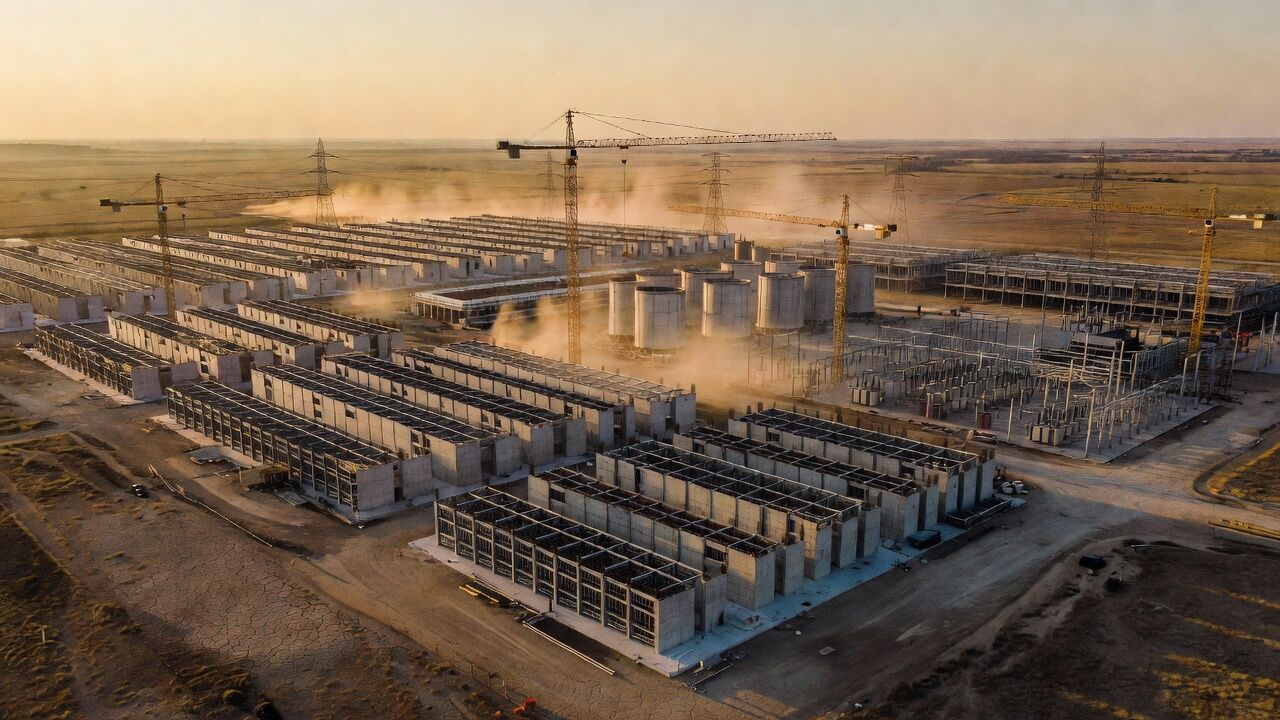
Four frontier labs shipped new models in a single week and the AI press spent the weekend arguing about 'model fatigue.' Fine. Let the marketing departments fight over benchmark charts. The story that actually matters happened two floors below the noise, in the part of the industry that sells shovels to everyone: Denver-based Crusoe quietly closed more than 3 billion dollars in new funding at a roughly 30 billion dollar valuation, according to Bloomberg. Ten months ago this company was worth about 10 billion. A private infrastructure firm just tripled its valuation in under a year, and almost nobody who follows model releases noticed.
That is the tell. The center of gravity in AI has moved from who ships the smartest model to who can physically build the buildings, wire the power, and deliver the GPUs. Crusoe's round — co-led by Atreides Management and Valor Equity Partners, with Mubadala Capital, the asset-management arm of Abu Dhabi's sovereign wealth fund, joining in — is one more data point in the same trend. The winners of this cycle will not be decided by a benchmark leaderboard. They will be decided by concrete, transformers, and the ability to turn contracted gigawatts into energized facilities on schedule.
What the Crusoe Round Actually Is
The numbers, as reported by Bloomberg and corroborated by TechCrunch, Reuters and The Edge: more than 3 billion dollars raised, roughly 30 billion dollars post-money, which puts the pre-money at about 27 billion. That is nearly three times the valuation from October 2025, when Crusoe closed a 1.375 billion dollar Series E that brought in Nvidia, Fidelity and Founders Fund alongside returning investors Valor and Mubadala. Bloomberg had reported back in July that Crusoe was in talks to raise about 3 billion at a valuation that could triple the company. The talks closed. The round has not been formally announced by Crusoe, so final terms remain technically unconfirmed — but the reporting is consistent across outlets, and the deal is described as finalized.
Read that pace again. A data center developer, not a model lab, went from 10 billion to 30 billion in ten months. The only thing that grew faster was the size of the checks investors were willing to write for physical infrastructure. That tells you where the market believes the bottleneck actually is. It is not in intelligence. It is in capacity.
The 13 Billion Jane Street Contract That Changed the Math
Money followed a contract. Bloomberg reported that the round came together after Crusoe locked in a five-year deal worth roughly 13 billion dollars to supply quantitative trading firm Jane Street with GPUs and AI infrastructure through Crusoe Cloud. That single customer commitment is reportedly what pulled additional investors into the raise. Think about what that means: a quant trading firm, not a hyperscaler and not an AI lab, is now the anchor tenant on one of the largest known cloud infrastructure contracts in the industry.
Jane Street's 2026 AI infrastructure shopping list puts the shift in perspective. Add it up and the firm has committed roughly 21.5 billion dollars across the neocloud sector this year: 6 billion in cloud capacity from CoreWeave, 1 billion in CoreWeave equity at 109 dollars per share, about 13 billion in Crusoe cloud capacity over five years, and a 1.5 billion dollar equity investment in FluidStack that Jane Street led just this week. In quantitative trading, getting access to hardware before your competitors is not a cost optimization. It is a structural advantage. The firms that run the fastest models on the newest silicon make markets the others cannot touch.
That is why finance is quietly becoming one of AI's most important customer classes. Labs grab headlines. Trading firms sign 13 billion dollar contracts.
From Flared Gas to Stargate: The Unlikely Resume
Crusoe's origin story matters because it explains the edge. Chase Lochmiller and Cully Cavness founded the company in 2018 around a simple, slightly ridiculous idea: capture natural gas that oil fields were flaring off as waste, use it to power portable data centers, and run crypto mining rigs in places nobody else wanted to build. It worked well enough that the energy expertise became the real asset. When the AI boom hit and everyone discovered that you cannot will a gigawatt-scale campus into existence, Crusoe already knew how to source power, manage modular builds, and operate in the field.
The company sold its original bitcoin mining unit to NYDIG in early 2025 and completed the pivot. Today Crusoe designs and operates full AI data center campuses for clients including OpenAI, Microsoft, Meta and Oracle. Its Abilene, Texas campus, built for OpenAI and Oracle, is the first phase of the broader Stargate project. In March, Microsoft agreed to lease an expansion of the Stargate site that was originally being developed for Oracle and OpenAI after those two backed out of talks to occupy it. In June, Crusoe said its contracted AI infrastructure capacity was approaching 5 gigawatts — company-reported, and a signal of pipeline scale rather than energized production. The portfolio includes a 1.0-gigawatt campus in Childress, Texas and a 900-megawatt Abilene campus to support Microsoft AI infrastructure.
The Competitive Picture: Same Race, Different Starting Lines
Crusoe is no longer just a landlord building campuses for other people to operate. Crusoe Cloud sells AI compute directly, which puts the company in the same lane as CoreWeave, Nebius and Lambda — all of which are either public or in the middle of enormous raises of their own. Lambda, backed by Nvidia, signed a reported 35 billion dollar cloud agreement with Anthropic, one of the sector's largest deals on record. Thinking Machines, another infrastructure player, is reportedly negotiating a 1 billion round at a 40 billion valuation. The entire neocloud category is inflating at once.
The market size argument is easy to make. Synergy Research Group puts total neocloud revenue at more than 25 billion dollars for 2025 and forecasts the market approaching 400 billion dollars by 2031, a 58 percent annual growth rate. At that growth rate, a tripled valuation in ten months starts to look almost rational. The uncomfortable part is that every company in this race is raising against the same constrained inputs: the same power grid, the same transformers, the same construction labor, the same GPU supply. Capital is not the bottleneck anymore. Execution is.
The Questions Nobody Has Answered
For all the size of the round, the open questions are the ones that matter:
1. How much of that 5 gigawatts is actually energized? Contracted capacity is not delivered capacity. The gap between announced megawatts and facilities drawing power is the single most important number in this industry, and Crusoe has not published a clean breakdown.
2. Who carries the risk when the grid slips? Power interconnection timelines are running years long in some markets. If a campus powers on late, the cost overruns land on Crusoe's balance sheet while the customer commitment stays fixed.
3. What are the real margins? Selling raw GPU hours as a neocloud is a different business from leasing shells to hyperscalers. Cloud services can earn more per megawatt, but only if utilization stays high and the fleet stays rented.
4. What does the sovereign money cost? Mubadala has now participated in two consecutive Crusoe rounds. Abu Dhabi's broader wealth ecosystem has positioned AI infrastructure as a strategic allocation. That capital comes with relationships and expectations that go beyond a term sheet.
5. When does the IPO actually land? Axios reported last month that Crusoe met with JPMorgan, Goldman Sachs, Morgan Stanley and Bank of America to discuss a near-term listing. At a 30 billion private valuation, the public market will want to see the delivery record, not just the contract backlog.
What This Means: The Balance Sheet Is the Product
Here is the operating-model shift worth understanding. A few years ago, AI investment was a story about research labs spending venture money on experiments. Now it is a story about balance sheets: infrastructure companies raising multi-billion rounds, customers becoming co-investors, sovereign funds underwriting national compute strategies, and trading firms locking in five-year GPU commitments the way they used to lock in office leases. The buyers have changed, the check sizes have changed, and the sales cycle has changed.
For anyone actually running servers — not just talking about them — the practical takeaway is that this market is pre-selling capacity that does not exist yet. Five-year contracts at 13 billion dollars are bets that the physical buildout will arrive on time. When you buy compute from a neocloud today, you are not just buying hardware. You are buying that company's ability to deliver on a construction schedule. Due diligence now means asking about interconnection queues, transformer lead times, and utilization rates, not just token prices and benchmark scores.
What Comes Next
Crusoe has the contracts and now it has the capital. The next twelve months will show whether it can convert roughly 5 gigawatts of contracted demand into energized, utilized, profitable infrastructure — or whether it becomes the cautionary example of demand outrunning concrete. Watch the power-on dates, watch the utilization disclosures, and watch for the S-1. The banks have already been briefed.
The model labs will keep shipping point releases and arguing about who is winning. Meanwhile, the real winners are being decided in Texas, on transformer order books and in the interconnection queues. That is where the money went this week, and that is where the signal is.
— Allan Ali, Sylt.ing
 Russian
 English
 Arabic
 French
 Spanish
 Portuguese
 Deutsch
 Turkish
 Dutch
Dutch
 Italiano
 Romaian
 Portuguese (Brazil)
 Greek
Greek