


World's First Live AI Brain Surgery Saved a Man's Sight. Here Is What It Means
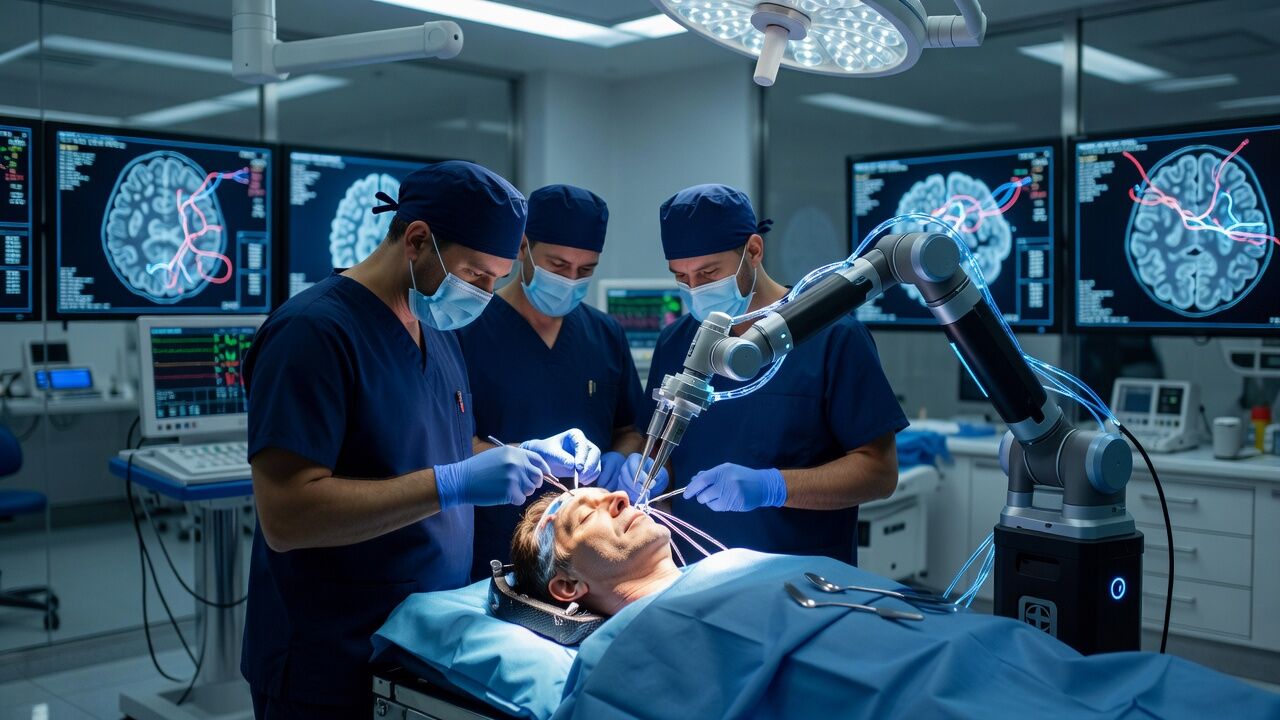
You have to see the video to believe it, but the short version is this: a 48-year-old customer services manager from Bedfordshire named Rhys Hibbert went into an operating room in London with an 11mm tumour pressing on the nerves that control his sight, and came out with his vision intact. The twist is that he did not do it alone. For the first time anywhere, an AI system watched the surgery live, in real time, and helped the surgeons decide where it was safe to cut.
If you are in the business of running AI systems, stop and pay attention. This is not another demo of a model that reads a scan and flags a suspicious spot. This is a model that sat in the loop during an operation with zero room for error, analysed a live video feed, and advised two neurosurgeons on what it was seeing. That is a completely different class of problem.
What the AI Actually Did in the Operating Room
The operation took place at the National Hospital for Neurology and Neurosurgery in London, with neurosurgeons Prof Hani Marcus and Mr Danyal Khan at the table. Hibbert's tumour was on his pituitary gland, a marble-sized organ at the base of the skull that sits dangerously close to the carotid arteries and the optic nerves. The surgical approach was endoscopic, meaning a thin camera on a stick went up through the nose to reach the base of the skull.
Here is where the AI earned its keep. On a second screen, the system analysed the live video feed from the endoscope, tracked the surgical instruments, and marked up where the critical hidden vessels and nerves were most likely to be, highlighting the areas where it was safest to remove the tumour. The surgeons themselves describe it as similar to facial recognition on a phone, except what it recognises is anatomy instead of faces. The numbers behind the risk explain why that matters: without that guidance, there was a 25 to 50 percent chance of not getting the whole tumour out, and a small but real chance of injuring a major blood vessel.
The Real-Time Requirement Nobody Talks About
Every AI person I know has sat through a medical AI pitch that sounds great until you ask one question: how does this behave when the answer cannot wait? Most medical AI today is retrospective. It reads a scan, compares it against training data, and produces a report that a radiologist reviews later. Useful, yes. Real-time, no.
This system works differently. It was trained on hundreds of videos of pituitary tumour removals, with researchers drawing around vessels and nerves frame by frame so the model could learn to recognise them. Prof Marcus put it bluntly: it is trained on more operations than most surgeons see or do in a lifetime, and it works in real time. That is the part that makes infrastructure people nervous. Real-time inference on a live video stream, inside a surgical environment, with no second chances and no timeout-and-retry. The model was funded by the National Institute for Health and Care Research and Google, and developed by researchers at University College London. This is not a hobby project.
Why This Is Different From Every Medical AI Demo You Have Seen
The difference is where the model sits in the decision loop. A scan-reading model is a consultant you call after the fact. This is an assistant standing in the room, watching the same feed the surgeon watches, pointing at structures and saying: careful, that is a vessel. The team is explicit that the AI does not make decisions and does not take control. The surgeons decide, the AI advises.
That framing sounds modest, but it is actually the whole story. The hard engineering problem in high-stakes AI is not building a model that is right most of the time. It is building a model that is reliable enough that a professional will keep it in the room when the stakes are a patient's sight. And it is building the trust loop around it, so the human knows when to listen and when to override. Their long-term ambition is a kind of ChatGPT for surgeons: another expert in the room you can turn to for advice, or ignore if you disagree.
The Questions Nobody Has Answered
I am not going to pretend this is all settled. A world first means exactly that: one patient, one operation, one carefully built bespoke tool. There are questions that the announcement does not answer, and they are the ones I would ask before putting this near a production pipeline.
First, liability. When the AI's advice is wrong, or when a surgeon follows it and the outcome is bad, who carries that? The surgeon, the hospital, the model's developers, Google? The UK's health innovation minister said AI needs proper safeguards and that safety will be taken seriously. That is a sentence, not a legal framework. Second, distribution shift. This model was trained on hundreds of pituitary operations. What happens the first time it sees an anatomy that is genuinely outside its training distribution? Real-time systems do not get to decline the request gracefully. Third, infrastructure. Where does that inference actually run, and what happens if the network drops mid-operation? If it is on-prem, fine. If it is cloud-dependent, somebody needs to answer for latency and availability in a room where neither is negotiable. Fourth, scale. One bespoke tool for one surgical team is a research triumph. A generalised tool that works across hospitals and hardware is a different project entirely.
What This Means: The AI-in-the-Loop Operating Model
Strip away the medical specifics and this is the pattern every serious AI deployment is heading toward: a model embedded in a live process, watching the same data the human watches, flagging what the human cannot reliably see, and doing it with latency measured in fractions of a second. The operating room is the extreme case, but the same architecture shows up in data centre operations, network monitoring, security response, and anywhere else a human stares at a live feed and could use a second pair of eyes that never blinks.
The reason this matters is not that AI is about to replace surgeons. It is the opposite. The surgeon stays in control, the AI makes the surgeon better, and the patient walks out with his sight. That is the operating model that wins: augmentation, not replacement, built on reliability, not vibes.
What Comes Next
The team is planning a larger trial, the only step that will tell us whether this generalises beyond a single brilliant case. Hibbert, for his part, says the surgery gave him his life back, and that eight weeks on, his sight keeps improving. He volunteered to be first because, in his words, if patients are not prepared to join research, medicine cannot progress.
He is not wrong. And for anyone building real-time AI, the lesson from that London operating room is simple: the bar is not being clever. The bar is being there, every time, in real time, without excuses. That is the standard this operation just set.
— Allan Ali, Sylt.ing
 French
 English
 Arabic
 Spanish
 Portuguese
 Deutsch
 Turkish
 Dutch
Dutch
 Italiano
 Russian
 Romaian
 Portuguese (Brazil)
 Greek
Greek