


 Monetization
Sam Altman Admits People Hate Data Centers as 156 Billion in Projects Get Blocked
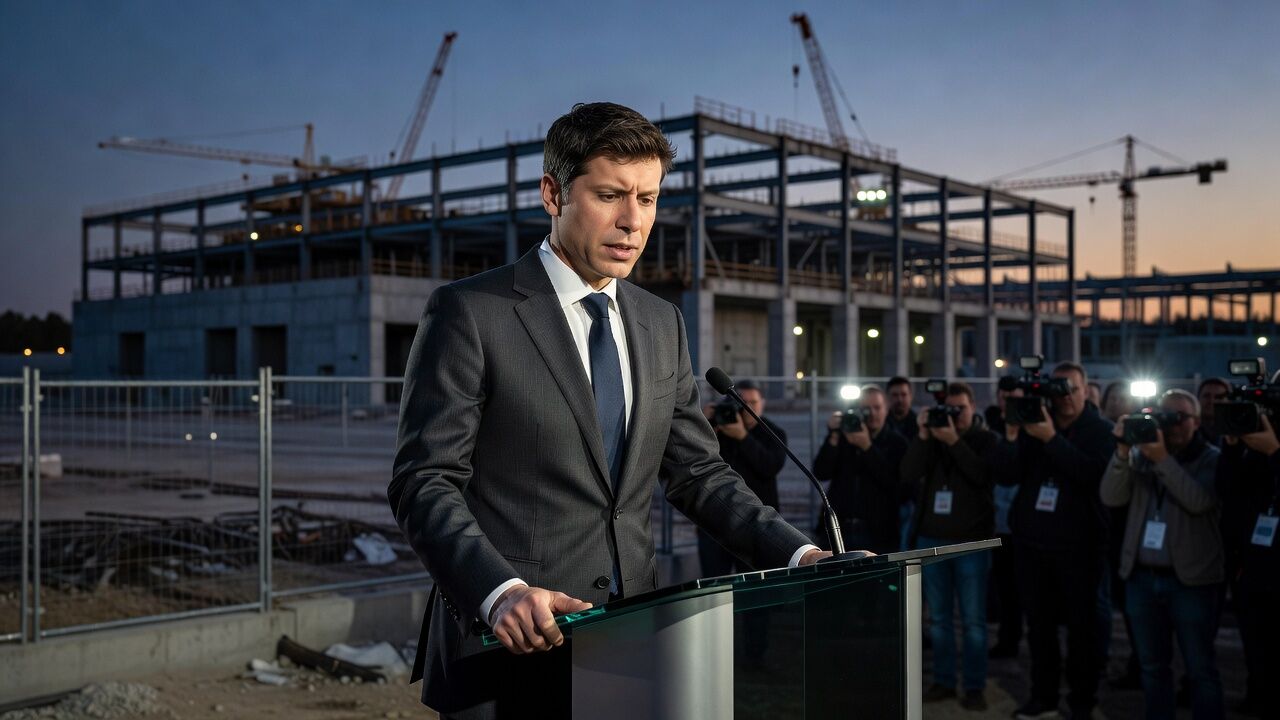
Sam Altman finally said the quiet part out loud. In an interview with Time magazine, the OpenAI CEO admitted what anyone who has tried to build anything in the last three years already knew: “Clearly, people hate data centers - right now, at least.” He added, “People are pretty negative on AI.” This is the guy planning to spend $50 billion this year on compute, telling you the ground game is broken. The numbers back him up: at least 48 data center projects representing $156 billion in investment have been blocked or stalled by local resistance. That’s not a speed bump. That’s a wall.
The $156 Billion Backlash
Put that $156 billion in context. It’s more than the annual GDP of half the countries on Earth. It’s money that was supposed to go into concrete, transformers and cooling loops, now sitting in legal limbo because county boards decided they’d rather fight than flip the switch. Gallup’s May 2026 poll shows 7 in 10 Americans oppose building data centers in their area, 48% strongly. Here’s the kicker: only 8% of those opponents actually live near one. This isn’t NIMBYism born of experience. It’s a national moral panic, spreading from the suburbs to the rural counties that used to beg for any tax base.
The outrage has gone national, and it has teeth. Local officials have proposed more than 120 moratoriums on data center development across 38 states as of July 2026. Maine passed the country’s first statewide moratorium before it was vetoed, and a record number of proposed projects were canceled in Q1 2026 after local pushback. This is not a fringe movement — it’s a coordinated, bipartisan rejection of the AI boom’s physical footprint.
Altman’s Admission and the Reorg
Altman’s Time interview wasn’t a strategic leak. It was a confession. A week before it, OpenAI’s head of data centers, Chris Malone, left the company. The Wall Street Journal reported it, CNBC confirmed it, and OpenAI’s official line was that the infrastructure team was “recently reorganized.” That’s corporate speak for “we are losing the war on the ground and the general just quit.” Malone was the guy responsible for the physical plants that make ChatGPT possible. His departure right before Altman’s admission is not a coincidence. It’s a signal that “build fast and ask for forgiveness” has hit a brick wall of permitting boards and angry ratepayers.
And yet the spending continues. Sachin Katti, the OpenAI executive overseeing compute, told Time: “If anything, we should have bought a lot more.” That’s a man watching the demand curve go vertical while the supply curve goes flat. OpenAI plans to spend $50 billion this year on compute — more than the annual revenue of most Fortune 500 companies. They are betting the farm that if they build it, the power will come. But the power isn’t coming, because the people who own the land and the grid are saying no.
Stargate’s Ambitious, Blocked Future
Let’s talk about Stargate, the OpenAI and SoftBank joint venture planning up to $500 billion in US AI infrastructure. By September 2025, six US Stargate sites were announced with roughly 7 GW of planned capacity, including the Abilene flagship and CoreWeave projects. Since then: a more-than-1-GW Michigan campus, a Georgia project contracted for 3.2 GW of power, and this month an agreement for roughly 8 GW of IT capacity in southern Ohio. OpenAI is planning beyond the original 10-gigawatt target. A lot of zeros. But those zeros mean nothing if the local grid operator won’t interconnect you.
Texas is the perfect case study. Governor Greg Abbott ordered regulators to scrutinize data centers seeking to connect to ERCOT before allowing projects to move forward earlier this month. Why? Because ERCOT was facing roughly 474 GW of requests for new connections — more than five times the state’s record peak electricity demand. Abbott isn’t anti-tech; he’s pro-grid, and he knows that if every speculative AI project hooks up, the system collapses during a heat wave. Texas is central to Stargate, with the Abilene flagship. If Texas slows down, Stargate slows down.
Pennsylvania is even more direct. Governor Josh Shapiro signed an executive order on August 18 imposing new energy-affordability, environmental and community requirements on data centers, and removed AI data centers from a fast-track permitting program. That’s a governor who was friendly to the industry, now slamming the brakes because constituents are screaming about electric bills. Pew Research found that among people who had heard a lot about data centers, 67% believed they were mostly bad for household energy costs. The EIA says US power consumption grew about 1.7% a year from 2020 through 2025, after barely growing over the previous 15 years. Data centers are a primary driver. When your bill goes up, you blame the giant concrete box humming down the road.
The Politics of Power
Here’s where it gets weird. President Trump champions data centers — he loves the optics of American AI dominance. But the voters don’t. A Fox News poll found most registered voters oppose data centers, including 60% of Republicans and 53% of MAGA voters. The base of the party that controls the White House is against the flagship industry of the current administration. This is not a partisan issue; it’s a pocketbook issue. People don’t care about the geopolitical race for AGI when their AC bill doubles in July.
OpenAI knows this. It pushed the White House to preempt state-level regulations and spent $1 million lobbying in the first half of 2026, according to the New Republic and Public Citizen. That’s a lot of money for a fight that is unwinnable at the local level. You can’t lobby a county zoning board with a Super PAC. You can’t preempt a township’s noise ordinance with a federal executive order. Data centers are built on land owned by locals, powered by local utilities, cooled by local water. If the locals say no, the project dies.
What This Means
Here’s the straight talk. The AI industry has a demand problem, but it’s not a chip demand problem. It’s a social license problem. Altman’s admission is the first honest thing a tech CEO has said about this in years. People hate data centers because they see the costs and not the benefits. The benefits are abstract: AI models that write code, generate images, maybe cure cancer. The costs are concrete: higher electric bills, water usage, diesel generator noise, and construction trucks on your rural road for three years.
The industry’s response so far has been to throw money at the problem. But $156 billion in blocked projects proves money isn’t the issue. Trust is the issue — and you can’t buy it with a lobbying check. The 48 projects that got blocked weren’t blocked because they were poorly financed. They were blocked because the community didn’t believe the developer’s promises about grid impact, water usage or property values. The industry has spent a decade promising data centers are “clean” and “quiet” and “good for the tax base,” and the public has stopped believing it.
The Gallup data is the most damning. Only 8% of opponents live near a data center. The opposition is ideological, not experiential. People have decided data centers are bad, full stop. You can’t engineer your way out of a cultural rejection. The only way out is to deliver tangible benefits to the communities that host these facilities, before construction starts, not after.
The Road Ahead
So where does this go? The industry is at a fork. One path is continued confrontation: push federal preemption, sue local governments, ram projects through. That path leads to more moratoriums, more canceled projects, deeper public distrust. The other path is radical transparency and community partnership: publish real-time water and power usage data, offer direct bill credits to nearby residents, tie tax revenue to local infrastructure improvements. That path is slower, but it’s the only one that leads to the 10-gigawatt-plus future Stargate and OpenAI are planning.
The EIA numbers show power demand is growing, and data centers are a big part of it. The question is whether the AI industry will be a partner in that upgrade or a parasite that gets rejected by the host. Altman’s comment suggests he understands the severity. But understanding and fixing are two different things. The $156 billion in blocked projects is a warning shot. If the industry doesn’t change, that number will double, and the next CEO to admit “people hate data centers” won’t be talking about temporary sentiment. They’ll be talking about a permanent ceiling.
The next 12 months are critical. The Ohio 8 GW agreement and the Georgia 3.2 GW contract are test cases. If those get built without massive local backlash, there’s hope. If they get tied up in court like the others, the AI buildout stalls. The technology is ready. The capital is ready. The only thing that isn’t ready is the public. And you can’t fix that with a press release.
— Allan Ali, Sylt.ing
 French
 English
 Arabic
 Spanish
 Portuguese
 Deutsch
 Turkish
 Dutch
Dutch
 Italiano
 Russian
 Romaian
 Portuguese (Brazil)
 Greek
Greek