


 Monetization
Done Selling Shovels: Nvidia's 3 Billion Bet on AI's Power Bottleneck
What the Nvidia-Lancium Deal Actually Is
On August 24, Nvidia announced a strategic investment in Lancium, the Texas energy infrastructure company that built the Abilene campus anchoring the Stargate buildout. The press release is careful with the details. It confirms the investment. It does not say how much. But the shape of the deal leaked two and a half weeks earlier. The Information reported, and Reuters corroborated, that Nvidia is putting up to 3 billion dollars into Lancium: an initial 2 billion for roughly a 20 percent stake, with another 1 billion contingent on grid interconnection milestones, at an implied enterprise value around 10 billion. Neither company has confirmed the numbers on the record. They do not need to. The direction is unmistakable.
This is not a chip deal. This is not even really a data center deal. It is Nvidia paying for a seat at the table where the real constraint on AI gets decided: who gets electrons, and who gets the wires to carry them.
The 3 Billion Structure: Chip Giant Becomes Power Landlord
Lancium is a Blackstone portfolio company, backed by Blackstone's energy transition and multi-asset funds, which have put more than 29 billion dollars of equity into energy businesses. Founded in 2017 and headquartered in The Woodlands, Texas, Lancium does not build chips and does not run data centers. It assembles the two things that take years to acquire: land and grid access. Its portfolio is 4 gigawatts of capacity under lease and a development pipeline exceeding 15 gigawatts of powered land.
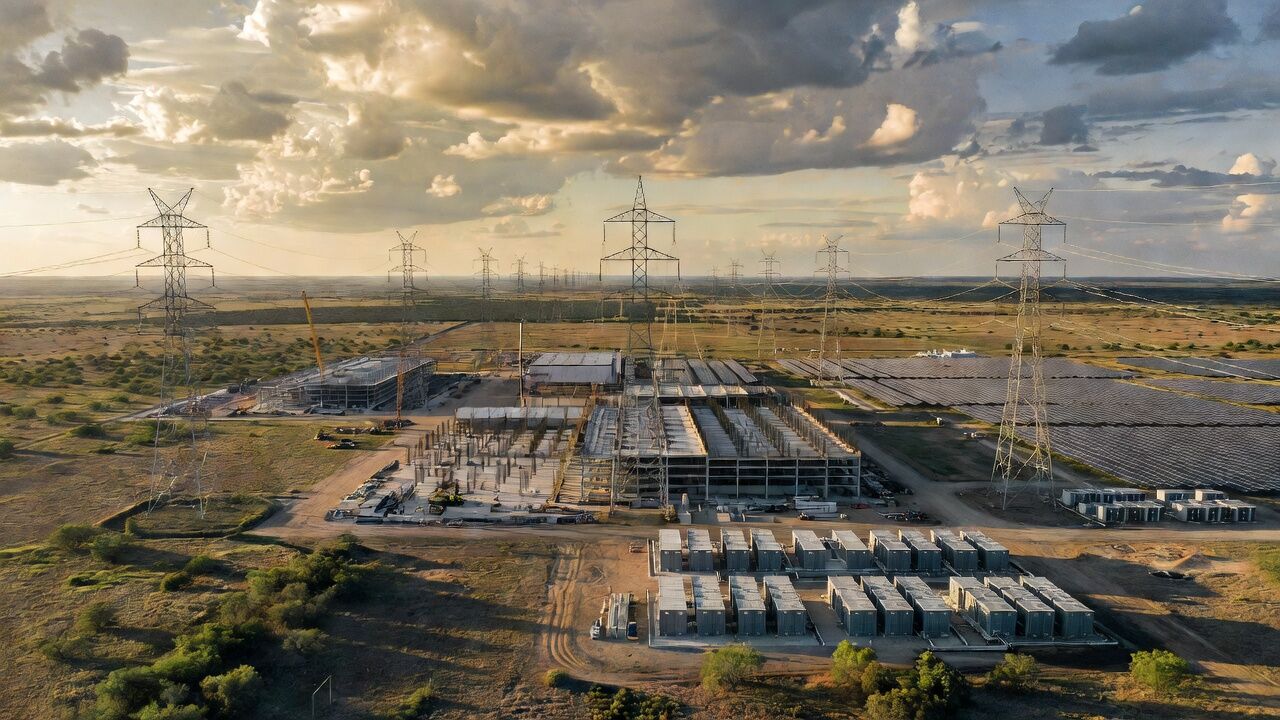
The flagship is Abilene. A 1,000-acre campus, 1.2 gigawatts, the first operational site of Stargate, the OpenAI-SoftBank-Oracle joint venture that has committed up to 500 billion dollars over four years. There is a second Texas campus planned at Childress, 1 gigawatt, in partnership with Crusoe, with construction expected to start in the third quarter of this year. Lancium holds a 600 million dollar debt facility secured in October 2025 to fund campus development. Its model is to own the land and the energy infrastructure, then bring in specialists like Crusoe to design, build, and run the actual data centers.
The deal structure matters as much as the dollars. The second billion is contingent on grid hookups, which is Nvidia telling you exactly where it thinks the risk lives. Not silicon. Not software. Interconnection.
Why DSX: The Technical Core of the Deal
Attached to the equity is a technical partnership. Lancium's campuses become strategic deployment sites for Nvidia's full AI factory stack, and two DSX components are named in the announcement.
DSX MaxLPS is the power play. Nvidia claims it lets operators run up to 40 percent more GPUs inside the same power budget, combining 45-degree-Celsius liquid cooling with in-rack optimizations that hold GPUs at their most energy-efficient operating point. For a developer whose binding constraint is megawatts, not square footage, that is the entire pitch. DSX Flex works the other side of the meter. It makes the AI factory grid-responsive, dialing consumption up and down on utility signals like load shedding, demand response, and pricing events, orchestrating across utility power, behind-the-meter solar, and storage.
That maps directly onto Lancium's DNA. This is a company that built its Texas footprint as a Bitcoin mining play, designed around flexible demand response on ERCOT. The same land, the same transmission contracts, the same queue positions assembled with miners in mind are now being capitalized at 10 billion dollars to serve AI loads that run around the clock.
The Competitive Picture: Nvidia's Power-and-Land Hand
This is not Nvidia's first move down the stack, and it will not be the last. In May it launched the DSX platform with reference designs now being adopted by CoreWeave, Crusoe, IREN, Lambda, and Nebius. Days before the Lancium announcement, Nvidia took a minority stake in Cloverleaf Infrastructure, another power-and-land developer. Earlier this year it signed partnerships with Apollo, BlackRock, Blackstone, Brookfield, Goldman Sachs, and KKR aimed at mobilizing more than 500 billion dollars of third-party capital for AI infrastructure.
The logic is consistent. Nvidia's growth is gated by how fast power-ready capacity comes online, so it is putting capital into the companies that control the power. Lancium is the clearest expression yet, because its campuses are leased or in late-stage development rather than aspirational. And the ERCOT context makes it concrete. Texas's large-load interconnection queue reached roughly 226 gigawatts in 2025, with about 73 percent of new applications coming from data centers. Queue position is the asset. The chips are secondary.
The 4 Questions Nobody Has Answered
First, who gets the power when a chip maker owns the land? Nvidia sells to AWS, Azure, Google Cloud, Oracle, CoreWeave, and it now controls strategic deployment sites. Does a cloud that wants AMD or Google TPU silicon get a Lancium campus? Do not hold your breath. This is a distribution channel for the full Nvidia stack, and the word 'open' is doing a lot of heavy lifting in the marketing.
Second, is 15 gigawatts of powered land real? The 1 billion contingent on grid milestones tells you the honest answer. Interconnection is the bottleneck, and paper megawatts do not become real megawatts until a transformer is bolted to a substation. The ERCOT queue does not expand on anyone's schedule.
Third, can a grid-responsive AI factory actually work? DSX Flex sounds great until your inference workload gets dialed back during a Texas summer peak. Training can checkpoint. Latency-sensitive inference cannot wait. Lancium's flexibility playbook was built for loads that curtail by design. AI does not curtail by design.
Fourth, what happens to everyone else in the queue? Bitcoin mining capex runs roughly 1 million per megawatt. AI and high-performance compute runs roughly 15 million per megawatt. When a 10-billion-dollar valuation gets attached to secured Texas power, the flexible loads, miners, small developers, everyone not writing nine-figure checks, get priced out of the interconnection race. Communities are already fighting back, and they were not consulted on any of this.
What This Means: The Bottleneck Just Moved
The chip company just bought the mine. For a decade, the story of AI infrastructure was about silicon: process nodes, packaging, HBM allocations, who gets the next batch of GPUs. Nvidia is telling you the story has changed. The constraint on AI compute growth is no longer chips. It is electrons and the wires that carry them, and the companies that own those wires now have a chip maker as a shareholder and a customer channel.
That is vertical integration at the physical layer, and it reshapes the market. Hyperscalers who compete with Nvidia's cloud partners now have to think about whether their power-ready land is also Nvidia-locked. Miners holding land and interconnect are sitting on assets that just got re-rated by the market. And towns facing a 1.2-gigawatt campus next door have just learned that the landlord's landlord is the most valuable chip company in history.
What Comes Next
Watch three things. Childress: construction start in Q3 is the first observable milestone, and it will tell you whether the pipeline converts to steel. The SEC filings: if Lancium pursues the 2027 IPO that the earlier reporting described, the size of Nvidia's stake will surface in black and white. And the ERCOT race itself, whether new generation comes online fast enough to stay ahead of AI load absorption, or whether the queue just keeps getting longer while the price of entry keeps climbing.
One thing is certain. The era of 'just buy GPUs and figure out power later' is over. The companies that control land, grid access, and interconnection are now the strategic asset of the AI economy, and the biggest chip maker on earth just paid 10 billion dollars to make sure it is never locked out of the room again.
— Allan Ali, Sylt.ing
 Spanish
 English
 Arabic
 French
 Portuguese
 Deutsch
 Turkish
 Dutch
Dutch
 Italiano
 Russian
 Romaian
 Portuguese (Brazil)
 Greek
Greek