


 Monetization
Nashville Flips Eminent Domain Against a Data Center — and the Legal Theory Is Wild
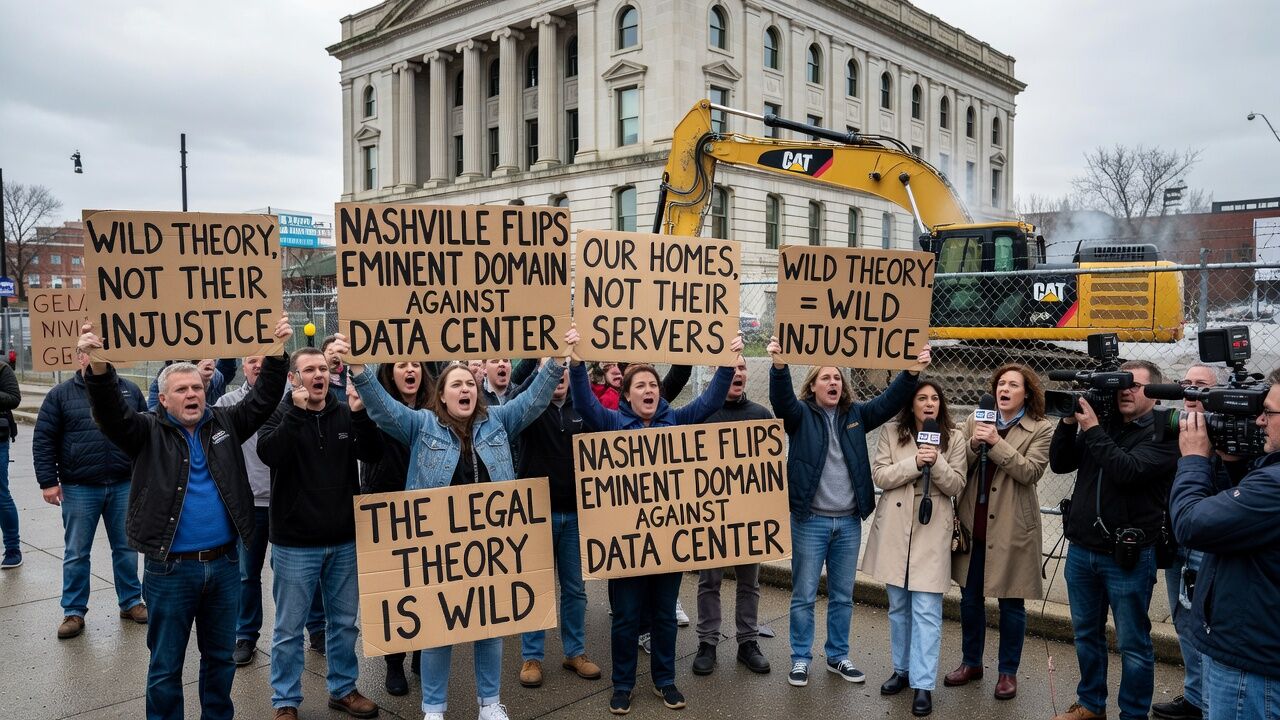
Nashville Flips Eminent Domain Against a Data Center — and the Legal Theory Is Wild
Let me be direct with you. If you've been following the data center infrastructure story this year, you've seen a predictable pattern: utility companies use eminent domain to seize private land for transmission lines that power AI data centers. Georgia Power is doing it right now — 330 parcels, 1,000 miles of transmission lines, 10 gigawatts of new capacity. The playbook is familiar. The powerful take from the powerless in the name of progress.
But Nashville just flipped that playbook upside down.
The city is threatening to use eminent domain not for a data center, but against one. And the legal theory behind the move is something I haven't seen in thirty years of watching this industry.
What Actually Happened in Nashville
Here's the story in straight numbers. Atlanta-based company DC BLOX signed a $23 million contract to purchase a 270,000-square-foot site adjacent to the Nashville Zoo. The plan: build two data center buildings drawing 50 megawatts of power. This isn't an AI training facility — DC BLOX's marketing VP Bill Thompson describes it as a "connectivity hub" between consumers and larger data centers. Think network edge, not GPU clusters.
The site sits in an existing industrial park that already hosts a smaller data center. DC BLOX filed its permit applications under existing zoning rules. By every conventional measure, this project had the legal right to proceed.
Then the zoo pushed back.
On June 29, Nashville Mayor Freddie O'Connell filed legislation to use eminent domain to seize the property. On July 21, the Metro Council passed a temporary moratorium on new data centers and approved new zoning restrictions. On July 22, DC BLOX closed on the $23 million purchase. On July 28, the council advanced the eminent domain legislation for a final vote scheduled for August 4.
The timeline matters here. The city moved fast — faster than I've ever seen a municipality move on a data center issue — and the escalation from zoning restrictions to outright seizure took less than a month.
The Clouded Leopard Problem
The heart of this fight is not what you'd expect. It's not about water consumption, grid capacity, or carbon emissions — the usual data center complaints. It's about clouded leopards.
The Nashville Zoo's president, Rick Schwartz, wrote in a June op-ed for the Tennessean that clouded leopards — an endangered species bred at the zoo — are "notoriously sensitive to any mechanical noise." The constant hum and vibration from data center cooling equipment, the zoo argues, would cause excessive stress and eliminate successful breeding.
This is new territory. Dr. Jennifer D'Agostino, chief animal program officer at the Oklahoma City Zoo and president of the American College of Zoological Medicine, told Reason magazine: "This is a bit of new territory. We don't have anything directly to compare data center noise to."
To be fair, data centers are not that loud. On a decibel scale, they're a bit louder than a library and quieter than a pickleball court. But noise isn't just about decibels — it's about character. A constant low-frequency drone at volumes that don't register on standard noise ordinances can still stress animals with sensitive hearing.
DC BLOX has committed to installing sound barriers, using quieter equipment, and keeping noise levels below zoning code limits. The company says: "We will not add perceivable incremental sound at the property line, and sound levels reaching the zoo will be even lower." But the zoo isn't buying it. More than 500,000 people have signed a petition supporting the zoo's position.
The Legal Trap: Eminent Domain as a Weapon, Not a Tool
Here's where this gets legally interesting — and I mean genuinely interesting, not law-review interesting.
Nashville's eminent domain legislation cites "Metro's need for office space" as the public use that justifies seizure. That is a transparent pretext. Everyone knows the real reason is stopping the data center. The question is whether a court will care.
Under Kelo v. City of New London (2005), the Supreme Court held that governments can seize private property for economic development — but the backlash was so fierce that most states passed laws restricting the practice. Tennessee's own laws are tighter than the federal standard, but still allow eminent domain for "public use." Office space for the metro government qualifies.
The legal problem for DC BLOX: the city's stated purpose is facially valid. A court would need evidence that the stated purpose is a sham — that the city has no real plan to use the land for offices and is simply trying to kill the project. DC BLOX's attorney Doug Sloan has signaled the company is prepared to make that argument, calling it a "pretextual taking."
The legal problem for Nashville: city zoning officials have already admitted that the new data center restrictions don't apply to DC BLOX because its permits were filed before the rules changed. The eminent domain play is a Hail Mary — and Hail Marys don't usually survive constitutional scrutiny.
There's also a fascinating irony here. The same week Nashville moved to use eminent domain against a data center, the Reason Foundation — a libertarian think tank that usually opposes eminent domain in all forms — ran the story with a tone that practically cheered the city on. When clouded leopards are involved, even the property-rights absolutists make exceptions.
The Irony: An Atlanta Company vs. Nashville's Anti-Data-Center Mood
DC BLOX is based in Atlanta, which adds a regional dimension to the story. Georgia — Atlanta's home state — is aggressively courting data centers while simultaneously fighting eminent domain battles of its own. Georgia Power is using eminent domain to build transmission lines that are 80 percent earmarked for data center load. Nashville is using eminent domain to stop a data center entirely.
Two Southern cities, two different approaches to the same tool. One uses it to enable data centers, the other to block them.
And Nashville's anti-data-center sentiment is not limited to the zoo. Fisk University — a historically Black university located near the proposed DC BLOX site — has been caught in the middle, with its president accusing opponents of spreading "misinformation" about the project. The data center debate in Nashville has become a proxy for larger fights about neighborhood character, environmental justice, and who gets to decide what gets built.
What This Means: The Public Backlash Has a New Playbook
If Nashville succeeds — and the August 4 vote is the critical test — it will establish a precedent that every NIMBY group in America will copy. The playbook goes like this:
Step 1: Identify a legally permitted project you don't want. Step 2: Find an environmental or animal-welfare angle that generates public sympathy. Step 3: Pressure the city council to use eminent domain. Step 4: Cite a pretextual "public use" that sounds reasonable. Step 5: Dare the developer to sue.
The cost of litigation alone could kill many projects, even if the developer ultimately wins. DC BLOX is well-funded, but most data center developers are not litigation shops. A year in federal court costs millions, and the delay alone can break project timelines.
On the other side, if DC BLOX wins and the court strikes down the eminent domain action, Nashville will have sent a signal that cities need to regulate data centers through proper zoning — not through ad hoc seizures. That would actually be the healthier outcome for everyone. Clear rules beat targeted retaliation every time.
What Comes Next
The August 4 Metro Council vote will tell us whether this is a serious legislative effort or political theater. If the council passes the eminent domain legislation, DC BLOX will almost certainly sue. The legal fight would take 12 to 18 months and could reach the Tennessee Supreme Court.
Meanwhile, every data center developer with a site near a sensitive environmental feature — a zoo, a wildlife refuge, a residential neighborhood — should be watching Nashville. What started as a local zoning dispute about clouded leopards has become a test case for a new kind of anti-data-center activism. The tools are changing. The playbooks are being rewritten.
And if you're Georgia Power, watching its own eminent domain battles from Atlanta headquarters while its hometown company fights Nashville's eminent domain action — well, the symmetry is almost too perfect to be real.
— Allan Ali, Sylt.ing
 Deutsch
 English
 Arabic
 French
 Spanish
 Portuguese
 Turkish
 Dutch
Dutch
 Italiano
 Russian
 Romaian
 Portuguese (Brazil)
 Greek
Greek