


 Monetization
Anthropic's 1.5 Billion Dollar Copyright Settlement Got Approved — and It Changes Everything for AI
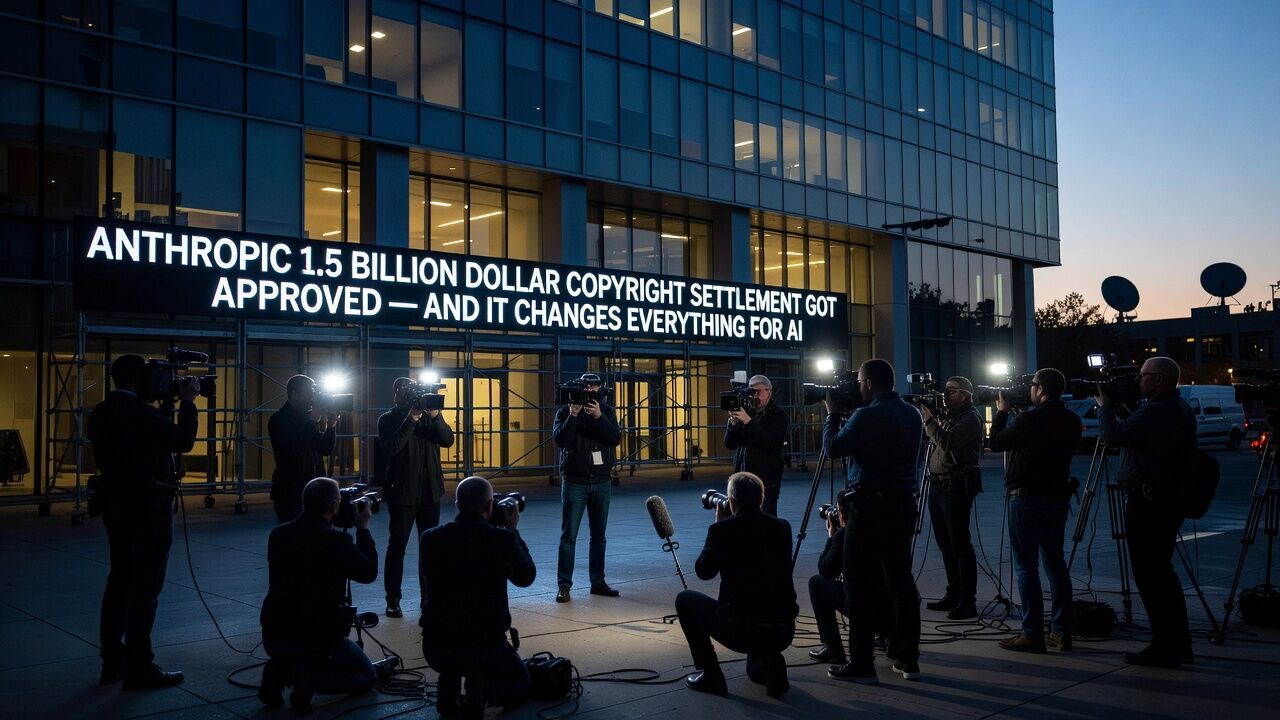
Anthropic's 1.5 Billion Dollar Copyright Settlement Got Approved — and It Changes Everything for AI
Let me be direct with you. If you have been following the copyright battles between AI companies and creators, you know the storyline by heart. Authors and artists claim their work was scraped and fed into training datasets without permission or payment. AI companies argue fair use and point to transformative purpose. The lawsuits pile up, the legal fees mount, and nothing ever really gets resolved because nobody actually wants to go to trial.
But on July 20, something genuinely historic happened. A federal judge in Oakland, California, granted final approval to Anthropic's $1.5 billion settlement of a class action lawsuit brought by authors and publishers over how the company obtained books to train its Claude chatbot. This is not just another settlement. It is the largest known copyright class action recovery in United States history — and it creates a precedent that every AI company with a training data pipeline needs to take seriously.
Here is what happened, what it actually means, and why the biggest questions are still unanswered.
The Details: 482,460 Works and a 1.5 Billion Dollar Payout
U.S. District Judge Araceli Martínez-Olguín, a Biden appointee, signed off on the settlement on July 20, finding it "fair, reasonable, and adequate." The settlement covers approximately 482,460 literary works that were included in datasets Anthropic downloaded from Library Genesis (LibGen) and the Pirate Library Mirror (PiLiMi) — two websites known primarily for distributing pirated content.
The plaintiffs' complaint did not mince words. "Anthropic has attempted to steal the fire of Prometheus," they wrote. "It is no exaggeration to say that Anthropic's model seeks to profit from strip-mining the human expression and ingenuity behind each one of those works." That language is dramatic, but it reflects a genuine grievance that courts are increasingly treating as legally actionable.
Under the settlement terms, approximately 54 named class members and over 500,000 potential class members will receive an estimated $3,100 per work. The payment structure is spread over time: Anthropic already deposited $300 million into the settlement fund after preliminary approval in September 2025, with an additional $300 million due within days of the final ruling. Two more installments of $450 million each follow on the first and second anniversaries of preliminary approval. That is a real financial commitment — not a symbolic gesture.
The Attorney Fee Fight Nobody Talked About
The plaintiffs' attorneys requested roughly $150 million in fees. Judge Martínez-Olguín cut that to approximately $101.6 million — about 7 percent of the settlement fund. That is actually a pretty modest fee award by class action standards, where one-third of the recovery is common. The court also approved approximately $2.6 million in expenses and an additional $18.2 million in anticipated costs.
Each of the three class representatives received a $15,000 service award, which is also standard for this type of litigation.
The fee fight matters because the structure of this settlement — where the attorneys take a relatively modest cut of a headline number — suggests the court was carefully scrutinizing whether the class was being adequately represented. That scrutiny will apply to every future AI copyright settlement that follows this model.
What Anthropic Must Destroy
Beyond the monetary payment, the settlement includes a structural requirement that is arguably more significant than the dollar figure. Anthropic must destroy the original files of the works it downloaded from the pirated book datasets within 30 days of the final judgment. The company must also certify whether Library Genesis and Pirate Library Mirror datasets with pirated material were used in training any of its commercially released large language models.
This destruction requirement matters because it closes a potential evidence chain. If Anthropic holds on to the files, future plaintiffs could use their continued possession as evidence of willful infringement in a separate proceeding. The destruction effectively wipes the slate clean for data acquired before the settlement cutoff — but it does nothing to address how Anthropic acquires training data going forward.
And that is the gap in this settlement that nobody is talking about.
The 3 Questions Nobody Has Answered
First: Does this settlement establish a per-work licensing benchmark for the entire AI industry? At roughly $3,100 per work across 482,460 works, the math works out to a specific per-unit cost that other copyright holders will inevitably reference in future negotiations. If a publisher can point to a court-approved settlement that values books at that rate, why would they accept less from OpenAI, Google, or Meta?
Second: What happens to the next 482,460 works that Anthropic trains on? The settlement covers a specific dataset from a specific time period. It does not grant Anthropic ongoing access to copyrighted material. If the company continues training new Claude models on data obtained through similar channels, every one of those works is a new potential claim. This settlement settles the past. It licenses nothing for the future.
Third: What does this mean for fair use as a defense? The judge explicitly noted that "success at trial was not assured" and that "a loss would have left the class with no recourse." That language is carefully neutral. It does not say fair use would have failed. It does not say it would have succeeded. It leaves the fair use question entirely unresolved — which means the next case that actually goes to trial will be the one that sets the binding precedent.
What This Means: The Licensing Era Has Arrived
The practical impact of this settlement is that the economics of AI training data just shifted. Before this case, AI companies operated with a calculated risk calculation: scrape first, ask forgiveness later, and if you get sued, settle before trial for a fraction of what a verdict might cost. That calculation still holds, but the cost of forgiveness just got a lot more expensive.
Every AI company with a large language model now has to ask itself a question it could previously defer: are we training on copyrighted material without a license, and what is that going to cost us when the settlement comes due?
The answer, based on this case, is roughly $3,100 per work. Do the math on your training dataset and see how you feel about that number.
For independent creators and small publishers, the settlement is a mixed bag. Getting paid for work that was already used is better than not getting paid. But the structural problem — that AI companies can take first and pay later, with the payment amounting to cents on the dollar of the value extracted — is not fixed by this case.
What Comes Next
The appeals window is still open. Any class member who objects to the settlement terms could theoretically appeal, though the judge's finding that the settlement is fair and adequate makes an uphill climb for objectors. Payments are tentatively expected to begin going out in August 2026.
The bigger story is what happens in the cases that are still pending. Multiple other class actions against AI companies over training data are working their way through the courts. The Authors Guild is pushing for a legislative solution. And the next major AI copyright case that actually goes to trial — rather than settling at the 11th hour — will be the one that defines the legal landscape for the next decade.
Anthropic paid $1.5 billion to make this problem go away for its current models. But the underlying legal question — whether training AI on copyrighted material without a license is fair use or infringement — remains as unresolved as it was the day the complaint was filed.
This settlement buys time, not clarity.
— Allan Ali, Sylt.ing
 Italiano
 English
 Arabic
 French
 Spanish
 Portuguese
 Deutsch
 Turkish
 Dutch
Dutch
 Russian
 Romaian
 Portuguese (Brazil)
 Greek
Greek