


 Monetization
AMD Drops Helios Rack, Zen 6 Venice CPUs, and a 2 Trillion Dollar AI Vision
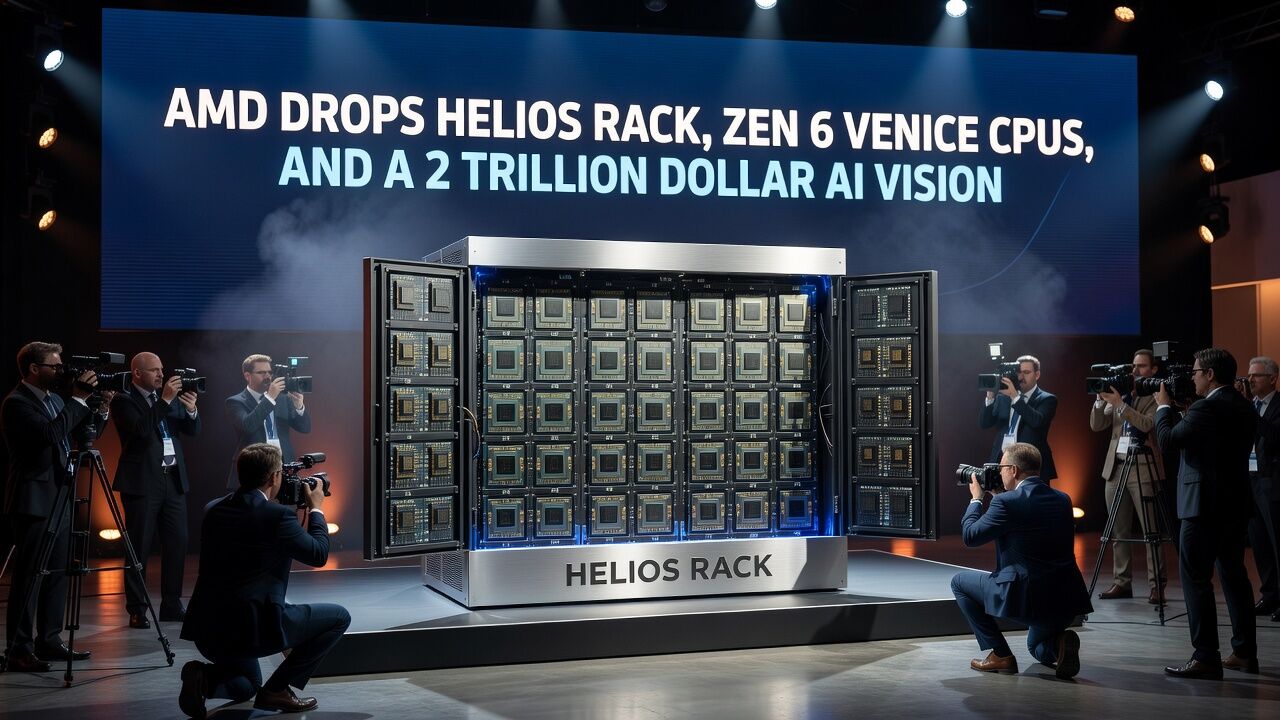
AMD Drops Helios Rack, Zen 6 Venice CPUs, and a 2 Trillion Dollar AI Vision
On July 23, AMD CEO Dr. Lisa Su took the stage at the Moscone Center in San Francisco for what she called "our biggest show ever." She wasn't exaggerating. The Advancing AI 2026 keynote ran two hours, filled the entire Moscone Center West, and laid out a product roadmap that, if AMD executes on it, fundamentally reshapes who owns the data center.
Let me cut through the marketing. This wasn't a press conference. This was AMD declaring war on three fronts simultaneously: NVIDIA for AI compute, Intel and Arm for server CPUs, and the entire notion that AI infrastructure has to be proprietary. And they brought receipts.
Helios: AMD's Answer to the NVL72 Is in Production
The headline announcement is Helios — AMD's first rackscale AI system. Think of it as AMD's version of NVIDIA's NVL72, but with a fundamentally different architecture. Helios combines MI455X GPUs, EPYC Venice CPUs, and Pensando Vulcano DPUs into a single rack that functions as one machine.
This isn't a paper launch. AMD announced Helios is in full production, with shipments starting in Q3 2026 and ramping through the second half of 2027. That's months, not years, away. OpenAI already has pre-production Helios racks and is optimizing them for deployment by end of year. Microsoft is lined up as a customer. Meta co-developed the OCP rackscale standards that Helios builds on.
And then there's Anthropic. In the week of the event, AMD and Anthropic announced a strategic partnership to deploy up to 2 gigawatts of MI450 Series GPUs in Helios racks. The first gigawatt lands in the first half of 2027. AMD is backing this with a $5 billion equity investment in Anthropic. Let that sink in — AMD is writing a $5 billion check to secure an anchor tenant for Helios.
Lisa Su put it simply on stage: "Helios is simply the best AI rack in the world." Bold claim. But the customer lineup — OpenAI, Anthropic, Meta, Microsoft — suggests she might be right.
The MI455X GPU: 320 Billion Transistors of Compute
The GPU powering Helios is the Instinct MI455X, and the specs are genuinely staggering. Built on 2nm compute chiplets with 3nm support silicon, packing 432GB of HBM4 memory and 320 billion transistors. AMD claims up to 40 PFLOPs of AI compute and 50% more memory capacity than the previous generation.
The performance numbers AMD put up are impressive. Up to 34x faster token throughput compared to the MI355X. The MI455X delivers 10x the performance of its predecessor. And when you look at tokens per dollar — the metric that actually matters for anyone running inference at scale — AMD claims Helios is 30% better than the competition, delivering 30% more tokens per dollar.
But here's the part that should worry NVIDIA. AMD is not just competing on specs. They're competing on openness. Every piece of Helios — the GPUs, the CPUs, the networking, the software stack — is built on open standards. The OCP form factor. Open networking. ROCm is open source. That matters to hyperscalers who don't want to be locked into a proprietary ecosystem.
EPYC Venice: Zen 6 Arrives With Up to 256 Cores
AMD also formally launched EPYC Venice — the Zen 6 architecture. And this is a bigger deal than most coverage is giving it credit for. Venice is built on TSMC's 2nm process and delivers up to 256 cores per socket. AMD called it "one of the largest generational gains in the history of EPYC."
The Venice family has three variants. Venice HF is the high-frequency chip shipping inside Helios, tuned for AI orchestration. The dense version packs 256 cores for throughput workloads. And there's a 128-core general-purpose SKU. Venice-X will follow with 3D V-Cache.
The performance claims are aggressive. AMD says Venice delivers 2x the agents per watt of the competition, and 2.2x performance per socket compared to NVIDIA's Vera CPU. The x86 compatibility advantage is real — everything still runs on x86, and AMD is making sure everyone knows it.
Venice is already in full production. Customer demand, AMD says, is higher than ever. Considering AMD now holds 46% of server CPU revenue share, that tracks.
Anthropic at 2GW, OpenAI at 6GW, Meta Co-Designing
The guest appearances at the keynote told the real story. This wasn't a product launch. It was a partner showcase, and the partners were the biggest names in AI.
Tom Brown, Anthropic's co-founder and chief compute officer, came on stage to announce the 2GW Helios deal. His message was clear: "Access to compute is central to keeping Claude at the frontier." Anthropic needs AMD as much as AMD needs Anthropic.
OpenAI's Mark Katti was even more direct. OpenAI is still deploying 6GW of AMD hardware from their earlier commitment. When Lisa Su joked that she's "never spoken to you where you haven't asked for more compute," Katti's response was deadpan: "I need more compute more quickly." OpenAI expects to start deploying Helios by end of 2026 and is already co-designing with AMD for MI500 and beyond in 2027.
Meta's Santosh Janardhan made a point that should make every infrastructure operator sit up: "Meta used to think about CPUs. Now they think about whole data centers as a single system." Meta believes CPUs are becoming "just as important as GPUs, if not more" for the agentic era. They're already one of AMD's deepest GPU partners, starting with MI300. Meta is "super excited" about MI450.
The 3 Questions Nobody Has Answered
For all the impressive hardware, there are questions AMD didn't fully address.
One: Can AMD sustain this pace? The roadmap shows a new GPU generation every year, a new rackscale system every year, and a CPU architecture every two years. MI500 in 2027 is supposed to deliver the "largest generational leap" with 2000x performance improvement in 4 years. That's an extraordinary claim. AMD has executed well on CPUs, but GPU architecture at this cadence is unproven at scale.
Two: Where does the power come from? AMD is selling 2GW to Anthropic, 6GW to OpenAI, and countless more to Meta, Microsoft, and everyone else. The grid can't handle this. AMD's own presentation acknowledged power is "the big limiter." They didn't offer a solution.
Three: Can ROCm.AI close the software gap? The ROCm.AI initiative — which uses AI agents (Codex, Claude) to automatically write and optimize GPU kernels — is clever. Hyperloom's 38% token rate improvement in a demo is real. But NVIDIA's CUDA moat is decades deep. AMD released ROCm.AI on July 23. Enterprise trust in AMD's software stack is not built in a day.
What This Means: The Infrastructure Battle Is Now a Three-Horse Race
The AI infrastructure market is no longer NVIDIA versus everyone else. It's NVIDIA versus AMD versus a growing Arm/ASIC ecosystem, and each camp is making different bets.
NVIDIA is betting on vertical integration — Grace CPU, Blackwell GPU, NVLink, CUDA, all proprietary, all designed to work together. AMD is betting on open standards — OCP racks, x86 compatibility, open-source ROCm, partner ecosystems. The Arm camp (NVIDIA Vera, Ampere, startups) is betting on efficiency and disaggregation.
AMD's strategy is smart. They can't out-NVIDIA NVIDIA on proprietary lock-in. So they're going the other direction: give hyperscalers what they actually want. Open hardware. Choice of software. No vendor lock-in. It's the same playbook that let AMD take 46% of the server CPU market from Intel.
AMD's TAM numbers tell you why they're investing so heavily. They project the AI accelerator market alone will hit $1.4 trillion by 2030. Total silicon TAM: $2 trillion, growing at 40% CAGR. If AMD captures even 20% of that, it's a $400 billion revenue opportunity. Helios is the vehicle for that bet.
The Roadmap: Florence, Rivenna, and Annual Racks
AMD showed their roadmap through 2030, and it's aggressive. Florence (Zen 7) is due in 2028 with ACE extensions. Rivenna (Zen 8) is under development for 2030. On the GPU side, MI500 arrives in 2027 (promising the largest generational leap), MI600 with CDNA Next in 2028. A new rackscale system every single year.
They also announced the MI430X for HPC — 288 TFLOPS FP64, shipping H1 2027 — targeting the traditional supercomputing market where double-precision floating point still matters. And the Instinct MI350P, a PCIe form-factor AI accelerator for enterprises that can't do rackscale deployments yet.
On the edge, AMD launched Kria AI, a system-on-module powered by Ryzen AI Embedded, going directly after NVIDIA's Jetson Thor in the robotics market. And Gorgon Halo — 192GB of LPDDR5X in a single client package, 64GB more than Strix Halo — for running large models locally.
What Comes Next
AMD just did something they've never done before. They showed a complete, end-to-end AI infrastructure stack — from client silicon to rackscale systems — and convinced the three biggest AI companies in the world (OpenAI, Anthropic, Meta) to commit to it.
The hard part starts now. Delivering Helios at scale. Making ROCm.AI actually close the CUDA gap. Building the software ecosystem that makes developers choose AMD not because it's cheaper, but because it's better.
But make no mistake: the AI infrastructure market just got a lot more competitive. And that's good for everyone who actually runs servers.
— Allan Ali, Sylt.ing
 French
 English
 Arabic
 Spanish
 Portuguese
 Deutsch
 Turkish
 Dutch
Dutch
 Italiano
 Russian
 Romaian
 Portuguese (Brazil)
 Greek
Greek