
 Monetization
Kimi K3: Moonshot AI's 2.8 Trillion Parameter Wake-Up Call for Silicon Valley
Kimi K3: Moonshot AI's 2.8 Trillion Parameter Wake-Up Call for Silicon Valley
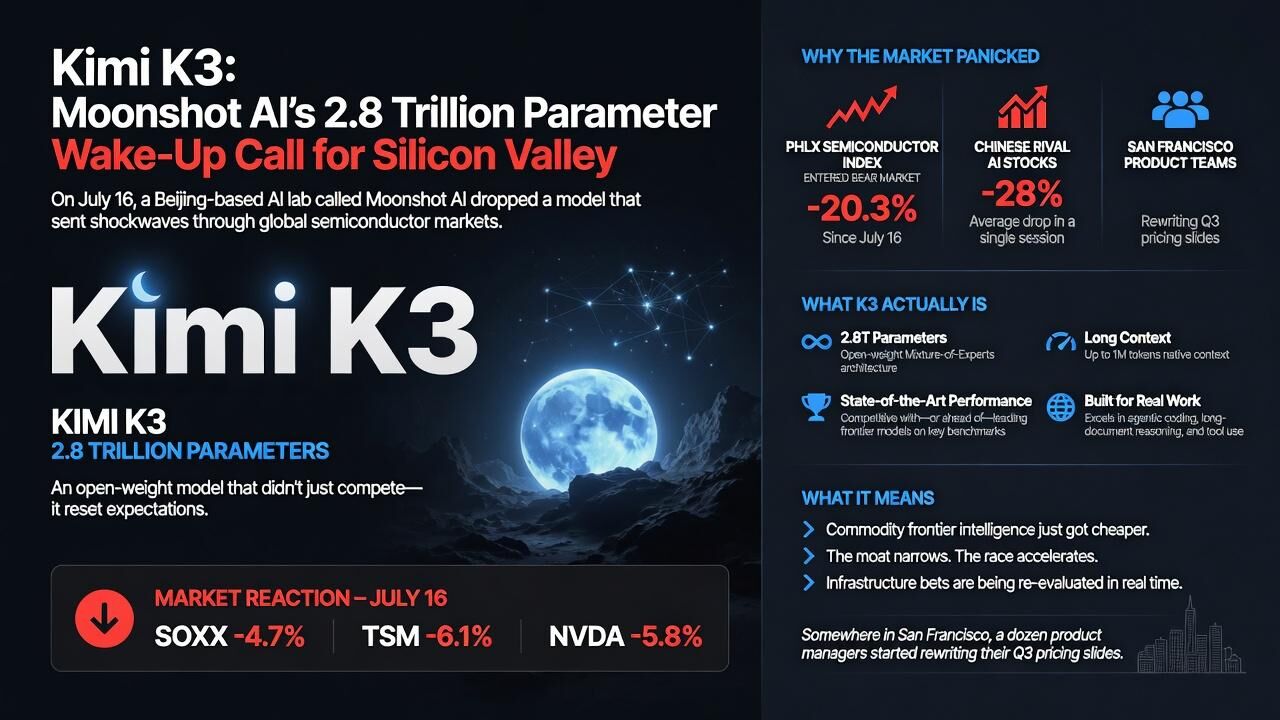
On July 16, a Beijing-based AI lab called Moonshot AI dropped a model that sent shockwaves through global semiconductor markets. Kimi K3 — a 2.8-trillion-parameter open-weight model — didn't just post competitive benchmarks. It triggered the Philadelphia Semiconductor Index to enter bear market territory. Chinese rival stocks tumbled 28 percent in a single session. And somewhere in San Francisco, a dozen product managers started rewriting their Q3 pricing slides.
Here's what K3 actually is, why the market panicked, and what it means for anyone building on AI infrastructure today.
What Kimi K3 Actually Is
Kimi K3 is Moonshot AI's flagship large language model — a sparse Mixture-of-Experts architecture with 2.8 trillion total parameters and 896 experts, of which 16 activate per token. It's the largest open-weight model ever released, beating Chinese rivals like DeepSeek V4 Pro (~1.6 trillion) and Zhipu's GLM-5.2 series by a wide margin.
The architecture brings two novel techniques. Kimi Delta Attention (KDA), a hybrid linear-attention mechanism Moonshot published as open research, keeps ultra-long sequences tractable without the quadratic cost blow-up of standard attention. Attention Residuals (AttnRes) replace traditional residual connections with what Moonshot claims delivers consistent scaling gains — roughly 2.5x better scaling efficiency over Kimi K2.
The context window sits at 1 million tokens — enough to hold an entire codebase or design system in view without elaborate chunking. Native multimodal input handles text and images. And the model runs an always-on "thinking mode" that can't be dialed down — every request gets the full reasoning treatment, whether you asked for it or not.
The Pricing Signal That Broke the Narrative
This is where the story gets interesting. Kimi K3 is priced at $3 per million input tokens and $15 per million output tokens. That makes it the most expensive model ever released by a Chinese AI lab — roughly three times the input cost and four times the output cost of Moonshot's own K2.6.
Bank of America analyst Alex Liu summed it up: "Moonshot AI priced K3 at a premium — the highest of any Chinese model to date." But he also noted that K3 sits at roughly 60 percent of Claude Opus 4.8 pricing and about half of GPT-5.6 Sol.
For the past two years, the Chinese AI narrative has been about price destruction. DeepSeek V4 Flash costs about two cents per standardized task compared to $2.75 on Claude Fable 5. The assumption was that Chinese labs would always undercut. K3 breaks that assumption entirely. Moonshot is signaling that their frontier model can command premium pricing — and they're betting the market will pay it.
The Benchmarks: Third Overall, First Where It Counts
K3 debuted at No. 3 on the Artificial Analysis leaderboard, behind Anthropic's Claude Fable 5 and OpenAI's GPT-5.6 Sol. That puts it ahead of Claude Opus 4.8 — a first for any Chinese open-weight model.
On the RealWorldQA benchmark — testing across 44 occupations and 9 industries — K3 scored 1,687, third behind Fable 5 Max (1,815) and GPT-5.6 Sol Max (1,747.8), but ahead of Opus 4.8 (1,600). On long-horizon knowledge work, it took second place at 1,527, beating GPT-5.6 Sol Max.
But the headline number comes from Arena.ai's blind front-end coding benchmark. Developers preferred K3 — scoring 1,679 points — over every leading U.S. model, including Fable 5 and GPT-5.6 Sol. In four of eight task-automation benchmarks, K3 ranked first, including Automation Bench, SpreadsheetBench 2, and BrowseComp.
One detail worth flagging for anyone building agentic workflows: Moonshot says these automation results came from a single-agent setup using the 1 million-token context — no compression tricks, no elaborate multi-agent orchestration. Raw context length plus strong retrieval can apparently rival complex agent scaffolding.
What the Market Panic Actually Reveals
The market reaction was severe and instructive. On July 17, the Philadelphia Semiconductor Index closed 20.2 percent below its June 22 all-time high — officially entering bear territory. The index dropped roughly 10 percent that week alone, the steepest weekly decline since April 2025.
Individual stocks got hit hard. Intel fell 13.5 percent for the week. Micron dropped 13.3 percent. NVIDIA shed 3.9 percent. Z.AI — a Chinese competitor — tumbled 28 percent in its biggest single-day slide since listing. MiniMax Group dropped 16 percent. The sell-off cascaded globally: Japan's Nikkei fell 4 percent, South Korea's Kospi dropped 6.4 percent.
The causal narrative was straightforward: a powerful, low-cost Chinese open-weight AI model would reduce demand for expensive AI chips. But the real picture is more nuanced. The SOX was already down 10 percent from its June peak before K3 launched. Netflix had missed earnings. Alphabet was hit by reports of Gemini 3.5 Pro delays. And the broader market was sitting on a 65 percent year-to-date gain in semiconductors — ripe for profit-taking.
K3 was the trigger, not the gunpowder. But the fact that a single model release from a Chinese lab could serve as that trigger tells you everything about how the market is pricing AI's future.
The Five Questions Nobody Has Answered
1. Can you actually run this thing? The open weights don't drop until July 27. Even then, a 2.8-trillion-parameter MoE model requires serious hardware. Even aggressively quantized, you're looking at multiple H100s or MI300Xs to self-host. The open-weight promise is real, but it's enterprise-only out of the gate.
2. What happens to the "cheap Chinese model" narrative? K3 priced at Sonnet levels — three to four times K2.6 pricing. If Moonshot can sustain demand at these prices, the entire competitive dynamic shifts. Chinese labs won't just be price disruptors — they'll be direct competitors on both quality and margin.
3. Does the reasoning cost matter? K3's "max only" reasoning mode means every request burns heavy compute. One independent tester reported spending roughly 13,241 tokens — about $0.25 — to generate a simple SVG. For production pipelines at scale, that cost multiplies fast.
4. How does this affect the US export controls calculus? K3 achieved frontier performance despite being built under hardware restrictions. If Chinese labs can close the gap with restricted hardware, the strategic value of export controls needs re-examination.
5. Is this a DeepSeek repeat? When DeepSeek R1 dropped in January 2025, NVIDIA lost 17 percent in a single day — nearly $590 billion in market cap. But NVIDIA recovered within months, and hyperscaler capex guidance only went up. The "cheap Chinese model kills GPU demand" trade failed before. The question is whether K3's architecture-driven efficiency gains make this time different.
What This Means: The Open-Weight Frontier Has Arrived
K3 marks a genuine inflection point. For the first time, an open-weight model sits in the top tier of global AI benchmarks — not just on price, but on capability. The gap between open and closed models has collapsed from months to days.
For builders evaluating models today, K3 belongs on the shortlist alongside Claude and GPT-5.x. That's not hyperbole. It's the reality of a landscape where a Beijing startup with 2.8 trillion parameters and a $3.15 billion valuation can go toe-to-toe with the most funded labs on the planet.
For the infrastructure layer, the implications are broader. If frontier models can run on fewer tokens (K3 uses about 21 percent fewer output tokens than K2.6 on equivalent tasks) and scale more efficiently (2.5x better scaling efficiency from KDA + AttnRes), the compute demand curve bends. Not breaks — but bends. That has consequences for GPU demand, data center build-out timelines, and energy procurement strategies.
What Comes Next
The open weights land on July 27. That's the real test — not benchmarks, not market reactions, but whether the community can actually run, fine-tune, and productize a 2.8-trillion-parameter model. The first self-hosted deployment, the first fine-tune, the first production pipeline running on K3 rather than through an API — those milestones will tell us more than any leaderboard position.
Moonshot is rumored to be raising another round at a $30-31.5 billion valuation and targeting a Hong Kong IPO within six months. DeepSeek just closed a $7.4 billion raise and is planning a 2027 IPO. Chinese AI labs are no longer just catching up. They're raising serious capital, shipping frontier products, and starting to dictate pricing terms.
K3 doesn't mean NVIDIA dies or the data center build-out stops. It means the competitive landscape just got a lot more interesting — and a lot more expensive for anyone who wasn't paying attention.
Check back on July 27. That's when we find out if the largest open-weight model ever built is actually open, or just another API with a promise attached.
— Allan Ali, Sylt.ing
Sources: Artificial Analysis leaderboard, Artificial Analysis long-horizon evaluation, Arena.ai front-end coding arena, BofA Global Research (Alex Liu), Bernstein Research (Robin Zhu), Macquarie Research (Ellie Jiang), Moonshot AI platform documentation, spoonai semiconductor analysis, The Straits Times, VentureBeat, Axios, Fortune.
===SUMMARY=== Moonshot AI's Kimi K3 — a 2.8-trillion-parameter open-weight model — triggered a semiconductor sell-off and hit #3 globally on AI benchmarks. The largest open-weight model ever built is a wake-up call for Silicon Valley.
 Deutsch
 English
 Arabic
 French
 Spanish
 Portuguese
 Turkish
 Dutch
Dutch
 Italiano
 Russian
 Romaian
 Portuguese (Brazil)
 Greek
Greek