


 Monetization
Janesville, PJM, and the Three Emergency Orders That Changed the Grid Forever
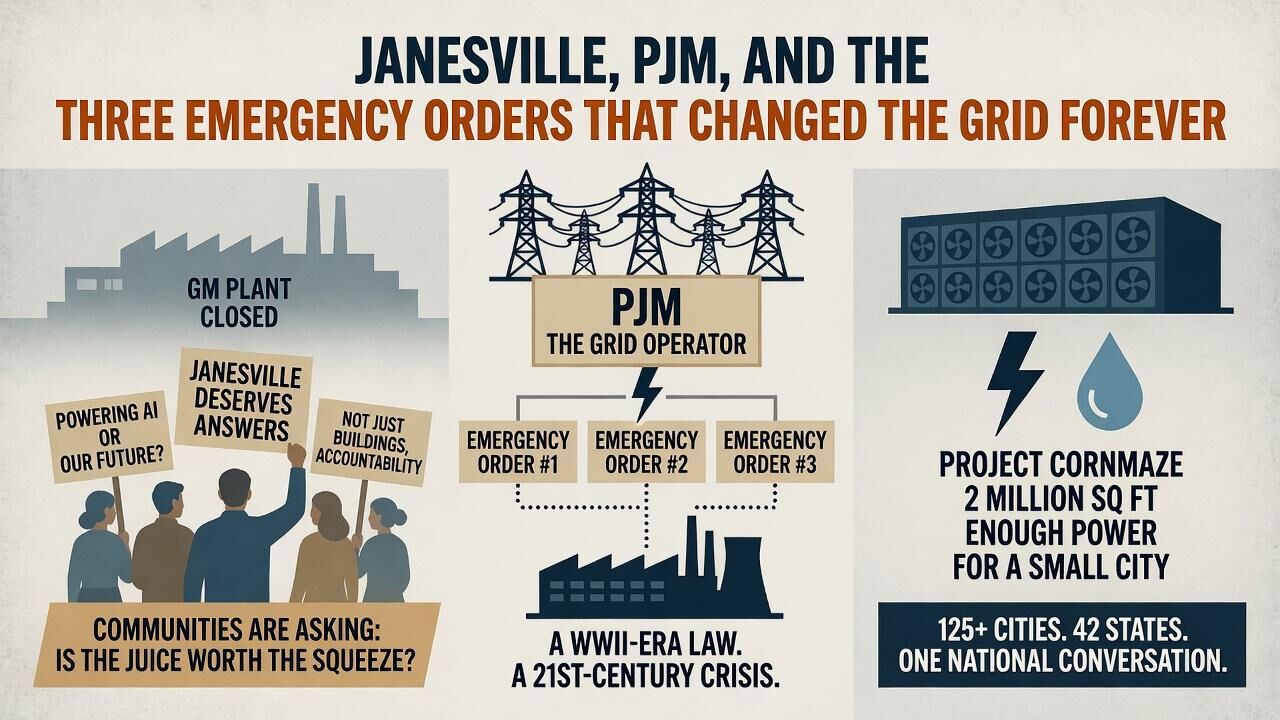
Janesville, PJM, and the Three Emergency Orders That Changed the Grid Forever
What the Janesville Fight Actually Reveals
PBS NewsHour ran a piece yesterday that should be required viewing for every tech executive, every data center developer, and every state regulator in this country. The segment covers Janesville, Wisconsin — a town that became a symbol of the Great Recession when GM closed its plant in 2008, killing thousands of manufacturing jobs. Now Janesville is ground zero for a different kind of battle: whether to allow an AI data center on what was once the GM site. And the residents are not rolling over.
The PBS report, by economics correspondent Paul Solman, lays out the tension in plain terms. AI is fueling stock market highs and construction booms. But the data centers that make AI possible consume staggering amounts of power and water — and the communities hosting them are starting to ask whether the juice is worth the squeeze. Janesville's proposed two-million-square-foot data center, code-named Project Cornmaze, would draw enough electricity to power a small city. And the county officials who signed non-disclosure agreements with the developer are facing a public that wants answers.
This is not an isolated story. It is a microcosm of what is happening in at least 125 cities across 42 states, where coordinated protests against data center build-outs reached a national scale in mid-July. And underneath the local zoning battles and public hearings, there is a much bigger story about the U.S. power grid — one that the federal government is now managing with a law written for World War II.
The Numbers That Broke the Grid
Let me give you the numbers that explain why Janesville is not an anomaly, but a symptom.
PJM Interconnection, the regional transmission organization serving 67 million people across 13 states and Washington, D.C., has invoked a 1935 federal emergency law three times in the last six months. Three times. For the same cause. That is not a coincidence. That is a structural failure playing out in real time.
Here is what the emergency orders reveal about the scale of the problem. PJM projects that data centers will add 65 gigawatts of new demand to its footprint over the next decade. To put that in perspective: 65 gigawatts is roughly equivalent to 65 nuclear reactors. And those data centers can be built in 18 to 24 months. The transmission lines and substations needed to power them take three to seven years. Transformer lead times are stretching two to five years. The math does not work.
PJM's capacity market — the forward auction that pays generators to guarantee future availability — has jumped more than eleven-fold in three successive auctions. From $28.92 per megawatt-day in the 2024-2025 delivery year to $333.44 per megawatt-day in the 2027-2028 auction. Monitoring Analytics, the independent market monitor, attributes 63 percent of that increase to data center demand. That translates to $9.3 billion in added costs that PJM customers collectively pay in a single delivery year.
Washington, D.C. residents saw their bills rise $21 per month beginning in June 2025. Western Maryland customers face $18 more. Ohio customers, $16 more. The Natural Resources Defense Council projects that by 2028, the average family in PJM's territory could pay approximately $70 more per month than before the data center boom began. Over the period through 2033, cumulative ratepayer costs may reach between $100 billion and $163 billion.
Emergency Law Has Become Standard Operating Procedure
Section 202(c) of the Federal Power Act was written in 1935. It was used 22 times during World War II. Between 2000 and February 2026, the Department of Energy invoked it across all U.S. grid operators approximately 26 times — typically for brief, unpredictable events like hurricanes or winter storms. The orders generally lasted hours to days.
In 2026 alone, the DOE has used Section 202(c) three times against PJM: once for a January cold snap, once for a May heat-and-maintenance squeeze, and again on June 30 when Energy Secretary Chris Wright signed two emergency orders directing AI data centers to disconnect from the grid and fire up their diesel backup generators within 15 minutes. The orders remained in force through the Fourth of July weekend, while a heat dome pushed feels-like temperatures past 100 degrees Fahrenheit from New York to Washington.
PJM demand hit approximately 163 gigawatts on July 2 — narrowly below the all-time record set in 2006. Day-ahead electricity prices spiked past $2,000 per megawatt-hour in parts of the system. Operating reserves fell to 5,091 megawatts, a margin so thin that one unexpected outage could trigger rolling blackouts.
The backup generators that data centers switch to under these orders are predominantly Tier 2 diesel units — among the most polluting forms of power generation permitted under EPA standards. And the emergency waivers contained in Wright's orders suspended normal emissions limits to the maximum extent feasible. So communities adjacent to data center campuses breathe diesel exhaust during the same heat events that already strain respiratory health.
A recent Congressional Research Service analysis flagged the pattern as novel. Balch and Bingham, the law firm advising energy sector clients on federal regulatory compliance, wrote in March 2026 that Section 202(c) has transformed from an emergency backstop into an active instrument of reliability management. DOE's own implementing regulations, finalized in 1981, state explicitly that the emergency authority does not intend to replace prudent utility planning and system expansion. Three orders in six months for a predictable structural load problem contradicts that intent.
The 4 Questions Nobody Is Asking
1. Who pays when the grid fails? The White House Ratepayer Protection Pledge, signed in March 2026 by Google, Microsoft, Meta, Amazon, Oracle, OpenAI, and xAI, is voluntary and legally unenforceable. PJM stakeholders voted down all major proposals to make equivalent requirements mandatory in November 2025. The costs are already socialized across every residential customer in PJM's territory, whether they use AI or not.
2. What happens when the diesel runs out? The emergency orders assume data centers have on-site fuel reserves adequate for extended operation. But those reserves are designed for testing and brief outages, not sustained multi-day deployment during a heat wave. If a Section 202(c) order runs for 72 hours and backup fuel depletes, the grid faces exactly the blackout scenario the order was designed to prevent.
3. Can the grid survive a second consecutive emergency summer? The December 2025 capacity auction cleared 6,625 megawatts short of PJM's own reliability requirement — the first time in history the grid has passed a formal threshold at which it cannot guarantee sufficient supply. The crisis is not coming. It is here.
4. What is the backup plan for the backup plan? Roughly one-third of all planned new U.S. data center power capacity is now designed to bypass the shared grid entirely through on-site fuel cells and natural gas turbines. That reduces the load on PJM but creates a two-tier system where AI infrastructure gets private power and residential customers get the crumbling shared grid. That is not a solution. It is a segregation of the electricity system by ability to pay.
What This Means — The System Is Working Exactly as Designed
Here is the uncomfortable truth that the Janesville story and the PJM emergency orders both illustrate: the current system is not broken. It is working exactly as designed. The costs of data center expansion are being transferred to residential ratepayers because the rules allow it. The grid is being pushed past its limits because market incentives favor speed over reliability. Emergency powers are being normalized because there is no structural mechanism to make data center developers pay for the capacity they consume.
This is not a failure of the system. It is the system optimizing for the wrong metric: speed of AI infrastructure deployment over grid reliability, local community impact, and long-term energy costs.
The political response is accelerating. Governor Greg Abbott of Texas called for a ban on new data center construction in rural areas and demanded that facilities generate their own electricity and reuse their own water. Senator Bernie Sanders and Representative Alexandria Ocasio-Cortez introduced the AI Data Center Moratorium Act. A Gallup survey found seven in ten Americans oppose data center construction in their local communities, with roughly half citing excessive power and water consumption as their primary concern.
Pennsylvania passed a new large-load tariff law in April. Virginia and Oregon are advancing rate-class legislation that would require data center developers to directly bear the transmission and capacity costs they cause. A FERC order in June 2026 directed six major grid operators to fast-track interconnection reforms within 60 days. The Federal Energy Regulatory Commission is hosting a July 2026 conference specifically to examine structural reforms to PJM's governance.
These are not cosmetic responses. They represent a fundamental reassessment of the relationship between AI infrastructure and the communities that host it.
What Comes Next
Janesville's city council is likely to vote on the data center project in the coming weeks. The outcome will be watched closely by every community facing the same decision — and there are hundreds of them. But the local zoning fight is only the visible surface of a much deeper structural problem.
The PJM emergency orders are not going away. The capacity auction shortfalls are not resolving themselves. The transformer lead times are not shrinking. And the $100 billion to $163 billion in cumulative ratepayer costs through 2033 is not a forecast — it is the bill that is already being mailed.
The question nobody in the AI industry wants to answer is the one Janesville's residents are asking: why should families pay for infrastructure that primarily benefits the shareholders of the world's most valuable companies? Until that question has a real answer — not a voluntary pledge, not a PR campaign, but a binding mechanism that makes data center developers pay their full cost — the backlash will only get louder.
And honestly? It should.
Watch the PBS NewsHour piece on Janesville. Then look at your next electricity bill. The connection is not theoretical. It is direct, it is measurable, and it is accelerating.
— Allan Ali, Sylt.ing
===SUMMARY=== PBS NewsHour's piece on Janesville's data center battle reveals a national crisis: PJM invoked a 1935 emergency law three times in 2026, data center costs are pushing family bills $70/month higher by 2028, and the AI industry has no answer for who pays.
 Italiano
 English
 Arabic
 French
 Spanish
 Portuguese
 Deutsch
 Turkish
 Dutch
Dutch
 Russian
 Romaian
 Portuguese (Brazil)
 Greek
Greek