


 Monetization
Google's Ad Tech Empire Is One Ruling Away From Getting Broken Up
Google's Ad Tech Empire Is One Ruling Away From Getting Broken Up
What Judge Brinkema Actually Ruled
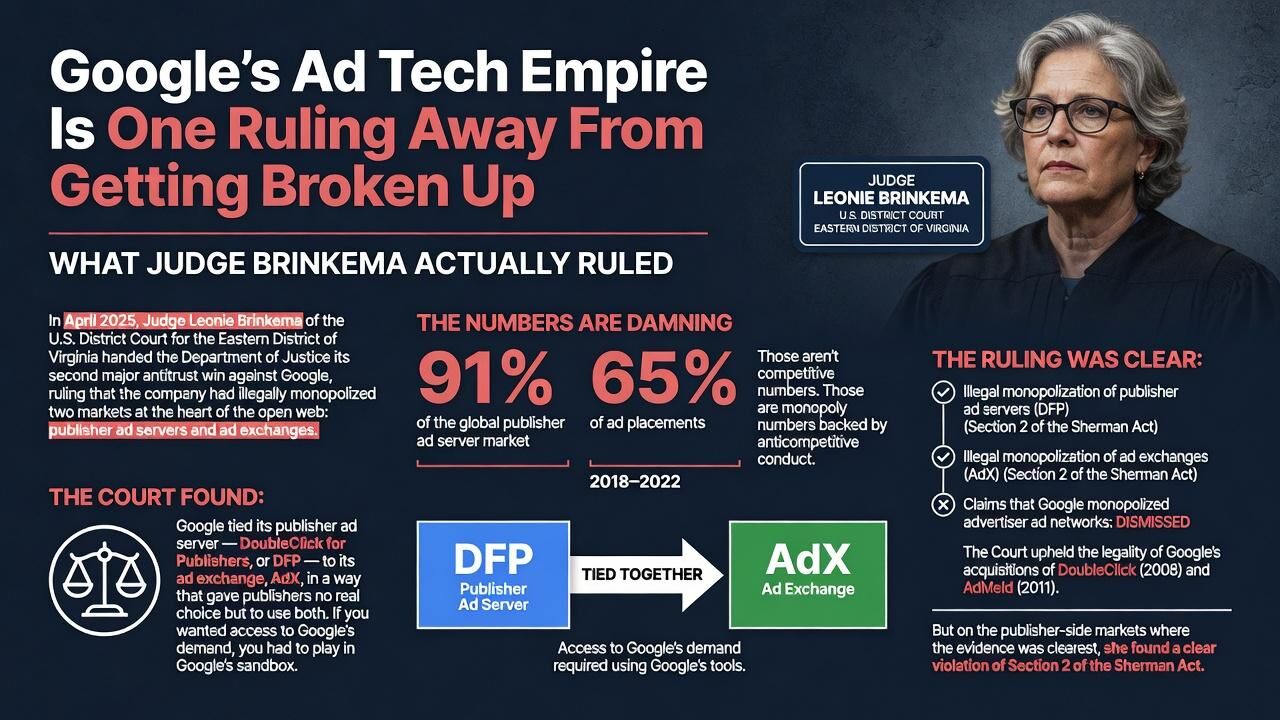
In April 2025, Judge Leonie Brinkema of the U.S. District Court for the Eastern District of Virginia handed the Department of Justice its second major antitrust win against Google, ruling that the company had illegally monopolized two markets at the heart of the open web: publisher ad servers and ad exchanges. The numbers are damning. Between 2018 and 2022, Google controlled roughly 91 percent of the global publisher ad server market and 65 percent of ad placements. Those aren't competitive numbers. Those are monopoly numbers backed by anticompetitive conduct.
Judge Brinkema found that Google tied its publisher ad server — DoubleClick for Publishers, or DFP — to its ad exchange, AdX, in a way that gave publishers no real choice but to use both. If you wanted access to Google's demand, you had to play in Google's sandbox. The ruling was thorough, precise, and damning. She dismissed claims that Google monopolized advertiser ad networks and upheld the legality of Google's acquisitions of DoubleClick (2008) and AdMeld (2011), but on the publisher-side markets where the evidence was clearest, she found a clear violation of Section 2 of the Sherman Act.
The 30 Billion Dollar Question
Google's ad tech business pulled in roughly 30 billion dollars in revenue in 2024, double what it made a decade earlier. Meanwhile, the open web publishers who feed that business have watched their print and digital ad revenue shrink year after year. There is a direct line between those two trends, and the court drew it.
The DOJ's Case vs Google's Counterproposal
The DOJ's remedy proposal is unambiguous: force Google to sell AdX outright. If that alone doesn't fix the conflict of interest, then a forced divestiture of DFP too. The government argues that only a structural breakup can restore competition in markets where Google's dominance has been entrenched for over a decade. The DOJ's counsel called on Google's "recidivist tendencies" during the remedies trial, arguing that behavioral fixes would be like telling a fox to guard the henhouse more fairly.
Google's counterproposal is narrower. The company says it will drop Unified Pricing Rules, eliminate its first-look and last-look bidding advantages, and open up interoperability. But here's the catch: Google is limiting those concessions exclusively to open-web display inventory. Programmatic guaranteed deals, private marketplaces, mobile in-app, CTV, and video inventory would not be covered. The DOJ's expert witnesses, including Advance Local's VP of ad tech Grant Whitmore, pointed out that this quarantines Google's concessions to only the least interesting, non-growing parts of publisher monetization.
The 5 Questions Nobody Is Answering
1. Who actually buys AdX? Google's counsel asked this repeatedly during the remedies phase. Index Exchange CEO Andrew Casale said his company would "do due diligence" on acquiring AdX, but Google's lawyers noted Index Exchange has only acquired two small companies in its history. A forced sale of AdX to a buyer that can't effectively operate it would harm publishers more than help them.
2. What happens to small publishers who use Google's tools for free? DFP is free for many small publishers. Under different ownership, that calculus changes. A new owner with profit motives and debt service obligations will charge for what Google currently gives away. The remedy that's supposed to help publishers could end up hurting the smallest ones most.
3. Does behavioral relief actually work in ad tech? The US courts have never required a structural divestiture as a remedy when a company tied one portion of its business to another, Google's counsel argued. But the DOJ's position is that the means to cheat in ad tech are "buried in computer code and algorithms" — making behavioral remedies nearly impossible to police effectively.
4. How does AI change the timeline? Judge Brinkema herself noted that "time is somewhat of the essence" because the ad tech landscape could change vastly in coming years due to AI developments in digital advertising. Google's counsel pointedly argued that the DOJ is "trying to shoe a horse that's about to be sent to pasture," alluding to the decline of open-web display ads and the growth of AI-native advertising.
5. What does this mean for the separate search case? Google's search monopoly case is already on appeal at the D.C. Circuit. Google filed its opening brief on May 22, 2026, asking the court to overturn Judge Amit Mehta's 2024 finding. The DOJ and 38 state attorneys general cross-appealed to reinstate the Chrome divestiture the district court rejected. The ad tech case is structurally separate but strategically connected — two front doors into the same house.
The European Dimension
While the US case inches toward a ruling, the European Union hasn't been waiting. The European Commission fined Google nearly 2.95 billion euros (roughly 3.5 billion dollars) in its own ad tech antitrust case, and told Google the only way to satisfy competition concerns was to sell off parts of its ad tech business. The UK's Competition and Markets Authority has designated Google with Strategic Market Status under its new digital markets regime. Google is fighting on three fronts simultaneously, and each front weakens its position on the others.
The transatlantic pressure matters because Google can't settle its way out of this one. Even if the US ruling is narrower than the DOJ wants, the EU and UK are pursuing their own structural remedies. A Google that keeps AdX in the US but is forced to divest in Europe faces an operational nightmare: maintaining two incompatible ad tech stacks across regions.
What This Means: The System Is Working Exactly as Designed
Here's the uncomfortable truth that neither side wants to admit: Google's ad tech dominance is not an accident, and it's not a bug. It is the logical outcome of a system where one company controls the publisher's ad server, the advertiser's ad network, and the exchange that sits between them. When you own the pipes on both ends, you can extract margin from both sides of every transaction. That's not a conspiracy theory. That's basic marketplace mechanics.
What makes this case different from the Microsoft antitrust battles of the early 2000s is the scale and speed. Microsoft's remedies took years to implement and the technology landscape shifted underneath them. Google's counsel made exactly this argument: by the time any divestiture is fully implemented, AI-native advertising may have already moved the market beyond what open-web display ads even look like today. They have a point. But they also have a history of saying the same thing about every antitrust challenge for the last decade, and their ad tech revenue keeps doubling anyway.
The FINN Partners July 2026 Media Pulse put it well: "Google has already been quietly losing ground in ad tech no matter what Judge Brinkema decides. A court order can force a sale. It can't force the open web to matter as much as it used to." That's the real story. The ruling will decide who owns the pipes. It won't decide whether the water still flows through them the way it used to.
What Comes Next
Judge Brinkema's ruling could land any day now. The legal community expects it before the end of July 2026, based on the Eastern District of Virginia's reputation as the "rocket docket" and the fact that closing arguments wrapped eight months ago. When it comes, it will fall into one of three buckets: full structural breakup (AdX divestiture, possibly DFP too), behavioral remedies only (rule changes but no sale), or a hybrid (AdX divestiture with DFP behavioral restrictions).
If the DOJ wins a full breakup, expect an immediate appeal from Google. The company can be expected to seek a stay of any divestiture order while the appeal proceeds, which could push implementation years down the road. If Google wins a narrow behavioral outcome, expect the DOJ to appeal on the grounds that the remedies are insufficient to restore competition.
Either way, the open web that publishers and advertisers have been operating on for the last two decades is about to change. Not because of the ruling specifically — but because the ruling is a symptom of a broader reckoning. The era of one company quietly controlling both ends of every ad transaction is ending. The question is whether the replacement will be genuine competition, or simply a new set of walls that look different from the old ones.
For publishers, the immediate advice is the same as it's been since 2020: diversify your ad tech stack. Don't build your monetization strategy around a single vendor, even if that vendor is free. Because free isn't a business model. It's a trap. And the trap is about to spring.
— Allan Ali, Sylt.ing
===SUMMARY=== Judge Brinkema's Google ad tech antitrust ruling is imminent. DOJ wants AdX sold off; Google fights for minor rule changes. The open web hangs in the balance as a 30-billion-dollar empire faces its most serious structural threat in decades.
 Turkish
 English
 Arabic
 French
 Spanish
 Portuguese
 Deutsch
 Dutch
Dutch
 Italiano
 Russian
 Romaian
 Portuguese (Brazil)
 Greek
Greek