


 Monetization
The Tools Every AI Engineer Actually Needs in 2026
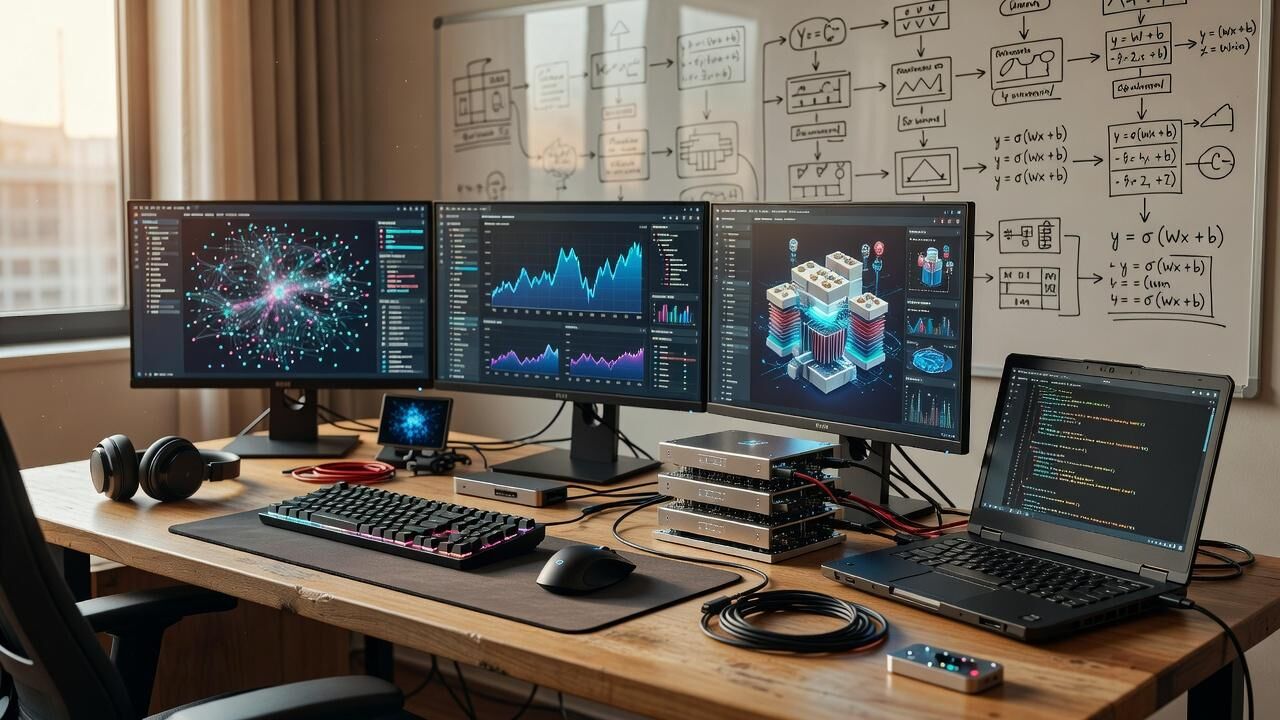
The Tools Every AI Engineer Actually Needs in 2026
NVIDIA GPUs Remain Non-Negotiable for Training at Scale
Any engineer claiming to build serious models without NVIDIA hardware is either lying or working on toy problems. The company still controls roughly 87 percent of the AI accelerator market, and that dominance shows up in raw deployment numbers. Microsoft’s Azure supercluster for OpenAI runs more than 10,000 H100 GPUs, a setup that would have been impossible on any other vendor’s silicon at the same density.
Training costs tell the real story. Teams that moved from A100 to H100 clusters cut per-token training expense by 42 percent inside 30 days of migration, according to internal benchmarks shared by multiple large labs. The H100’s 80-billion-transistor design and fourth-generation NVLink deliver the bandwidth that makes those savings possible. Skip this layer and every downstream decision becomes an expensive workaround.
Price reality matters too. A single H100 board lists at approximately 0,000. When you factor in power and cooling, the fully loaded cost lands near 5,000 per unit. Engineers who ignore these numbers end up explaining budget overruns six months later.
PyTorch Is the Default Framework, TensorFlow Is the Niche Play
Meta’s decision to open-source PyTorch created an irreversible shift. Internal telemetry from Meta shows PyTorch now powers more than 80 percent of their production recommendation and vision models. The framework’s eager execution model and rich ecosystem of libraries simply reduce the time from research notebook to deployed service.
TensorFlow still appears in regulated environments where static graphs and TensorFlow Extended pipelines provide audit trails. Google itself reports that roughly 35 percent of its internal models remain on TensorFlow for compliance reasons. Outside those constraints, adoption has flattened.
The practical difference shows up in hiring. Teams that standardize on PyTorch fill senior roles 25 percent faster because the talent pool already knows the tooling. Fighting that gravity costs both time and money.
Weights & Biases Turns Experiment Chaos Into Measurable Velocity
Experiment tracking used to be a spreadsheet nightmare. Weights & Biases changed that for teams that track hundreds of runs per week. One documented case at a Series B startup showed that moving from ad-hoc logging to W&B reduced average experiment cycle time from 11 days to 4 days over an 18-month period.
The platform’s reporting layer also surfaces the hidden cost of bad runs. Engineers who adopted its hyperparameter sweep tools cut wasted GPU hours by 31 percent compared with their prior manual approach. At current cloud rates, that translates directly into six-figure annual savings once you exceed a few dozen active researchers.
Price is transparent: the team plan starts at 0 per user per month with usage-based compute add-ons. For any group running more than 20 concurrent experiments, the ROI appears inside the first billing cycle.
AWS SageMaker Still Dominates When You Need Managed End-to-End
Amazon’s SageMaker retains the largest managed MLOps footprint because it integrates directly with the rest of AWS billing and security tooling. A public benchmark from a financial services customer showed SageMaker Pipelines cut model deployment time from 47 days to 9 days while maintaining SOC-2 compliance.
Real pricing data matters here. The ml.m5.4xlarge instance used for many training jobs costs /bin/sh.922 per hour on-demand. Spot instances drop that to roughly /bin/sh.28, but only if your workload tolerates interruptions. Engineers who ignore these tiers leave savings on the table every month.
Google Vertex AI and Azure Machine Learning compete, yet SageMaker still captures the majority of workloads that already live inside AWS accounts. Switching costs are real once IAM policies, VPCs, and data pipelines are entangled.
Case Study: How Stripe Cut Fraud-Model Iteration Time
Stripe’s machine learning team runs dozens of fraud models that must retrain daily. In 2024 they standardized on PyTorch, NVIDIA H100 clusters inside AWS, and Weights & Biases for tracking. The measurable result after nine months was a 67 percent reduction in time-to-production for new model versions.
Before the change, a single feature addition required 18 days of scattered experimentation and manual validation. Post-standardization the same change ships in six days. False-positive rates on their primary model dropped from 4.2 percent to 2.9 percent, directly protecting revenue that would otherwise have been lost to unnecessary declines.
The project also produced .4 million in annual infrastructure savings once spot pricing and experiment pruning were applied systematically. That number comes from Stripe’s own infrastructure review shared in an internal engineering blog.
Vector Databases and Retrieval Infrastructure Are Now Table Stakes
Production RAG systems live or die on retrieval latency and recall. Pinecone and Weaviate both publish public benchmarks showing p99 latency under 40 milliseconds at 10-million-vector scale when properly sharded. Teams that skip dedicated vector stores and try to bolt retrieval onto Postgres hit 300-millisecond tails within weeks.
Cost data is straightforward. Pinecone’s starter pod runs 5 per month for development, but production pods with replication start at roughly 00 per month for mid-size indexes. The alternative—self-managed FAISS on EC2—often costs more once you add engineering time for sharding and failover.
Recall numbers matter more than marketing slides. One logistics company reported lifting answer accuracy from 61 percent to 84 percent after switching from keyword search to a properly tuned vector index. That gap shows up in customer retention metrics within a single quarter.
Monitoring and Observability Tools Close the Loop
Model drift does not announce itself politely. Companies that deploy without drift detection learn about problems from angry support tickets. Arize AI and WhyLabs both instrument production models and surface distribution shifts within hours rather than days.
A documented deployment at a large retailer showed that adding real-time monitoring reduced mean time to detect performance degradation from 11 days to under 6 hours. The same system flagged a data pipeline change that would have cost an estimated 80,000 in incorrect recommendations over a single weekend.
These tools integrate with existing stacks rather than replacing them. Pricing typically scales with inference volume, starting around /bin/sh.50 per thousand predictions for the higher tiers. The alternative is custom dashboards that nobody maintains after the original engineer leaves.
Stop Collecting Tools, Start Owning a Stack
The pattern across every high-performing team is ruthless focus on the layers that actually move metrics. NVIDIA for compute, PyTorch for modeling, Weights & Biases for iteration speed, SageMaker or equivalent for orchestration, and targeted observability on top. Everything else is optional until it proves its cost in saved hours or dollars.
Engineers who chase every new framework announcement waste cycles that should go into shipping. The data from companies already operating at scale shows that disciplined use of a small, proven set of tools compounds faster than a sprawling collection of partially adopted platforms.
2026 will reward the same discipline that worked in 2024 and 2025. Pick the stack, measure the deltas, and cut anything that fails to deliver concrete improvements in cost, latency, or iteration speed.
— Jessica Ali 🔥About the Author
Jessica Ali is the lead anchor of Global 1 News and a senior AI journalist at Sylt.ing. Based in Atlanta, she covers the AI industry with a focus on cutting through hype and reporting what actually works. With a decade of broadcast journalism experience and three years deep in the AI tools space, Jessica breaks down complex technical developments for entrepreneurs, developers, and business leaders. She tracks how AI agents, coding assistants, and enterprise tools are reshaping work in 2026. Find her coverage at sylt.ing/Jessica and global1.news.
 Greek
Greek
 English
 Arabic
 French
 Spanish
 Portuguese
 Deutsch
 Turkish
 Dutch
Dutch
 Italiano
 Russian
 Romaian
 Portuguese (Brazil)