


 Monetization
Nationwide Data Center Protests Hit 125 Cities as Anti-AI Movement Goes National
What the July 18 Protests Actually Showed
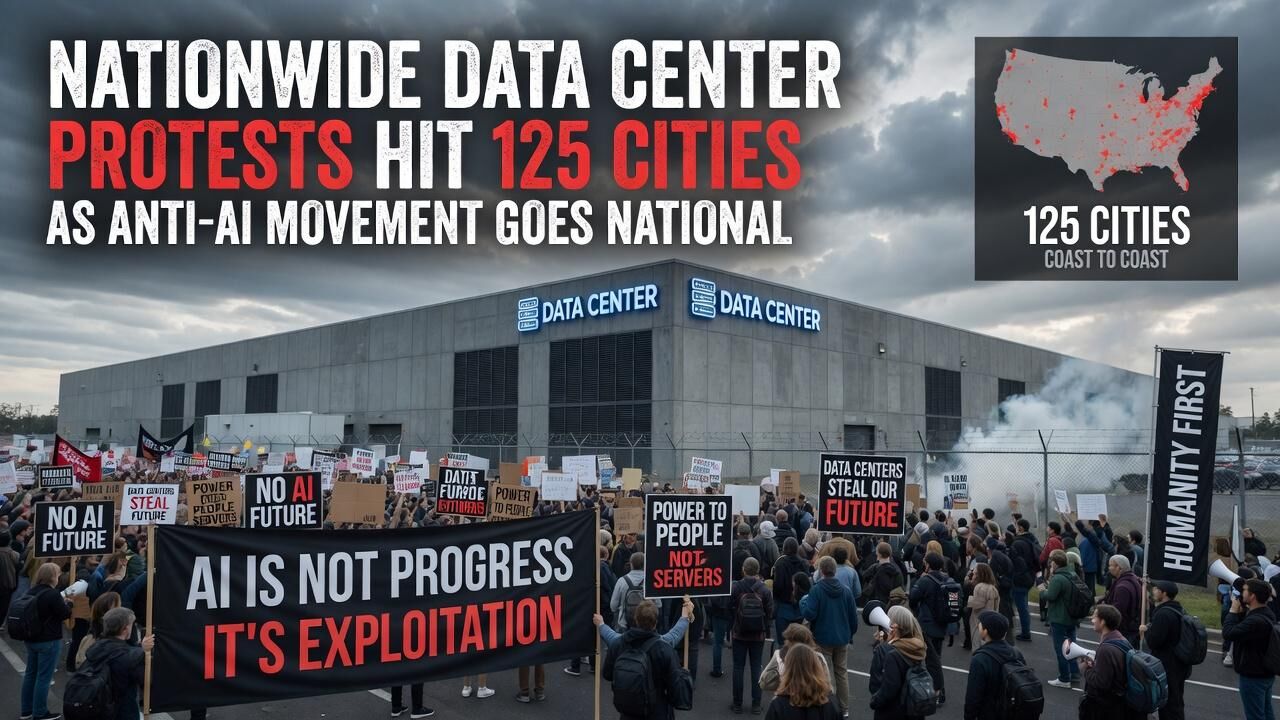
On Saturday, July 18, something shifted in the AI infrastructure debate. Activists in 125 cities across 42 states — from Wasilla, Alaska to Naples, Florida — staged the first nationally coordinated day of action against the data center build-out. And it wasn't a small gathering. By some counts, 142 separate protests materialized across the country in a single day. The group behind it, HumansFirst, co-founded by former Tea Party leader Amy Kremer, calls it a cross-partisan revolt against what it terms "Big AI."
The ABC News segment that ran on the same weekend captures exactly what made these protests different. For two years, data center opposition has been local — a county commission hearing here, a zoning board meeting there. What HumansFirst demonstrated is that those local fights now have national infrastructure. People showed up in Texas (18 rallies, the most of any state), in Georgia (11 rallies), in California, Florida, and Pennsylvania (7 each). Red states, blue states, battleground states — the map of discontent doesn't track with political ideology. It tracks with where the data centers are going.
The Numbers Behind the Backlash: 98 Billion Blocked and Counting
To understand why this movement has momentum, you have to look at the numbers. Research firm Data Center Watch documented $98 billion in data center projects blocked or delayed between March and June 2025 alone. In the first quarter of 2026, opposition blocked or delayed an additional $130 billion in projects — matching the full-year 2025 total in just three months. More than 800 community opposition groups are now active in 49 states.
That financial impact has translated into legislative action. State lawmakers introduced more than 300 bills in the first half of 2026 to regulate the data center build-out. On July 14, New York Governor Kathy Hochul signed the nation's first statewide permitting freeze on new AI data centers drawing 50 megawatts or more. Virginia became the first state to tax data center electricity consumption directly — a 1.1 cent per kilowatt-hour levy that took effect July 1. In Pennsylvania, the full state House passed a bill banning non-disclosure agreements in data center deals by a 171-31 vote with bipartisan support.
Meanwhile, at the federal level, Democratic Representatives Alexandria Ocasio-Cortez and Bernie Sanders have called for a nationwide moratorium. The White House Ratepayer Protection Pledge — which commits some companies to pay their own grid connection costs — remains voluntary and non-binding.
Who Is HumansFirst and Why the Coalition Matters
HumansFirst is the most interesting organizational development in this fight. The group was co-founded by Amy Kremer, a former Tea Party leader, co-founder of Women for Trump, and an organizer of the January 6 rally in 2021. That background would ordinarily make her an unlikely figurehead for a movement that includes left-wing activists concerned about climate change, water consumption, and corporate overreach.
But that is precisely the point. "The data center boom has been sold as inevitable," Kremer wrote on X after the July 18 protests. "It is not. Communities have every right to ask what they are giving up and what they are getting in return."
The protests drew Texans like Eva Cardona, 31, a self-described political nomad and first-time activist who organized one of the 18 Texas rallies. "I've been hearing about unregulated AI and the rapid growth was alarming me," she told Reuters. On the other end of the political spectrum, Ivan DelSol, 54, helped lead a protest in California's Imperial County, where a proposed data center could draw 260 million gallons of water per year from the already-depleted Colorado River. "It's dystopian that you would use this much fresh water for AI," DelSol said.
A Reuters/Ipsos poll from June found that just one-third of Americans approve of the current pace of data center construction, and only 14 percent would support one being built in their community. A Gallup poll from March found that roughly 70 percent of respondents oppose new AI data centers in their neighborhood — a higher opposition rate than Americans express toward nuclear power plants.
The Local Stories: From Kenilworth to California
In Kenilworth, New Jersey, a small borough of roughly 8,500 people, the local planning board approved a $1.8 billion AI data center last May. The opposition has been fierce. A petition to halt construction gained over 12,000 signatures — more than the town's entire population. On July 18, protesters gathered outside the municipal court at 10 a.m. with plastic horns, whistles, and a drum. They kept going through heavy rain. "You think this is pressure? Wait 'til there's no water pressure," one sign read.
In Texas, data center water consumption has become a central grievance. A study by the Houston Advanced Research Center and the University of Houston found that data centers in Texas alone will consume 49 billion gallons of water in 2025, rising potentially to 399 billion gallons per year by 2030. Globally, a United Nations report estimated that data centers last year consumed enough water to fill 1.8 million Olympic-sized swimming pools.
The industry points to liquid cooling systems as a mitigation. Liquid cooling can reduce direct water use by 70 to 90 percent for high-density AI workloads. But that does not reduce the underlying electricity demand — and electricity is where the ratepayer pain lives. In the PJM grid region, capacity market costs jumped from $2.2 billion to $14.7 billion in a single year, with data centers accounting for nearly two-thirds of the increase. Residents of Washington, DC, saw electricity bills increase by an average of $21 per month; western Maryland customers by $18; Ohio customers by $16.
What This Means: The Infrastructure Revolt Nobody Saw Coming
Here is what the tech industry has not fully processed: the data center opposition is not a NIMBY problem that can be solved with better PR. It is a structural conflict between the scale of AI infrastructure and the legal and political systems designed for an earlier era of industrial development.
The approval process for data centers still runs through local zoning systems designed for conventional industrial facilities. Nothing in those systems was built to handle a facility that consumes electricity equivalent to 100,000 households while employing fewer permanent workers than a grocery store. Virginia's Department of Taxation found the state's data center industry added 1,610 jobs statewide in fiscal year 2025 while receiving approximately $1.9 billion in tax incentives — roughly $1.18 million per permanent position.
To be clear, the industry is not wrong about the strategic necessity. AI compute demand is surging, and the US is in a global competition for AI leadership. But for the people showing up at those 125 protests, those strategic imperatives are abstract. The 30 percent rate increase on their electricity bill is not abstract. The 260 million gallons of water is not abstract. The surveyors on their family's land is not abstract.
What Comes Next
The July 18 protests did not change any laws. But they changed the perception of the opposition. What was once a patchwork of local disputes has become a national political movement with a measurable financial track record and a midterm election in its sights. Amy Kremer has predicted data centers will be a defining issue in November's midterms and the 2028 presidential race. Whether that prediction holds depends on whether HumansFirst can sustain the coalition it has built across partisan lines.
The original Tea Party became a transformative electoral force; it also fractured over time into competing factions with incompatible agendas. The data center opposition movement faces a version of the same challenge: local grievances are vivid and immediate, but the policy solutions — NDA bans, community benefits mandates, grid cost allocation reform — require sustained engagement with legislative processes that are easier to mobilize against than to navigate.
For now, one thing is clear: the era when data centers could be approved quietly through local planning boards with NDAs shielding the terms from public view is ending. The 125-city protest was the signal. The midterms are the test.
— Allan Ali, Sylt.ing
===SUMMARY=== Anti-AI data center protests hit 125 US cities in first national mobilization. 98 billion in projects blocked, 300+ state bills filed. Analysis of the cross-partisan movement and what it means for AI infrastructure.===SUMMARY===
 Portuguese (Brazil)
 English
 Arabic
 French
 Spanish
 Portuguese
 Deutsch
 Turkish
 Dutch
Dutch
 Italiano
 Russian
 Romaian
 Greek
Greek