


 Monetization
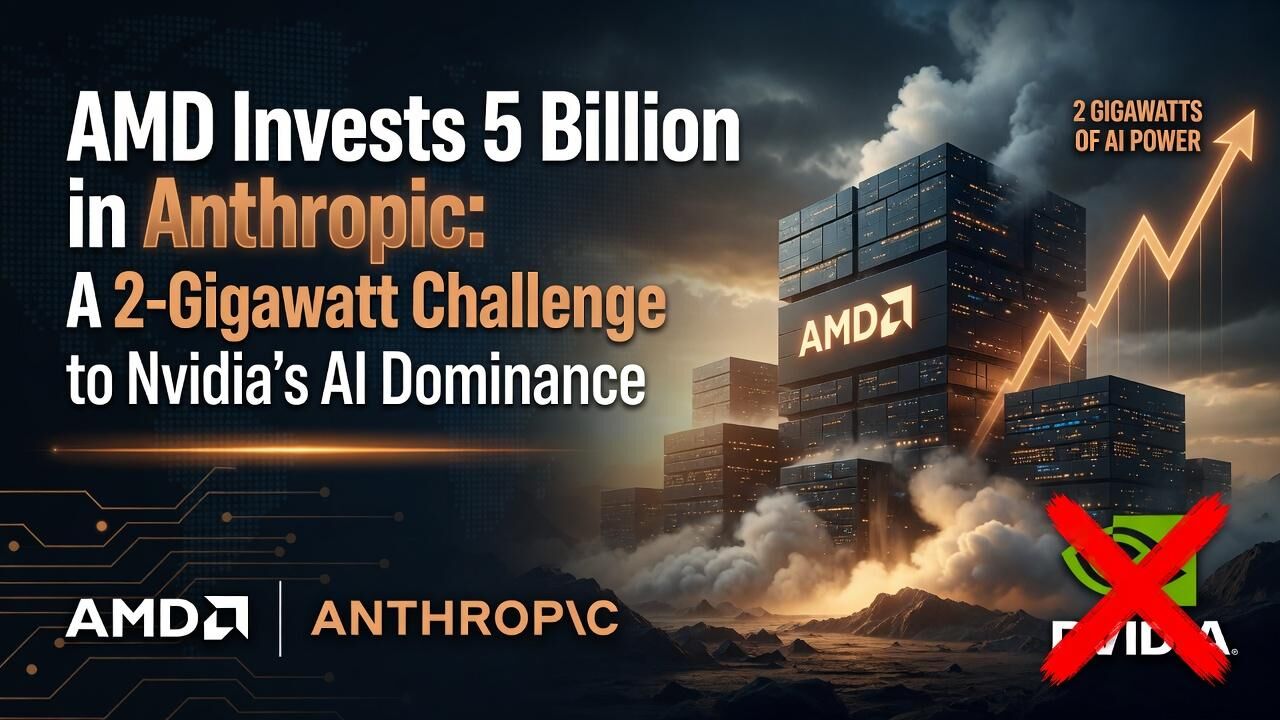
AMD Invests 5 Billion in Anthropic: A 2-Gigawatt Challenge to Nvidia's AI Dominance
What the AMD-Anthropic Deal Actually Is
On July 22, Advanced Micro Devices and Anthropic announced a strategic partnership that is — by any measure — one of the largest AI infrastructure deals ever signed. AMD committed up to $5 billion in a strategic equity investment in Anthropic, and Anthropic committed to deploying up to 2 gigawatts of AMD Instinct MI450 Series GPUs across its AI workloads.
The first gigawatt is scheduled to come online in the first half of 2027, deployed in AMD's Helios rack-scale systems. Each Helios rack packs 72 Instinct MI455X accelerators, 31 terabytes of HBM4 memory, and up to 2.9 FP4 exaFLOPS of inference compute — paired with EPYC "Venice" CPUs, Pensando networking, and AMD's ROCm software stack.
This is not a press release about a pilot program or a memorandum of understanding. This is a binding multi-gigawatt deployment with a $5 billion equity check attached. The terms are real, the hardware is shipping, and the timeline is measured in months, not years.
The $5 Billion Structure: Supplier Becomes Shareholder
The equity component is worth dwelling on because the structure tells you more about AMD's strategy than the headline number does. When AMD struck its landmark deal with OpenAI, the arrangement ran the other direction — OpenAI received warrants for up to roughly 10% of AMD's stock. The customer got equity upside in the supplier.
This time, AMD is putting its own money into its buyer. AMD becomes both supplier and shareholder in Anthropic. That changes the incentive alignment fundamentally. AMD's success is now directly tied to Anthropic's growth. Every Claude subscription, every API call, every enterprise deployment that runs on AMD silicon earns AMD a return on its investment twice — once through hardware sales, once through equity appreciation.
It also signals AMD's understanding that the AI infrastructure market is winner-take-most at the silicon level. Amortizing the R&D cost of a GPU architecture across a single hyperscaler customer doesn't work. You need captive demand. By investing directly in Anthropic, AMD is buying guaranteed demand for its highest-margin products while simultaneously positioning itself for upside in the company that may define the next generation of AI applications.
The Helios Architecture: What AMD Is Selling
This is the part that infrastructure operators care about. AMD's Helios is not a GPU card. It is a complete rackscale system — accelerators, CPUs, networking, and software — designed to compete head-to-head with Nvidia's DGX and HGX platforms.
The key specs matter: 72 Instinct MI455X accelerators per rack, 31 TB of HBM4 memory, and up to 2.9 FP4 exaFLOPS. The interconnect uses UALink-over-Ethernet, which means AMD is betting on open standards rather than proprietary NVLink-style fabric. For operators already running Ethernet-based data centers, that reduces the infrastructure lock-in risk.
Anthropic's deployment pairs these Helios racks with EPYC Venice CPUs for host processing and Pensando DPUs for network acceleration across Azure's AI backend networking infrastructure. The full stack — GPU, CPU, networking, ROCm software — ships as a single integrated system. AMD's press release confirmed that Anthropic is already running its current-generation MI355X GPUs, making this an expansion of an existing relationship rather than a greenfield deployment.
The Competitive Picture: AMD's Three-Card Hand
This deal is AMD's third major AI infrastructure announcement in the span of four days. On July 20, Microsoft committed to deploying AMD Helios at scale on Azure for frontier model inference. Oracle is already in the queue to deploy 50,000 MI450 GPUs this quarter. Now Anthropic joins with a 2-gigawatt commitment.
Three tier-1 customers — Microsoft, Oracle, Anthropic — within one week. That is not a coincidence. It is a coordinated market assault timed to AMD's Advancing AI event and the Helios platform launch.
To put the 2-gigawatt number in perspective: a single gigawatt is roughly equivalent to the output of a nuclear power reactor. Anthropic's total committed compute portfolio now spans Nvidia GPUs, Amazon's Trainium chips under Project Rainier, 3.5 gigawatts of Google TPU capacity supplied by Broadcom from 2027, 300 megawatts of Nvidia compute rented from SpaceX's Colossus 1 data center, and now 2 gigawatts of AMD Instinct silicon. AMD becomes roughly the sixth distinct silicon source feeding Claude.
The diversification strategy is deliberate. Anthropic does not want to be dependent on any single chip supplier — and AMD gets to be the new entrant in a portfolio that was previously dominated by Nvidia and custom ASICs.
The Three Questions AMD Has Not Answered
For all the excitement, there are real open questions that anyone running infrastructure should be asking.
First: Can AMD deliver on time? OpenAI's first gigawatt of AMD capacity was due in the second half of 2026 — and SemiAnalysis reported that those shipments have faced delays. Anthropic's first gigawatt is now scheduled for H1 2027, which pushes any meaningful revenue contribution from this deal into late 2027 at the earliest. AMD's track record on GPU volume shipments against Nvidia has been uneven. The MI300X ramp was solid. The MI350 series hit its targets. But 2 gigawatts at scale is a different order of magnitude.
Second: What happens to ROCm adoption? The software stack has been AMD's Achilles heel against CUDA for years. The engineering collaboration with Anthropic — Claude optimizing workloads for Instinct, ROCm development accelerated by Anthropic's feedback — is strategically sound, but it takes time. CUDA's moat is not just the compiler; it is the entire ecosystem of libraries, frameworks, and trained engineers. A single customer, even one as sophisticated as Anthropic, cannot close that gap alone.
Third: Does the equity investment change Anthropic's independence? AMD is now a significant shareholder in Anthropic, alongside Google, Amazon, and existing venture investors. That is a lot of competing interests around a single board table. When AMD's hardware roadmap conflicts with Anthropic's compute needs — and it will, eventually — whose interest wins? The $5 billion check buys AMD influence, not control, but influence in a company that is simultaneously your customer, your engineering partner, and your equity holding is a relationship that requires careful governance.
What This Means: The Silicon Monopoly Is Breaking
The most important takeaway from this deal is not about AMD or Anthropic specifically. It is about what the aggregate of these announcements tells us about the AI infrastructure market: Nvidia's effective monopoly on large-scale AI training and inference is cracking.
One year ago, every major AI deployment ran on Nvidia. Today, Microsoft has committed to AMD Helios on Azure. OpenAI has committed to AMD Instinct capacity. Oracle is deploying AMD GPUs. Anthropic is deploying 2 gigawatts of AMD silicon. Meta is building custom AMD Instinct accelerators for specific workloads. The shift from single-vendor dependency to multi-sourcing is happening faster than most industry observers predicted.
This is healthy for the market. Competition drives down pricing, accelerates innovation, and reduces the single-point-of-failure risk that concentrated around Nvidia's supply chain. AMD still has a long way to go before it matches Nvidia's software ecosystem, and Nvidia's next-generation Blackwell Ultra and Rubin architectures will keep the pressure on. But the narrative that Nvidia owns AI silicon exclusively is no longer supported by the evidence.
What Comes Next
The AMD-Anthropic deal sets a floor for how AI infrastructure partnerships will be structured going forward. Expect to see more supplier-equity deals, more multi-gigawatt commitments, and more integration between chip companies and AI labs. The era of buying GPUs off the shelf and calling it an AI strategy is over.
For operators and infrastructure planners, the implications are straightforward: start planning for a multi-vendor silicon future now. If your deployment architecture is locked into CUDA-specific optimizations that cannot run on ROCm or custom ASICs, you are making a bet that Nvidia's dominance will continue indefinitely. This week's news suggests that bet is getting riskier by the day.
The next twelve months will determine whether AMD can execute on its volume commitments and whether Anthropic's multi-silicon strategy delivers the cost and performance advantages it promises. But one thing is already clear: the AI infrastructure market just became a lot more interesting — and a lot more competitive.
— Allan Ali, Sylt.ing
===SUMMARY=== AMD invests up to $5B in Anthropic and commits 2GW of Instinct MI450 GPUs in a landmark AI infrastructure deal that challenges Nvidia's silicon dominance. Helios racks with 72 accelerators deploy starting H1 2027.
 Romaian
 English
 Arabic
 French
 Spanish
 Portuguese
 Deutsch
 Turkish
 Dutch
Dutch
 Italiano
 Russian
 Portuguese (Brazil)
 Greek
Greek