


 Monetization
The Grid Emergency That Wouldnt End: Data Centers on Diesel as the Heat Dome Arrives
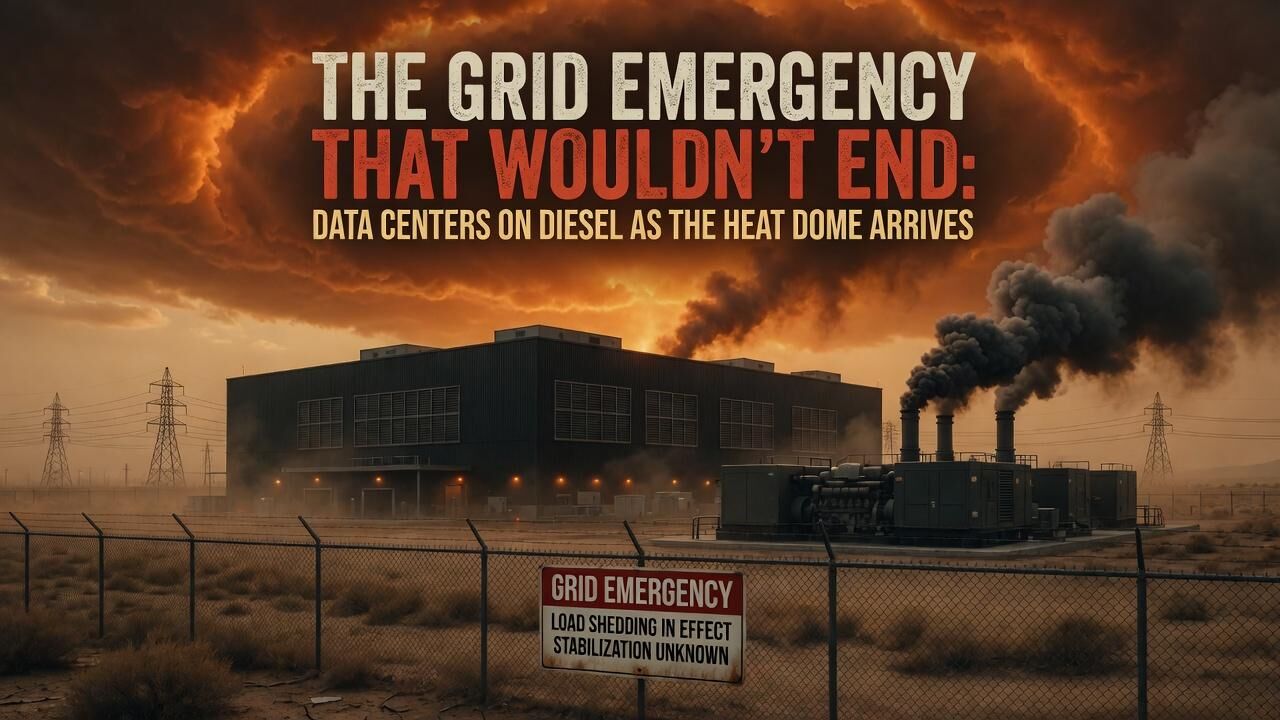
The Grid Emergency That Wouldn't End: Data Centers on Diesel as the Heat Dome Arrives
On June 30, with temperatures already pushing past 100°F across the Northeast, Energy Secretary Chris Wright signed the third emergency order of 2026 under Section 202(c) of the Federal Power Act. The directive authorized PJM Interconnection to order any customer drawing 50 megawatts or more at a single delivery point to switch to onsite backup generation within 15 minutes of an emergency signal. The targets were not hospitals or water treatment plants — those were explicitly exempted. The targets were AI data centers.
The order expired on July 6, but the problem did not. A second heat dome is now settling over the same region, with more than 112 million Americans under heat alerts and the grid already running closer to its limits than at any point in the last two decades. PJM's instantaneous load hit approximately 162.7 gigawatts on July 2, approaching the all-time record of 165.563 GW set in 2006 — and the peak forecast for this second heat event may exceed 166 GW, which would break that record. The Section 202(c) process, designed in 1935 for rare, acute emergencies, has become a seasonal operating procedure.
Three Orders. One Pattern.
The Department of Energy issued three Section 202(c) orders to PJM in 2026. That statute, written when Franklin Roosevelt was president, allows the Energy Secretary to compel emergency action when grid reliability is threatened. Before this year, it was rarely invoked. Now it is a recurring tool that grid operators reach for when data center demand meets extreme weather.
The most recent order, signed June 30 and extended through July 6, is the most telling. It required large-load customers — primarily data centers and hyperscale AI campuses — to run on diesel generators when PJM issued an emergency signal. The logic is straightforward: data centers have backup generators designed for exactly this purpose. Residential customers do not. When the grid is 6.8 GW short of its reliability target and temperatures are pushing infrastructure past its limits, diesel is the emergency valve.
The human cost of the first heat dome is settled: at least 44 people died between July 1 and July 4 — 29 in New Jersey, seven in Pennsylvania, four in Illinois, three in New York, and one in Mississippi. The second dome is now peaking, with heat index values expected above 100°F in New York and Washington.
The Diesel Dilemma: Loudoun County's Wake-Up Call
In Loudoun County, Virginia — home to more than 600 data centers consuming a quarter of the state's electricity — the diesel backup strategy hit a wall. A data center campus in Sterling ran its diesel generators for 24 consecutive hours during the emergency, and local regulators discovered they had no legal authority to stop it. A Loudoun County supervisor is now calling for new laws after WUSA9 reported that the Virginia State Corporation Commission confirmed it could not restrict the generator use under current regulations.
The incident at the Vantage VA2 campus in Sterling illustrates the regulatory gap that the AI buildout has exposed. Data centers install diesel generators as backup for grid failures — they are required to have them for reliability. But when the grid fails structurally rather than accidentally, and those generators run for days instead of hours, the emissions and noise become a community problem that no existing regulation addresses. The smoke from those generators drifts into neighborhoods. The particulate matter settles on schools. And there is nothing local officials can do about it.
This is not hypothetical. Canadian wildfire smoke from more than 836 active fires reached the Great Lakes and Northeast while the generators were running, compounding the air quality impact. The combination of diesel exhaust from data centers and wildfire PM2.5 created conditions that the FAA confirmed degrade aircraft navigation equipment — adding flight delays on top of grid strain on top of public health risk.
The Feedback Loop Nobody Modeled
The TechTimes coverage of the heat dome crisis surfaced a feedback mechanism that the industry has not accounted for. A Cambridge-NTU study analyzing 20 years of NASA satellite data across 6,000 data center locations found that facilities raise local land surface temperatures by an average of 2 degrees Celsius after beginning operations, with the effect extending up to 10 kilometers from the site and reaching as high as 9.1 degrees Celsius in extreme cases. The "data heat island effect" means data centers are not just victims of the heat dome — they are modest contributors to local temperature elevation.
The implication is uncomfortable. Data centers consume more cooling energy as ambient temperatures rise, and their cooling loads peak exactly when the grid is most constrained. During a heat emergency, AI inference and training demand does not drop because it is 103°F outside — but the grid's capacity to serve that demand does drop. The feedback loop runs both ways: data centers raise local temperatures, which increases their cooling demand, which strains a grid that is already failing to keep up.
Mishal Thadani, CEO of AI infrastructure platform Rhizome, framed the structural problem directly: data centers need the most energy exactly when the grid has the least to give. That is not a scheduling conflict that can be resolved by shifting workloads to off-peak hours.
The Grid Emergency in Numbers
- 3 — Section 202(c) emergency orders issued to PJM in 2026
- 162.7 GW — PJM's peak load on July 2, approaching the 2006 record of 165.563 GW
- 6.8 GW — Shortfall between PJM's procured capacity and its reliability target
- 50 MW — The threshold at which PJM can force data centers to diesel backup
- 44 — Confirmed deaths from the July 1-4 heat dome
- 112 million — Americans under heat alerts during the current heat dome
- 600+ — Data centers in Northern Virginia, consuming 25%+ of the state's power
- $9.3B — Data center-attributed capacity market costs on PJM ratepayers
- 2°C — Average local temperature increase from data center operations (Cambridge-NTU)
These numbers are not projections. They are the current state of the grid as it enters the hottest part of the summer.
What This Means: Emergency Has Become the Baseline
When a statute written in 1935 gets invoked three times in six months to force data centers onto diesel backup, the grid is not experiencing an emergency — it is operating in a new normal that the regulatory framework was never designed for. The Federal Energy Regulatory Commission has yet to issue guidance specific to AI-driven load growth. The Section 202(c) process was designed for hurricanes and plant failures, not for a structural demand shift that compounds every summer.
The Loudoun County diesel incident exposes the gap between what the grid needs and what communities can tolerate. The grid needs backup generation ready to fire when demand spikes. Communities need air that does not contain diesel exhaust from generators running for 24 consecutive hours. Right now, the grid wins every time because the emergency orders give it legal cover and no regulator has authority to say otherwise.
The question is whether the third heat dome — or the fourth — will produce an incident serious enough to force policy change. Zurich Insurance has already flagged severe weather as the leading cause of loss in its U.S. data center builders' risk portfolio. First Street Foundation found that 79 percent of global data center capacity faces elevated acute climate hazards. The insurance industry and the satellite data are converging on the same conclusion: the current model was designed for average conditions, and average conditions are disappearing.
What Comes Next
PJM and the DOE will continue to use emergency orders as needed through the summer. But emergency orders are not a solution — they are a temporary workaround that externalizes costs onto communities in the form of diesel emissions, noise, and health impacts. Several state utility commissions have begun examining whether the public interest standard for grid infrastructure should account for emergency generator emissions. Loudoun County is likely to push for legislation that gives local regulators authority over backup generator runtime during non-failure events.
But the deeper question is whether the grid can be brought to a place where emergency orders are not needed every summer. PJM has no spare capacity beyond 2027, per ICF's assessment. The 6.8 GW shortfall in the most recent capacity auction means new generation is not coming online fast enough to close the gap. Until that changes, the summer script is written: heat dome arrives, grid tightens, data centers switch to diesel, and communities breathe the exhaust. WUSA9's report on the Sterling incident is below. Watch it, and ask yourself how many summers this pattern can repeat before something breaks permanently.
— Allan Ali, Sylt.ing
 Russian
 English
 Arabic
 French
 Spanish
 Portuguese
 Deutsch
 Turkish
 Dutch
Dutch
 Italiano
 Romaian
 Portuguese (Brazil)
 Greek
Greek