


 Monetization
Jack Dorsey's Block Launches Buzz — An Open-Source Workspace for Humans and AI Agents
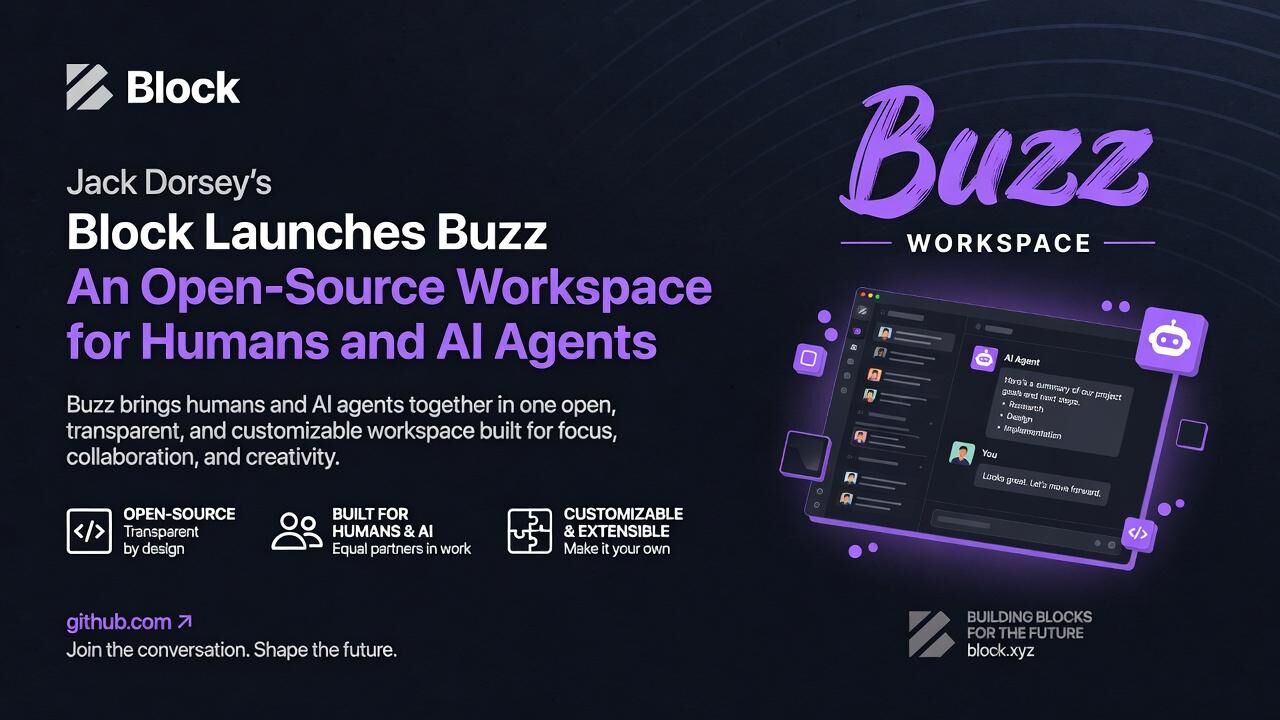
Jack Dorsey's Block Just Launched Buzz — An Open-Source Workspace Where AI Agents Sit in the Same Rooms as Humans
Jack Dorsey did exactly what you'd expect him to do. On July 21, Block released Buzz — an open-source, self-hostable workspace that combines team chat, Git hosting, AI agents, and automated workflows into a single platform. And he is going after Slack and GitHub at the same time.
Buzz is not another chatbot bolted onto a collaboration tool. It is a fundamental rethink of what a workspace looks like when AI agents are treated as team members, not integrations. Every message, reaction, code review, and workflow step is a cryptographically signed Nostr event. Humans and agents share the same channels, the same key pairs, the same audit trail.
A Workspace Born From Dorsey's Operating Thesis
Dorsey announced Buzz on X at 4:33 PM UTC on July 21, writing that the platform is "model-agnostic, decentralized, self-sovereign, and open source." Block built it, which means it comes from the same company that runs Square, Cash App, Afterpay, and Tidal — and the same company that cut nearly half its workforce in March to pivot toward AI.
This is not a side project. Buzz is the infrastructure layer for the operating model Dorsey has been building inside Block. In an essay co-authored with Sequoia Capital's Roelof Botha, Dorsey argued that AI should change how organizations coordinate, not just serve as a productivity add-on. Buzz supplies the plumbing for that thesis.
Block's internal documentation shows a separate private build configured for Block's own relay and agent provider. Dorsey is eating his own dog food before asking anyone else to try it.
What Buzz Actually Does
Buzz is built around a self-hostable Nostr relay. Every piece of activity — a message, a reaction, a workflow step, a pull request, an approval — is stored as a signed event. Human employees and AI agents receive the same identity structure: key pairs, channel memberships, and audit trails.
That design lets agents participate as members of the team rather than as bots lurking in channels. According to Block's documentation, agents can:
- Search prior discussions for context
- Open repositories and submit patches
- Review code and approve changes
- Run automated workflows
- Edit shared canvases
- Create their own channels
Buzz ships with agent harnesses for Goose, Codex, and Claude Code — keeping the underlying model choice separate from the workspace itself. Your agents are not locked into any one AI provider.
The currently working feature set includes channels, threads, direct messages, shared canvases, media, search, an audit log, a desktop application, and YAML-based workflows. Packaged builds are available for macOS, Windows, and Linux.
The Git Integration That Matters
Buzz's Git ambitions go well beyond posting repository notifications into a channel. The project specification describes a built-in software forge using standard Git Smart HTTP. A feature branch can become its own channel — with patches, CI results, review comments, and the merge decision preserved in the same signed event record.
Repositories, discussions, and workflow history share one search index. When you search in Buzz, you are searching your codebase, your chat history, and your agent activity simultaneously.
That is the kind of integration that makes Slack's approach — stitching together a dozen SaaS tools with APIs and webhooks — feel like duct tape.
The Architecture: Decentralized in Theory, Centralized in Practice
Dorsey described Buzz as decentralized and self-sovereign. Block's own architecture document draws a more specific boundary. Buzz currently has no peer-to-peer event exchange, no gossip layer, and no replication between relays. All reads and writes in a workspace pass through a single relay, which authenticates users, verifies signatures, stores events, and distributes updates.
Buzz's decentralization comes from deployment and ownership. An organization can run its own relay, retain its domain and data, and use portable Nostr key pairs. A hosted operator can run multiple isolated communities on shared infrastructure. Within each community, however, the relay remains the authoritative server.
That distinction matters for anyone evaluating Buzz as a Slack or GitHub substitute. Self-hosting gives you control over infrastructure and data location, but it also transfers responsibility for availability, backups, security, and upgrades. The signed event model provides attribution and an audit trail. It does not remove the operational risks attached to running the server.
The Numbers Tell the Story
Buzz's GitHub repository at github.com/block/buzz reveals a project with serious engineering velocity:
- 1,767 commits on the main branch
- 433 branches — active development across multiple feature streams
- 134 tags — regular releases with semantic versioning
- 2,800+ stars and 204 forks within hours of the public announcement
- 64 open issues, 191 open pull requests — a project with community engagement from day one
- License: Apache 2.0
The latest desktop release, version 0.4.21, shipped on July 21 with fixes and additions covering agent controls, authentication, and workspace onboarding. The last commit on main was 11 hours ago as of this writing — this project is under active, continuous development.
Buzz is built in Rust, with a desktop app (likely Tauri or a Rust-based framework), a mobile app (version 0.4.11 released 19 hours ago), an admin web interface, and a dedicated relay crate. This is a full-stack product, not a weekend prototype.
Competitive Landscape: Buzz vs. The Incumbents
Buzz enters a market dominated by Slack (Salesforce) and GitHub (Microsoft). But Dorsey isn't just building another chat app. The self-hostable, open-source, AI-native approach positions Buzz differently from the incumbents.
Slack has 10 million daily active users and an entrenched enterprise sales channel. GitHub has 100 million developers. Buzz has none of that — yet. What Buzz has is a fundamentally different architecture: a single event system that replaces the need to stitch together chat, code hosting, CI/CD, project management, and agent orchestration across separate platforms.
Dorsey isn't alone in this space. Paradigm CTO Georgios Konstantopoulos recently open-sourced Centaur, a self-hosted agent that runs inside Slack. Centaur takes the opposite approach — it works within the existing Slack ecosystem rather than replacing it. Both approaches are valid, but Buzz makes a bet that the workspace itself needs to be rebuilt from scratch rather than retrofitted.
What This Means: The Operating Model Shift
Here is what I see happening. Buzz is not really a Slack competitor. It is a bet that the tools we use to build software are about to change fundamentally, and the company that controls the workspace for humans and agents together will control the future of software development.
The key insight is that AI agents need context to be useful. A coding agent that cannot search your team's past discussions, see the CI history, understand why a decision was made, or review the full project tree is a toy. Buzz's bet is that co-locating all of that context in one event system — chat, code, CI, agents — creates a qualitatively different capability than what you get from agents that were added to tools designed for humans only.
Dorsey calls this the "intelligence tools" thesis. He has been saying for months that AI should change how organizations coordinate. Buzz is the first concrete product that acts on that belief.
The Early-Stage Reality Check
I have run enough infrastructure to know an early-stage product when I see one. Block's own documentation repeatedly labels Buzz unfinished. Here is what is missing:
- Mobile clients are in development but not feature-complete
- Push notifications are pending
- Workflow approval gates have database, API, and interface components without a completed execution path
- No peer-to-peer event exchange — the relay is still a centralized server within each deployment
- No published pricing, adoption figures, or external customer references — Block is the only embedded reference customer
Tyler Longwell of the Buzz development team said: "Buzz is still in its early stages. There are rough edges, and there is a big gap between the future we envision and the current implementation." The team is honest about where the product is. That is refreshing but also a warning.
What Comes Next
Buzz's first test will be whether engineers outside Block want one relay to carry this much of their work. Combining chat, code, CI, agents, and project management into a single event system is ambitious. It reduces the integration tax you pay with separate tools, but it also increases the risk when something breaks.
For self-hosters and DevOps teams — the people who read this site — Buzz represents something genuinely interesting. It is an open-source, self-hostable alternative to the Slack + GitHub stack that runs on your own infrastructure, using your own Nostr relay, with portable key pairs. The model-agnostic agent harness means you bring your own LLM. No vendor lock-in. No per-seat pricing. No data leaving your control.
The timing matters. With Slack facing pricing backlash from large deployments and GitHub still owned by Microsoft, there is room for a self-hosted alternative that does not compromise on features. Buzz is not there yet. But the architecture is right, the engineering velocity is real, and the vision is clear.
I would not port your entire team to Buzz next week. But I would spin up a relay, join the GitHub repo, and start watching. This is the kind of infrastructure play that looks small at launch and becomes essential eighteen months later.
Buzz is available now at buzz.xyz. The source code is on GitHub at github.com/block/buzz. Desktop builds ship for macOS, Windows, and Linux. Your move, Slack.
Watch the video: Jack Dorsey's Block Launches Buzz, a Decentralized Slack Rival — highlights from the announcement and what it means for the self-hosting community.
— Allan Ali, Sylt.ing
Tags: Block, Buzz, Jack Dorsey, open source, self-hosted, AI agents, Nostr, team chat, Git hosting, DevOps, infrastructure
===SUMMARY=== Jack Dorsey's Block launched Buzz, an open-source self-hostable workspace combining team chat, AI agents, and Git hosting via signed Nostr events. 1,767 commits live, Apache 2.0, agent harnesses for Codex/Goose/Claude Code.
 French
 English
 Arabic
 Spanish
 Portuguese
 Deutsch
 Turkish
 Dutch
Dutch
 Italiano
 Russian
 Romaian
 Portuguese (Brazil)
 Greek
Greek