


 Monetization
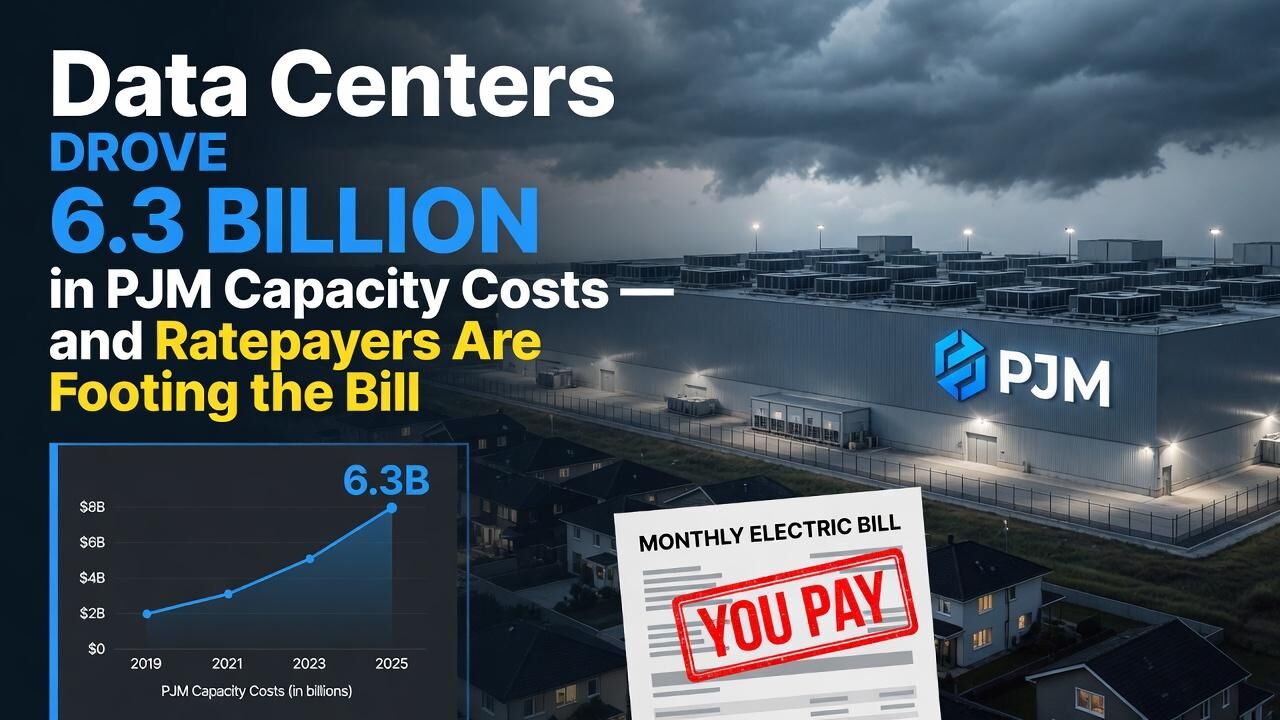
Data Centers Drove 6.3 Billion in PJM Capacity Costs — and Ratepayers Are Footing the Bill
The Number That Should Scare Every PJM Ratepayer
Here is a number that should stop you cold: 6.3 billion dollars. That is how much data center demand added to PJM Interconnection's latest capacity auction, according to Joseph Bowring at Monitoring Analytics — the grid operator's independent market monitor. In a single auction cycle, data centers accounted for 38 percent of the total 16.4 billion dollars in capacity charges. And that is not an anomaly. Over the last four auctions, data center-related costs totaled 29.4 billion dollars — 46 percent of the 63.6 billion dollars that PJM ratepayers across 13 states and the District of Columbia are on the hook for.
Let that sink in. Nearly half of what you are paying on your electric bill for capacity charges is tied to power plants and transmission lines built for data centers that — in many cases — have not even broken ground yet.
The Numbers Behind the Crisis
This is not theoretical. The data is stark:
- Latest auction (2028/2029 delivery year): 6.3 billion dollars attributed to data centers — 38 percent of 16.4 billion dollars total
- Last four auctions cumulative: 29.4 billion dollars attributed to data centers — 46 percent of 63.6 billion dollars total
- Forecast speculative costs: 6.2 billion dollars of the 2027/2028 auction costs relate to data centers that do not even exist yet
- Price trajectory: 28.92 dollars per megawatt-day in 2024 to 333.44 dollars per megawatt-day in 2027 — an 833 percent increase in four years
- Household impact: From roughly 2.30 dollars a month in capacity charges per household to 17.40 dollars — and the NRDC projects that could hit 70 dollars a month if left uncollared
These are not marginal adjustments. This is a structural transfer of wealth from every household in PJM's footprint to the power generation sector, driven by a single customer class: AI data centers.
Why This Matters for Infrastructure Builders
If you run servers in PJM territory — which covers everything from Chicago to Washington DC — you are feeling this directly. Your hosting bills are going up because your providers' power costs are going up. Your clients are asking why their monthly bill keeps climbing. And the answer is not inflation or fuel prices. It is data center demand that the market monitor says is distorting the entire capacity auction system.
Bowring was blunt about it: "PJM is continuing to act like it is business as usual. You have to open your eyes and recognize that it is really a paradigm shift." When the independent market monitor — whose job is literally to watch the numbers — says the grid operator is in denial, you should pay attention.
The White House Pledge That Is Not Working
Back in March, Google, Meta, Microsoft, Amazon, and others stood at the White House and signed a Ratepayer Protection Pledge. They promised to protect consumers from price hikes caused by data center energy demands. It sounded good in the press conference.
Bowring's assessment? Impossible under current PJM rules. "There is only one way to do what hyperscalers agree is the right thing to do, and that is to run a separate auction," he told Utility Dive. A separate auction for data centers would let hyperscalers buy their own capacity at their own price, while removing their load from the base auction that sets rates for everyone else. Good for them, good for ratepayers. Simple in concept. Politically messy in execution.
PJM's board is developing that backstop auction proposal, aiming to file with FERC this month for a September auction. But the stakeholder process has been slow, contentious, and the PJM staff proposal would only procure about 6.8 GW of capacity — likely not enough to take the price pressure off the base auction.
The Regulatory Reckoning Is Here
This is not just PJM. The broader regulatory picture is shifting fast:
- New York: Governor Hochul signed Executive Order 62 on July 14 — the first statewide data center moratorium in the nation, halting permits for new hyperscale facilities over 50 MW
- FERC: On June 18, the Commission gave six grid operators 60 days to justify or reform their large-load interconnection rules — deadline is roughly mid-August
- Virginia: A new GS-5 large-load tariff takes effect January 1, 2027, designed to shift grid upgrade costs from ratepayers to data center developers
- Morningstar DBRS: The credit ratings agency issued a report on July 20 warning that escalating stakeholder opposition — new taxes, restrictions, and moratoriums — could become a "material credit factor" for data center projects
The credit rating agencies are the canary. When Morningstar DBRS starts warning that community opposition threatens project financing, the industry has a problem that goes beyond public relations.
What This Means: The Market Is Telling Us Something
Here is the uncomfortable truth that nobody in the data center industry wants to say out loud: the current model is not sustainable. You cannot build 300+ megawatt facilities on a grid that was designed for a 20th-century load profile, expect residential ratepayers to absorb the grid upgrade costs, and pretend there will not be a political backlash.
The backlash is here. It is happening in New York with the moratorium. It is happening in Georgia where homeowners are fighting eminent domain seizures for transmission lines. It is happening in Virginia where new tariffs are shifting costs back to developers. And it is happening in PJM's capacity auction where the numbers have become so absurd that the market monitor is publicly calling for a structural redesign.
The question is not whether the system changes. The question is whether the industry leads that change or has it imposed on them by regulators who are tired of hearing from angry constituents whose electric bills have tripled.
What Comes Next
PJM's backstop auction proposal is the immediate next milestone. If it goes to FERC in September as planned, we will see a test case for whether separate auctions for data center capacity can actually work. If it gets bogged down in stakeholder fights — which is entirely possible — expect more states to follow New York's lead with their own moratoriums and ratepayer protection laws.
For infrastructure builders and hosting providers, the takeaway is straightforward: start budgeting for higher power costs. The days of stable, predictable electricity pricing in PJM territory are over. Whether the fix comes through market redesign, regulatory action, or both, the era of cheap grid power for data centers is done.
The 6.3 billion dollar question is who pays for what comes next. And right now, the answer is you.
— Allan Ali, Sylt.ing
===SUMMARY=== PJM's independent market monitor revealed data centers drove 6.3 billion dollars in the latest capacity auction costs — 38% of the total. With cumulative costs hitting 29.4 billion across four auctions, Allan breaks down what this means for ratepayers, hosting providers, and the infrastructure industry. Video commentary anchored by CNBC's interview with Hut 8 CEO Asher Genoot.
 English
 Arabic
 French
 Spanish
 Portuguese
 Deutsch
 Turkish
 Dutch
Dutch
 Italiano
 Russian
 Romaian
 Portuguese (Brazil)
 Greek
Greek