


 Monetization
New York's Data Center Moratorium: The AI Buildout Just Hit Its First Political Wall
What Just Happened
Watch New York Gov. Kathy Hochul discuss the moratorium in her own words — an ABC News Live interview that lays out the administration's thinking behind the order, the ratepayer concerns driving it, and what comes next for the state's data center pipeline.
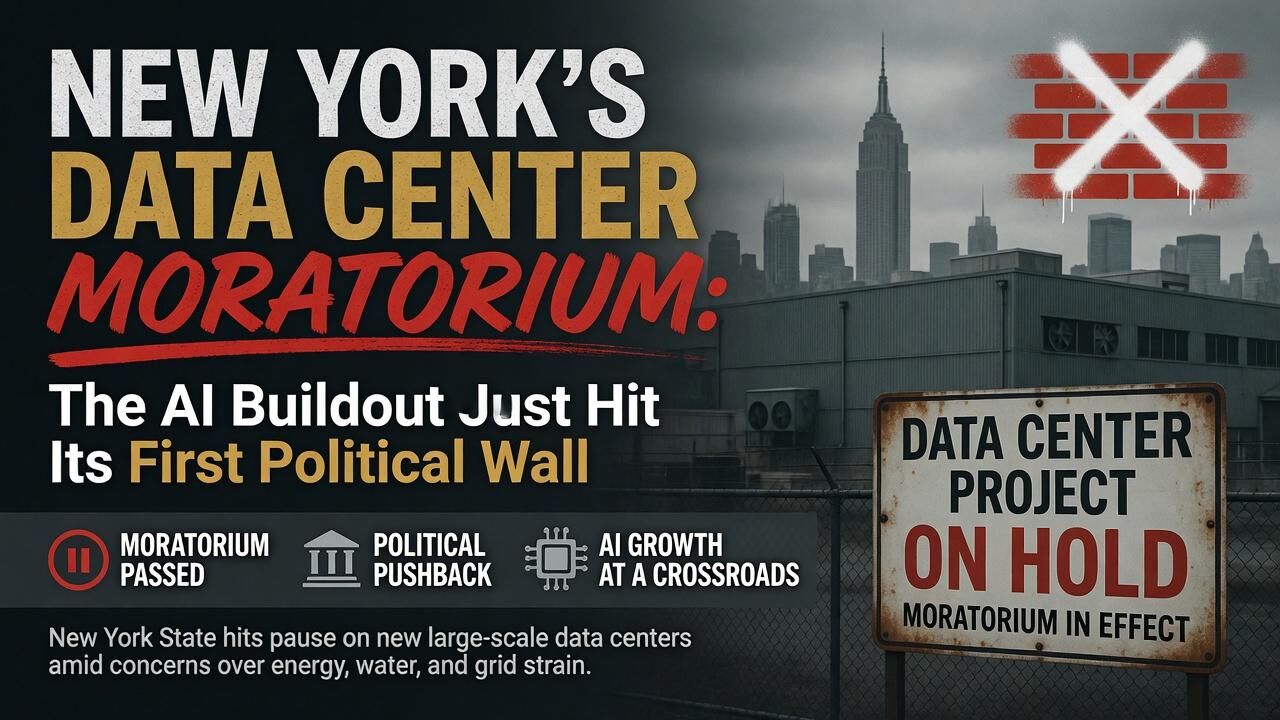
On July 14, New York Governor Kathy Hochul signed an executive order imposing a yearlong moratorium on the construction of new hyperscale data centers — the first statewide ban of its kind in the United States. The order targets any facility requiring more than 50 megawatts of power, freezing a pipeline worth an estimated $10 billion in development.
In her announcement, Hochul framed it as a ratepayer protection measure: "As data center development threatens to hike up utility bills, deplete our natural resources, and create uncertainty for New Yorkers, it's my responsibility to take action and lead." The language is explicitly distributional — this isn't a technology-skeptic argument, it's a who-pays argument. And that distinction matters, because it sets a template every other state with a strained grid is now watching.
The order directs New York's Department of Environmental Conservation to pause environmental permits for hyperscale projects while the Department of Public Service develops a Generic Environmental Impact Statement covering energy demand, water usage, and environmental standards. Existing facilities are untouched. Projects that already have all necessary permits proceed as planned. But anything still in the pipeline? Frozen.
The $10 Billion Question
The moratorium hits a data center pipeline that was just beginning to heat up. New York isn't Northern Virginia — it's not a dominant hyperscale market — but it has 148 existing data centers and an estimated 28 more under consideration. The executive order effectively zeroes out near-term growth for the state's largest power consumers.
The construction industry is furious, and for good reason. Mike Elmendorf, president and CEO of Associated General Contractors of New York State, told Construction Dive: "It effectively slams the door on those projects, and that sends a hell of a message to people looking to make huge investments in New York that maybe they should look twice." Carlo Scissura of the New York Building Congress said the move "will damage our state's economy, its workforce, and our competitive standing in the industries of tomorrow." Brian Sampson of the Associated Builders and Contractors called it "another missed opportunity for New York."
These are not abstract complaints. Data center construction has been the construction industry's golden goose in 2026 while most other sectors have faltered. The contractors who staffed up for hyperscale work — who turned down other projects to prepare — are now staring at a year of uncertainty.
The Permission Layer Activates
Gennaro Cuofano over at FourWeekMBA nailed the structural read: the binding constraint on AI infrastructure has migrated, in sequence, from chips to electrons to permits and political license. New York's moratorium is the first formal institutional expression of that third constraint. The Permission Layer just became real.
The numbers behind this are staggering. Goldman Sachs estimates the AI capex cycle at roughly $1 trillion. The Big Five hyperscalers — Amazon, Google, Meta, Microsoft, and Apple — are on track to spend approximately $725 billion on AI infrastructure in 2026 alone. That capital is being deployed against shared infrastructure: grids, water systems, transmission lines whose costs are socialized across ratepayers. When infrastructure spending reaches that scale, it attracts distributional politics. That is exactly what happened on July 14.
Hochul's order does not ban data centers permanently. It is an executive order — temporary, revisable, reversible by a subsequent administration. But the precedent it sets is the real story. As Cuofano put it: "The frictionless-siting assumption underneath trillion-dollar hyperscaler capex plans just became less certain everywhere, not only in New York."
What This Means: The Three Shockwaves
First, the buildout has hit its political-economy wall. Securing land and power generation — as Meta is doing with its $50 billion Project Hyperion in Louisiana and Google with Project Tembo in Wyoming — is necessary but no longer sufficient. Social license can be withdrawn by executive order on a Tuesday morning. Hyperscalers that built their siting strategies around permitting speed now have to model political risk as a first-order variable.
Second, the externality has become political. The $23 billion in electricity price increases already attributed to data center demand — documented by the PJM Market Monitor and reported in Fortune and The Conversation — now has a political name. Hochul explicitly linked data center growth to higher utility bills, depleted natural resources, and grid uncertainty. That framing will gain traction in every state with a tight grid and a rate-sensitive electorate.
Third, precedent reprices siting risk everywhere. New York is not protecting an existing data center hub — it is setting a template: an executive order, a 50 MW threshold, a multi-domain standards process, and a ratepayer-harm rationale. Other governors in capacity-constrained states now have a replicable playbook. The question is not whether more states will follow — it's which one is next.
The Ratepayer Trap
While the moratorium story dominates headlines, the underlying cost-allocation problem is arguably more significant — and far harder to fix. A Fortune article co-published with The Conversation on the same day as the order laid out the mechanics: data center cost allocation is broken, and residential ratepayers are the ones getting stuck with the bill.
Theodore J. Kury from the University of Florida explains that when utilities invest in new infrastructure — substations, transmission lines, generation capacity — those costs get allocated across customer groups. Data centers, with their sophisticated load-management systems, can fine-tune consumption to avoid contributing to coincident peak demand, the metric used to allocate many grid costs. Residential customers cannot do the same. The result is a structural bias in rate-setting that shifts costs from hyperscalers to households.
Every state except Georgia, Idaho, and Louisiana has a consumer advocate to represent residential customers in utility proceedings. But these advocates are often legally barred from taking positions on how costs should be allocated between customer groups. So while data centers hire expert cost-allocation consultants to argue for minimal cost allocation to them, no one is structurally empowered to argue the opposite on behalf of households. The system is not rigged — it's worse. It was designed for an era before single customers consumed 50+ megawatts.
What Comes Next
The order gives New York's regulators up to a year to write binding standards. The New York State Legislature passed a broader bill setting a 20 MW threshold last month, but it hasn't reached Hochul's desk yet. Whether the executive order gets codified into permanent law — or challenged in court — will shape the next phase of this story.
But the bigger picture is not about New York. It's about the signal this sends to every other state. Twelve states have now filed data center moratorium bills in 2026. Maine came within a veto of passing one. Georgia is debating whether to phase out data center tax credits. Counties across Virginia are slowing approvals. The nationwide community opposition movement that coalesced into coordinated protests on July 18 — with demonstrations from New Jersey to Utah — shows that the political energy behind these fights is not going away.
Hyperscalers have responded by going nuclear — literally. Microsoft signed a deal to restart Three Mile Island. Google and Amazon are buying into small modular reactors. Meta is investing $50 billion in a Louisiana campus with dedicated behind-the-meter gas generation. But these are private solutions to a public infrastructure problem. Securing your own power doesn't solve the ratepayer question, the water question, or the land-use question. The Permission Layer doesn't have a private workaround.
New York's moratorium is the first domino. It will not be the last. The AI infrastructure buildout just learned that building is easy. Getting permission is the hard part now.
— Allan Ali, Sylt.ing
===SUMMARY=== New York Governor Hochul signed the first US statewide moratorium on hyperscale data centers (50+ MW), freezing a $10B pipeline. The move signals a new political-economy constraint on AI infrastructure as siting risk reprices everywhere. Permission, not power, is now the bottleneck.
 Deutsch
 English
 Arabic
 French
 Spanish
 Portuguese
 Turkish
 Dutch
Dutch
 Italiano
 Russian
 Romaian
 Portuguese (Brazil)
 Greek
Greek