


 Monetization
New York Just Froze the AI Data Center Buildout: What the Nation's First Statewide Moratorium Means
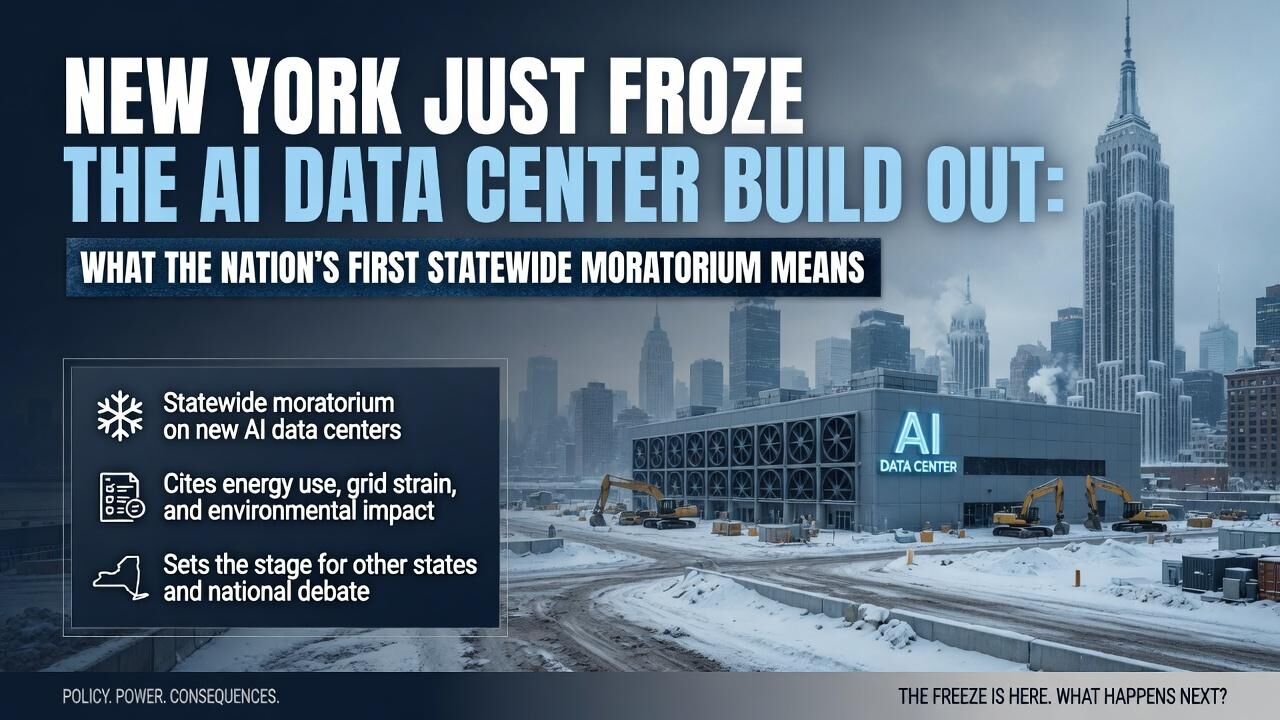
The Order: What New York Actually Did
On July 14, 2026, New York Governor Kathy Hochul signed an executive order that stops being hypothetical and starts being real. The nation's first statewide moratorium on large data center construction is now law — or at least, as close to law as a governor's signature on an executive order gets.
The order immediately pauses state environmental permitting for any data center with a peak load of 50 megawatts or more. The pause runs for up to one year while the Department of Environmental Conservation writes a statewide Generic Environmental Impact Statement — a single framework setting consistent standards for energy demand, water use, and air quality that replaces the current patchwork of local decisions. The order also directs the state to give localities guidance on negotiating community benefits within 60 days, and signals that operators should expect to pay a premium for the extra power they consume rather than pushing those costs onto residential ratepayers.
Hochul's own framing was blunt. Data center development, she said, 'threatens to hike up utility bills, deplete our natural resources, and create uncertainty for New Yorkers.' That is a ratepayer-first argument, not a technology-skeptic one — and the distinction matters.
The order does not touch existing facilities. It does not ban data centers permanently. And it has not been codified into legislation — the legislature's own bill, the Responsible Data Center Development Act, which passed the Senate 44-16 and the Assembly 102-39 with a stricter 20 MW threshold, still sits on Hochul's desk unsigned. She called it complex and said it needs more work. In the meantime, the executive order is the law of New York's land, and it went into effect the moment she signed it.
The $10 Billion Question
The direct economic impact is not small. New York has roughly $10 billion in data center projects in its pipeline, according to Bisnow, much of it still in early planning stages. That pipeline now faces an indefinite permitting pause. The projects that haven't received environmental approval are frozen. The ones that have can still proceed, but the clock on their certainty just started ticking.
Business groups are already pushing back. The Democrat and Chronicle ran an op-ed calling the moratorium 'profoundly deleterious,' warning of lost investment, fewer jobs, diminished tax revenue, and what they termed 'potentially forgone life-saving innovations.' The argument is familiar: regulation kills progress. But the counter-argument, which carried the day in Albany, is that uncontrolled progress kills affordability — and affordability is what voters actually feel in their monthly bills.
New York is not a dominant hyperscale market. Northern Virginia, Dallas, Phoenix, and Silicon Valley absorb the bulk of US data center capacity. The immediate capacity impact of a New York pause on the national AI buildout is small. The precedent is what keeps tech executives up at night.
Why This Matters Outside New York
Moratoriums on data centers have been proposed in at least a dozen states. Almost all stalled. Maine came closest earlier this year before Governor Janet Mills vetoed the measure, worried it would block a project in a town hit hard by a mill closure. Counties and municipalities have imposed their own temporary bans, but no state had drawn a statewide line — until now.
What changed is the politics. Data centers were once an economic-development trophy. States competed to land them with tax breaks and fast-tracked permits. Consumers Union, the AARP, and local ratepayer advocacy groups didn't show up at those ribbon cuttings. Now they do. The power and water these facilities consume have collided with voters' utility bills, and affordability has become the dominant electoral issue in more states than data center operators want to admit.
New York's move gives every other governor a template to copy. The mechanism is straightforward: an executive order, a MW threshold, a multi-domain standards process covering energy, water, and environment, and a ratepayer-harm rationale. Any governor in a capacity-constrained state can now pick up that playbook and run with it. That is why the tech industry is watching a state that barely hosts hyperscale capacity so closely.
Food & Water Watch, the environmental group, called the order 'a huge step forward for New York communities fighting against an onslaught of massive data center proposals.' If that language sounds like it could be echoed in Virginia, Ohio, Georgia, or Texas — the states that actually host the buildout — that is because it already is.
The Grid Is Already Breaking
The New York order didn't happen in a vacuum. The grid constraints that justify it are visible in real time across the country.
On June 11, 2026, the Department of Energy issued an emergency order under Section 202(c) of the Federal Power Act — a 1935 law — allowing Duke Energy to run its power plants at maximum output across the Carolinas, temporarily setting aside air quality and environmental permit limits to prevent rolling blackouts. The order cited high temperatures and grid strain. Data center load is a measurable driver of that strain.
Meanwhile, PJM Interconnection, the nation's largest grid operator serving 65 million people across 13 states, held its capacity auction for 2026/2027 and saw clearing prices hit $329 per megawatt-day — up from roughly $29 per megawatt-day just two years ago. That is an 11x increase. PJM's Independent Market Monitor explicitly identified data center demand as the primary driver. The auction also fell roughly 6,600 MW short of PJM's reliability target. That shortfall means the grid is pricing scarcity, and every household and business in the PJM footprint will feel it in their electricity bills.
The Citizens Utility Board called these sustained high prices a 'ramp-up in urgency for data center reform.' A 60% jump in electricity prices on the largest US grid, driven by data center demand, has a way of focusing the political mind.
What This Means: The System Is Working Exactly as Designed
Here is the uncomfortable truth the tech industry does not want to confront: the political system is responding exactly as it should to a trillion-dollar capital cycle that is now large enough to constitute a measurable share of US economic output.
Goldman Sachs estimates ~$1 trillion in AI-related capex over the next several years. That is a supply-side number. The demand-side reality is that this capital is being deployed against shared infrastructure — grids, water systems, transmission lines — whose costs are socialized across ratepayers. When infrastructure spending reaches that scale, it attracts distributional politics. That is not a bug. It is the feature.
Hochul's order explicitly frames AI infrastructure spending as a distributional question: who pays, and how much. The binding constraint on the AI buildout has moved in sequence — from chips, to electrons, to permits and political license. New York's order is the first formal institutional expression of that third constraint. The frictionless-siting assumption underneath trillion-dollar hyperscaler capex plans just became less certain everywhere, not only in New York.
This is also the moment when the affordability argument beat the environmental argument. Hochul did not cite carbon emissions or climate impact in her executive order. She cited utility bills, water depletion, and uncertainty for New Yorkers. The left and the right are converging on the same conclusion from different premises: data centers cost communities money, and someone needs to pay for the grid capacity they consume.
The Data Center Power Crisis in Numbers
For those who prefer data to rhetoric, the numbers paint a stark picture:
- Global data center electricity consumption is on track to hit 565 TWh in 2026, up 26% year-over-year per Gartner. AI-optimized servers alone account for 31% of that total and will surpass conventional servers by 2027.
- US data center power demand is projected to reach 106 GW by 2035, up from roughly 20 GW today — a 5x increase in under a decade.
- The PJM capacity auction clearing price for 2026/2027 hit $329/MW-day, up from ~$29/MW-day two years prior — an 11x increase, with data centers identified as the primary driver.
- PJM's auction fell 6,600 MW short of its reliability requirement, a shortfall directly attributed to data center-driven demand growth.
- The DOE has issued multiple Section 202(c) emergency orders in 2026 alone — to Duke Energy in the Carolinas, to ERCOT in Texas, to PJM and NYISO — all citing grid stress to which data center load is a measurable contributor.
- New York's $10 billion data center pipeline is now frozen, but the 12 other states with active moratorium proposals represent a far larger share of planned hyperscale capacity.
These numbers are not abstract. Every megawatt of data center load that gets added to an already-strained grid is a cost that someone bears. The question the New York moratorium forces — and the question every other state is now asking — is whether that someone should be shareholders or ratepayers.
What Comes Next
The next twelve months will determine whether New York's moratorium is a one-off or the first domino. The state's Department of Environmental Conservation has 12 months to produce the Generic Environmental Impact Statement that will set the permanent standards. If those standards become a national template — and the ratepayer-protection principle embedded in them spreads to Virginia, Ohio, Georgia, and Texas — the economics of the hyperscale buildout change fundamentally.
For operators, the message is clear: self-generate or pay the premium. The days of pulling grid power at residential rates are ending. Microsoft, Google, Amazon, and Meta are already moving in this direction — Meta's nuclear agreements with TerraPower and Oklo totaling 6.6 GW, Google's Project Tembo in Wyoming, Meta's Project Hyperion in Louisiana. But private power procurement solves the electricity problem; it does not solve the political problem. Social license cannot be bought with a PPA.
For the rest of us, the message is equally clear: the AI buildout is no longer someone else's problem. The data centers powering the models we use every day are consuming resources that belong to all of us, and the political system is finally starting to ask whether the price is right. New York asked first. It will not be the last.
The grid was already breaking before AI arrived. AI just made it impossible to ignore.
— Allan Ali, Sylt.ing
===SUMMARY=== New York Governor Kathy Hochul signed the nation's first statewide data center moratorium on July 14, 2026, freezing permits for 50 MW+ facilities for up to one year. The order signals a political shift: AI infrastructure's externalities have become a ratepayer issue, not just an environmental one. With PJM capacity prices up 11x, DOE emergency orders piling up, and 12+ states eyeing similar restrictions, the era of frictionless hyperscale siting is over. Allan Ali breaks down what the moratorium means, why the grid was already breaking, and what comes next for the trillion-dollar AI buildout.
 Spanish
 English
 Arabic
 French
 Portuguese
 Deutsch
 Turkish
 Dutch
Dutch
 Italiano
 Russian
 Romaian
 Portuguese (Brazil)
 Greek
Greek