


 Monetization
Eminent Domain for AI: When the Government Takes Your Land for Data Center Power Lines
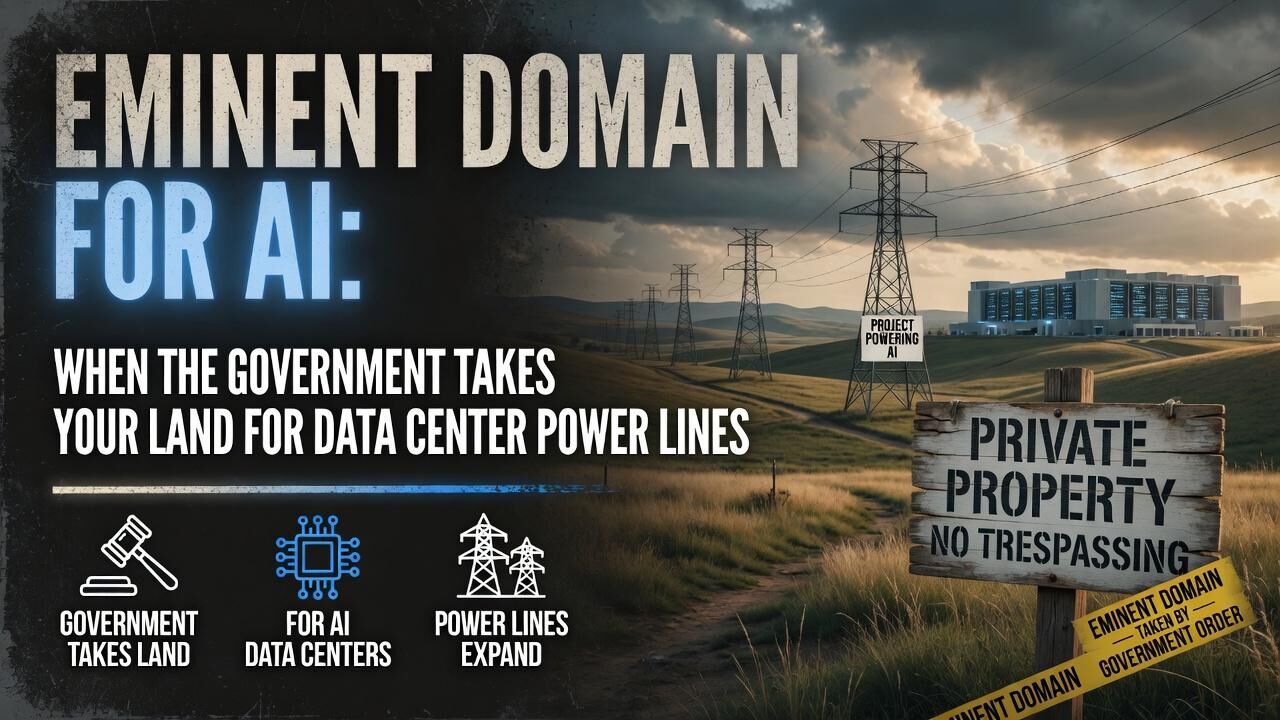
The Video: Georgia Homeowners Face an Impossible Choice
Watch this CBS Mornings segment first. It's six and a half minutes that capture everything wrong with how we're building AI infrastructure in America. Skyler Henry reports from rural Georgia where homeowners like Ansley Brown are being told: sell your family's land, or the state will take it. The buyer? Georgia Power. The purpose? Transmission lines for AI data centers. The families being displaced don't even know which tech companies will benefit — Georgia Power refuses to name its customers, citing 'safety and security.' As Brown put it: 'To us, it's theft. It's literally a billion-dollar company stealing land from smaller people.'
300 Parcels, 35 Miles, One Utility
Here are the numbers that matter. Georgia Power is building a 35-mile transmission line across rural Georgia. The project requires acquiring more than 300 separate land parcels. Some homeowners accepted the utility's offers. Others are fighting. By Georgia Power's own admission, 70 to 80 percent of the electricity this line carries will go to data centers — not to homes, not to schools, not to hospitals. The remaining 20 to 30 percent serves general residential and commercial demand.
That ratio is the whole story. When a utility uses eminent domain — the government's constitutional power to seize private property for 'public use' — the question is whether a transmission line that primarily serves private data centers qualifies. Ansley Brown's mother, facing the prospect of eminent domain proceedings against a billion-dollar company with a legal team on retainer, eventually accepted the terms to avoid the process. 'My mom wants an apology from Georgia Power. That's it,' Brown said. No apology has been issued.
This isn't isolated to Georgia. In Pennsylvania, NextEra is facing opposition over the Mid-Atlantic Resiliency Link transmission line. In Oregon, regulators upheld approval for a transmission line that may serve a single data center. In Indiana, Meta has a data center campus drawing 1,200 megawatts. The pattern is national.
The Legal Framework: Can a Data Center Count as 'Public Use'?
The Fifth Amendment's takings clause says the government can take private property for 'public use' with 'just compensation.' But the Supreme Court has interpreted 'public use' broadly. In the 2005 case Kelo v. City of New London, the court held that economic development qualified — allowing the city to seize homes for a private development around a Pfizer facility. That redevelopment never happened, and Pfizer eventually left. The public backlash was immediate. Forty-five states enacted eminent domain reform laws in response.
But here's the catch: those reform laws don't block utilities. Governments can delegate eminent domain power to 'common carriers' — power companies, water utilities, pipeline operators. Every state has its own rules. Texas requires that a project 'serve the public' and 'cannot be built only for the builder's exclusive use.' South Dakota and Vermont have affirmed seizures by power companies, determining that grid reliability qualifies as public use. But the Mississippi Supreme Court rejected a condemnation in 1984 because the transmission line would have crossed state lines without benefiting in-state customers.
The legal argument that could stop this: if a transmission line mostly serves data centers owned by out-of-state corporations, does it actually serve the public of that state? That question hasn't been settled. And until it is, utilities are building fast.
45 States Reformed Eminent Domain After Kelo — But It's Still Happening
This is the part that should make you angry. Forty-five states passed reform laws after Kelo specifically to prevent private property from being taken for private economic development. Yet here we are, two decades later, watching a utility use that same power to take land for AI data centers. The reform laws didn't close the utility delegation loophole. Power companies can still exercise eminent domain because courts have historically treated grid infrastructure as 'public use' by default.
What's changed is the scale. The AI boom has created electricity demand that the existing grid wasn't built for. Data centers used more than 4 percent of total U.S. electricity in 2024, according to Pew Research. That number is climbing fast. To meet it, utilities need new transmission lines. And new transmission lines need land. And when landowners say no, the utility reaches for the legal hammer it already holds.
What This Means: The AI Boom's Hidden Cost
Every conversation about AI infrastructure focuses on the visible numbers: the $700 billion in hyperscaler capex projected for 2026, the megawatts consumed, the gigawatt-scale campuses being built. What doesn't get discussed is the invisible cost — the land, the families, the communities being asked to absorb the externalities of a technology boom they may never benefit from.
Georgia Power won't even name its data center customers. The families losing their land don't know whether it's for OpenAI, Google, Meta, or someone else entirely. The utility cites 'safety and security.' What that actually means is that the public relations cost of naming the beneficiaries is higher than the legal cost of the takings. The asymmetry is stark: a regulated monopoly with state-delegated condemnation authority against families whose best defense is a TikTok account.
This is not an accident. It's the system working exactly as designed. Utility law was built for an era when transmission lines served the general public. The AI boom has bent that framework past its breaking point, and the people caught in the gap are rural landowners with limited legal resources.
The Data Center Power Crisis in Numbers
To understand why this is happening everywhere, look at the macro numbers. Hyperscalers confirmed more than $130 billion in capital expenditure in Q1 2026 alone — Alphabet, Amazon, Meta, and Microsoft combined. The full-year projection is $700 billion. Data centers accounted for over 4 percent of U.S. electricity in 2024. There are more than 3,000 data centers operating in the U.S. and another 1,500 in development, per Pew Research. And polling from Gallup shows that 7 in 10 Americans oppose AI data centers in their communities — citing higher utility bills, pollution, noise, and loss of green space.
The power demand is real. The opposition is real. The legal framework was not designed for either the scale of the demand or the intensity of the resistance. Something has to give, and right now, it's the families in rural Georgia.
What Comes Next
The Federal Energy Regulatory Commission has yet to issue guidance specific to AI-driven load growth. Several state utility commissions have begun examining whether the public interest standard for eminent domain should account for the proportion of capacity going to private commercial customers versus general residential service. Georgia has not yet reached that question formally. It will have to.
For now, the legal asymmetry will continue to favor the utility. But the political math is shifting. When 70 percent of Americans oppose data centers in their communities, and eminent domain stories like this one keep surfacing, the pressure on state legislatures will grow. The 45 states that reformed eminent domain after Kelo can reform it again — this time to close the utility delegation loophole. The question is whether they'll do it before more families are displaced.
Watch the CBS Mornings segment above. It's six and a half minutes, and it tells you more about the real cost of AI infrastructure than any industry report will.
— Allan Ali, Sylt.ing
===SUMMARY=== Georgia Power is using eminent domain to seize 300+ rural parcels for transmission lines feeding AI data centers. Families face displacement, utilities refuse to name customers, and the legal framework can't keep up. A CBS Mornings investigation exposes the human cost of America's AI infrastructure buildout.
 Arabic
 English
 French
 Spanish
 Portuguese
 Deutsch
 Turkish
 Dutch
Dutch
 Italiano
 Russian
 Romaian
 Portuguese (Brazil)
 Greek
Greek