


 Monetization
AI Data Centers Are Using Eminent Domain to Take Your Land — And It's Only Getting Worse
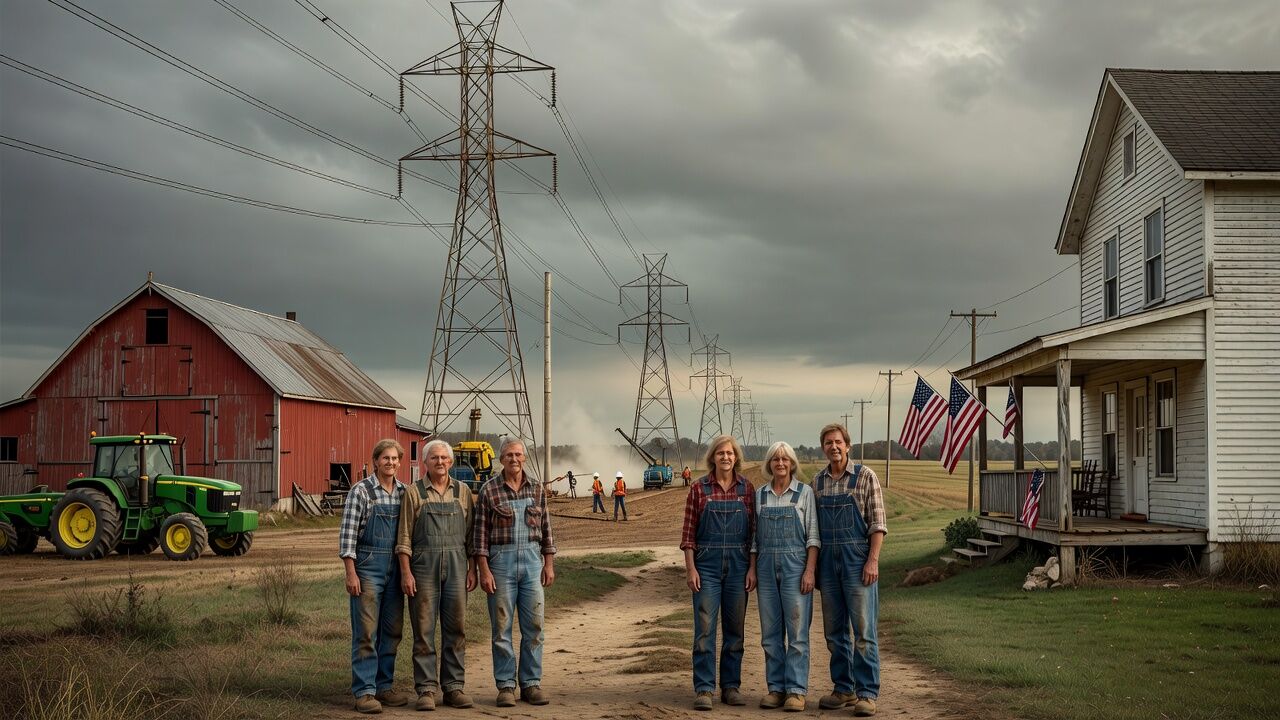
The Land Grab You Haven't Heard About
If you own land in rural America, pay attention. The AI data center boom is coming for your property — and your government is helping them take it. Across at least three states this month alone, families are getting letters, surveyors are showing up on their land, and utility companies are invoking a legal power originally intended for building roads and schools: eminent domain.
The math is simple. AI data centers consume staggering amounts of electricity — a single facility can draw 1,200 megawatts, nearly twice the residential power usage of an entire metro area. But the transmission lines to deliver that power don't exist yet. So utilities are building them, and they're using state-backed condemnation powers to run those lines straight through private farms, homesteads, and family properties built up over generations.
Georgia: 300 Parcels and Counting
Georgia Power is in the midst of what might be the most aggressive eminent domain campaign linked to AI infrastructure in the country. The utility is acquiring more than 300 rural parcels for a new transmission line. By their own admission, 70 to 80 percent of the capacity on that line will go directly to data centers — not to residential customers, not to schools or hospitals, but to private tech companies running AI workloads.
Ansley Brown's family is one of the affected households. Her mother's property sits along the planned route. "To us it's theft," Brown told CBS News. "It's literally a billion dollar company stealing land from smaller people, people who can't fight back." After finding no coordinated response from local officials, Brown started posting affected residents' stories on TikTok. The utility, Georgia Power, says eminent domain is "always a last resort" — but the families being displaced don't see it that way.
Georgia Power declined to identify which companies will receive the electricity from the new line, citing "safety and security." That means homeowners having their land condemned don't even know which billion-dollar corporation benefits from their loss.
Indiana: Google's 1,200MW Campus
About 500 miles northwest, a similar fight is playing out in Morgan County, Indiana. Google is building a data center campus on more than 550 acres of former farmland near Monrovia. AES Indiana wants a new high-voltage transmission line roughly 10 miles long to feed it — with steel poles up to 195 feet tall and a permanent easement 200 feet wide slicing across private homes and farms.
The families in the way include Paul Slagle, a pastor and restaurant owner whose 26 acres hosts hundreds of people every year for community gatherings and the annual Independence Day fireworks show over Shadow Lake. "We've worked so hard to create a little patch of heaven for our family and friends to enjoy," Slagle told the Indianapolis Star. "It's been a dream come true. Now it's all in jeopardy."
Others include Shannon Glaze Skyles, whose 20-acre property would be bisected by the line, destroying its value completely. And Otis Pugh, a disabled combat veteran, whose 77-acre nonprofit hunting and fishing preserve for disabled veterans would be split in half — killing duck blinds, shooting houses, and the oldest trees where eagles roost.
Ohio: The One That Got Away
But there's one case where the families actually won — and it tells you everything about how this system works. In Wood County, Ohio, the Luidhardt family has been farming for at least three generations. When Will-Power, the pipeline affiliate of the Meta data center being built in Middleton Township, came asking for their 40 acres to run a natural gas pipeline, they said no.
The family reached out to Maurice Thompson of the 1851 Center for Constitutional Law, who filed a motion to intervene with the Ohio Power Siting Board. His argument was straightforward: Ohioans' private property cannot be taken simply to benefit purely private corporate projects. "This is redistribution of wealth of the worst sort — taking property from regular Ohioans and giving it to California billionaires for their own benefit, under the false pretense of progress," Thompson wrote.
Will-Power had an offer on the table: some landowners were being offered as much as $200,000 an acre. "They offer an insane amount of money and a lot of people have sold out," Jon Luidhardt said. "Money isn't an object to them, and they don't care about family history." But in this case, the pressure worked. After Thompson's motion, Will-Power removed the Luidhardt property from the pipeline route and redrew their map around it.
"They finally had someone stand up to them," Luidhardt said.
What This Means: The System Is Working Exactly as Designed
The uncomfortable truth is that none of this is illegal. Eminent domain is the government's constitutional power to take private property for "public use" with "just compensation." But the definition of "public use" has stretched to include transmission lines that serve a single private customer. In Indiana, AES can deposit the appraisal money with the court and take possession of your property while you are still fighting over the price in court.
Georgia Power's spokesperson said the company has "worked hard to be transparent" — but won't name which data centers the line will serve. In Ohio, the power plant was fast-tracked because it operates "behind-the-meter," serving only Meta's data center, not the grid. No public hearings were held.
This is what happens when your power grid wasn't built for AI. The existing transmission infrastructure can't handle the load, so utilities are playing catch-up. And the people paying the price — literally and figuratively — are the families who happen to live on the path of least resistance.
The Data Center Power Crisis in Numbers
The scale of the demand is staggering. Google's Indiana data center alone could draw up to 1,200 megawatts — nearly twice the power of every AES residential customer in Central Indiana combined — and consume 4 million gallons of water per day. Meta is building similar facilities across the Midwest. The U.S. has more than 3,000 data centers already online with another 1,500 in development, according to Pew Research. And every single one of them needs power lines, water pipes, and land access that someone already owns.
Ohio has seen a proposed constitutional amendment to ban data centers, though it won't make this year's ballot. Indiana's legislature is debating eminent domain reform. Georgia's Public Service Commission hasn't formally addressed the question of whether the "public interest" standard applies when most of the power goes to private AI companies. The Federal Energy Regulatory Commission has yet to issue AI-specific guidance on transmission planning.
What Comes Next
This is going to get worse before it gets better. The AI buildout isn't slowing down — it's accelerating. Every major hyperscaler has billions in capex committed for 2026 and 2027. Every dollar of that spending requires power, and every new transmission line requires land.
The property rights battle over AI infrastructure is just beginning. The questions being tested in Georgia, Indiana, and Ohio will define who shoulders the cost of this transition. If you own land near any proposed data center or transmission corridor, the system is not designed to protect you. It is designed to take what it needs and compensate you later.
The Luidhardts got lucky — they had a lawyer who knew the system and a pipeline company that blinked. But most families don't have a constitutional law attorney on speed dial. And as the AI data center boom spreads from Georgia to Indiana to Ohio and beyond, more families are going to get letters they never expected.
Watch the video above. Share this article. And if you live in a state where data center buildout is happening, start paying attention to your local utility commission meetings. Because by the time the surveyors show up, it's already too late.
— Allan Ali, Sylt.ing
===SUMMARY=== Across Georgia, Indiana, and Ohio, utility companies are using eminent domain to seize private land for transmission lines and pipelines serving AI data centers. Georgia Power is taking 300+ parcels, AES Indiana is building 195-foot towers through farms for Google, and Meta's pipeline affiliate faced down only after a family lawyer intervened. The AI buildout is accelerating, and property owners are the ones paying the price. Greek
Greek
 English
 Arabic
 French
 Spanish
 Portuguese
 Deutsch
 Turkish
 Dutch
Dutch
 Italiano
 Russian
 Romaian
 Portuguese (Brazil)