


 Monetization
The Data Center Rebellion: 30 Billion in Projects Blocked as Communities Push Back
The Rebellion Is Real — and It's Bipartisan
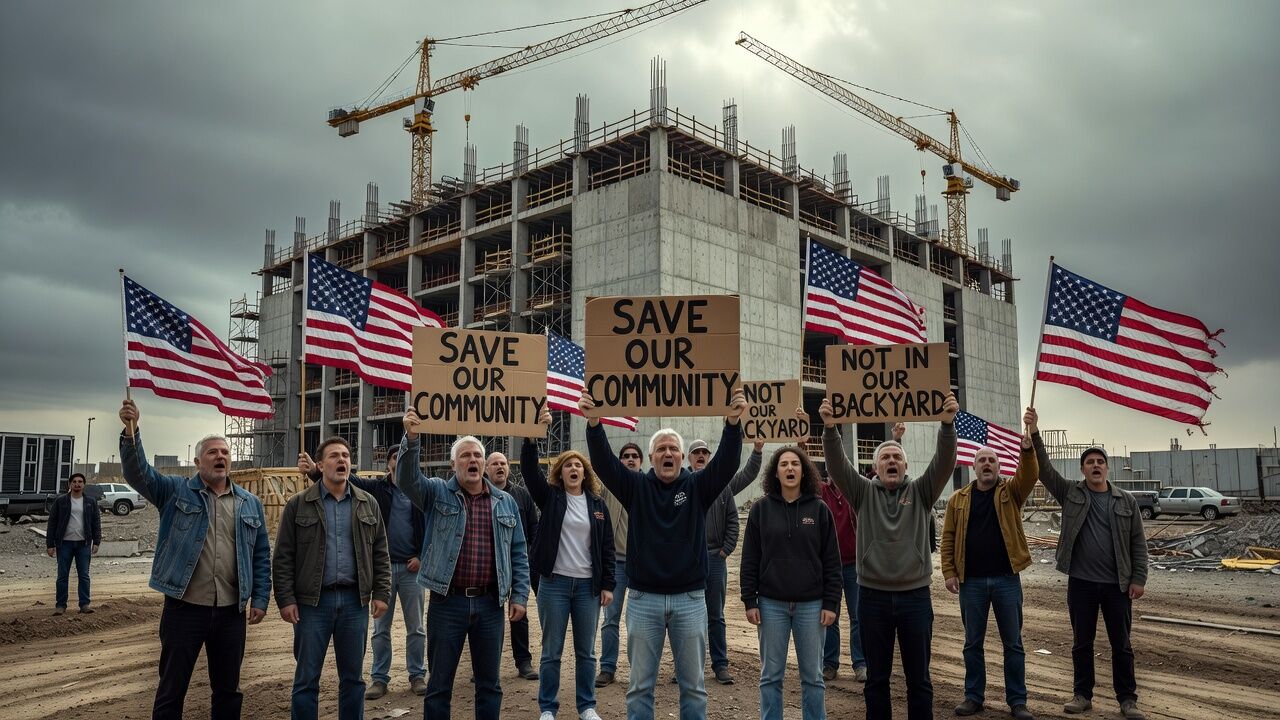
On Saturday, July 18, Americans from Wasilla, Alaska, to Naples, Florida, showed up in force. More than 100 coordinated protests organized by Humans First, a conservative-led nonprofit, targeted AI data centers in nearly every state. Texas alone had 18 demonstrations scheduled. In Kenilworth, New Jersey — a borough of 8,500 residents — a $1.8 billion data center project faced a crowd with signs, whistles, drums, and colored chalk, undeterred by heavy rain.
"The data center boom has been sold as inevitable," wrote Amy Kremer, Humans First founder and longtime grassroots organizer, on X. "It is not."
She's right. And the numbers back her up.
$130 Billion Blocked in Three Months
Data Center Watch, a tracking project from AI intelligence firm 10a Labs, reported that organizers blocked or delayed at least 75 projects nationwide worth approximately $130 billion from January through March 2026. That's the most disruptive quarter since tracking began in 2023 — and it nearly matches the $156 billion total for all of 2025.
This is not a cyclical spike. It's a structural shift.
The number of active opposition groups has more than doubled to 833 across 49 states. Communities have internalized a playbook: show up at planning board meetings, file petitions, swarm public hearings, and take legal action. In some cases, researchers found, opposition mobilized before any project was officially filed — the mere rumor of a data center was enough to trigger organized resistance.
The Strange Politics of 'Not in My Backyard'
What makes this moment fascinating is the political alignment. This isn't a liberal-vs-conservative fight. In North Carolina, sociologist Tressie McMillan Cottom spent time with organizers and noted that people are "crossing political divides" to oppose local construction projects. They're attending "political education sessions about water rights, land use, and thermodynamics."
Humans First is led by Amy Kremer, a Tea Party veteran and Women for Trump cofounder. Her message is framed as "America First" — American data, American energy, American land, but no American voice in how the technology is deployed. At the same time, progressive Reps. Alexandria Ocasio-Cortez and Bernie Sanders have called for a nationwide moratorium on data center construction.
When a MAGA organizer and AOC agree on something, you know the issue has cut through.
The Economics Cut Both Ways
Proponents of data center expansion point to real success stories. In Loudoun County, Virginia, 53 million square feet of data centers occupy about 3% of the county's land area — yet generate a projected $1.3 billion in property tax revenue in 2026, roughly half the county's total. In Louisiana, Meta's data center project in Richland Parish more than doubled the local sales and use tax, funding $50,000 teacher bonuses.
Those are not small numbers. Scott Franklin, a director of the parish's chamber of commerce who sold his land to Meta for the project, told the Wall Street Journal: "Anybody that complains about teachers getting a $50,000 check, they just instantly lose all credibility with me."
But for every Loudoun County, there's a community worried about rising electricity bills, strained water resources, noise, and the disappearance of residential land. Data center electricity consumption hit 565 TWh in 2026, up 26% year over year, per Gartner. AI-optimized servers alone account for 31% of that figure. A single training cluster can draw as much power as 100,000 households.
The question communities are asking isn't "do we want AI?" — it's "do we want this facility in our backyard, and what do we get in return?"
What This Means for AI Infrastructure
Here's where the rubber meets the road for anyone running servers or building in this space. The AI industry is hitting a physical constraint that no amount of software optimization can solve: you cannot build a data center in a community that doesn't want one.
This is not about nimbyism. It's about the collision of hyperscale buildout timelines with democratic processes. A data center takes 18 to 36 months from approval to operational — and that clock doesn't start until the community signs off. When 75 projects worth $130 billion stall in a single quarter, the downstream effect ripples through the entire AI supply chain: GPU orders, fiber runs, substation construction, cooling systems, and the software companies waiting to deploy on that capacity.
The industry is already responding. In Utah, one developer vowed to handle all communications personally after backlash reduced the approved land area for a site by 50%. In Illinois, Governor J.B. Pritzker is pushing for a "legislative framework for responsible data center development" with proper environmental reviews. OpenAI, meanwhile, published a report claiming China is trying to influence the U.S. data center debate by using ChatGPT to generate memes and social media comments — a sign that the industry is getting defensive.
What Comes Next
The midterm elections are looming, and data center opposition is expected to be a live issue. Both parties are still figuring out their messaging — the money flowing in from tech's political action committees makes it complicated. But the grassroots genie is out of the bottle.
The AI industry spent the last three years in a land grab, announcing multi-billion dollar campuses and nuclear power deals with the assumption that communities would welcome the economic boon. That assumption is no longer safe. The next phase of AI infrastructure buildout won't be determined by who has the best GPU — it'll be determined by who can navigate zoning boards, public hearings, and community organizing.
In my line of work — running servers, planning capacity, deploying infrastructure — this is the variable nobody modeled three years ago. It's time to start.
The playbook is written. The opposition has organizational talent from both ends of the political spectrum. And the data is clear: AI's infrastructure problem isn't just about chips and power. It's about people.
— Allan Ali, Sylt.ing
===SUMMARY=== Data center opposition has hit record levels in 2026 — $130 billion in projects blocked or delayed in Q1, 833 grassroots groups across 49 states, and nationwide protests on July 18. The bipartisan backlash is reshaping where and how AI infrastructure gets built, and the industry can no longer assume communities will welcome facilities. Real estate, regulation, and local politics are now the bottleneck. Spanish
 English
 Arabic
 French
 Portuguese
 Deutsch
 Turkish
 Dutch
Dutch
 Italiano
 Russian
 Romaian
 Portuguese (Brazil)
 Greek
Greek