


 Monetization
The Data Center Revolt Goes National: 142 Protests, 42 States, and a Movement That Blocked 286 Billion
The Revolt That Went National
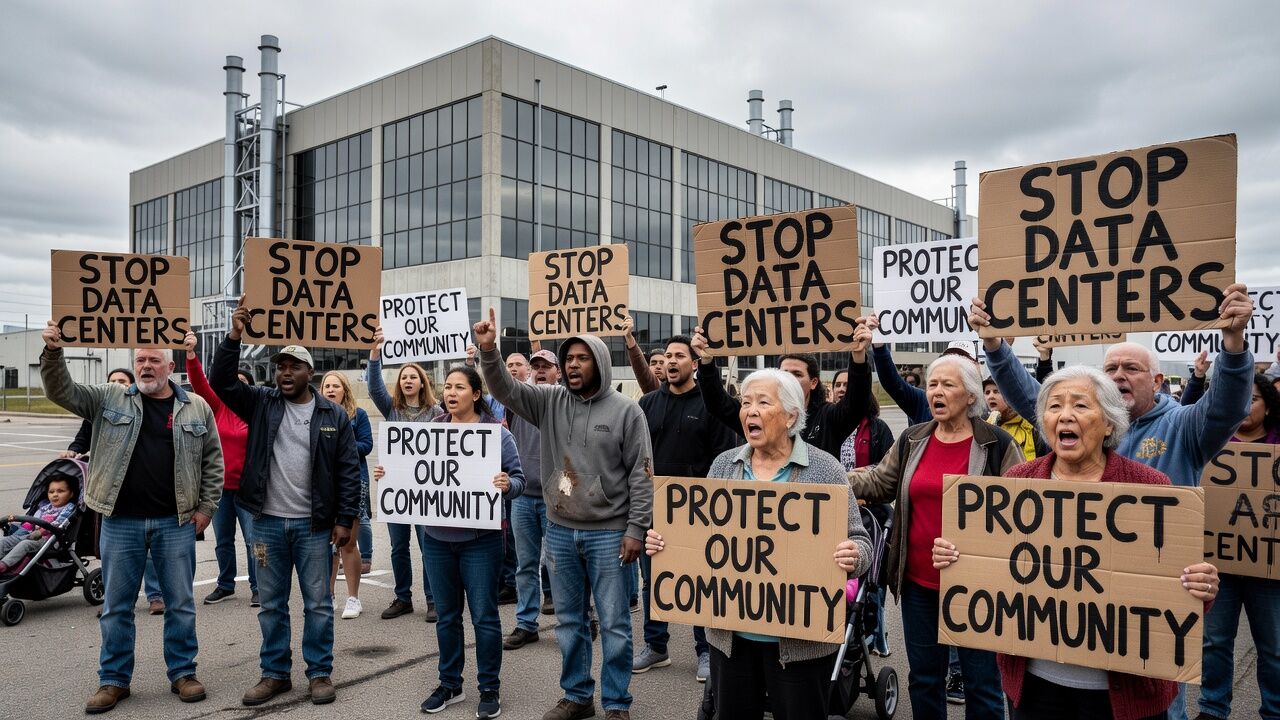
On Saturday, July 18, something happened that the AI industry has been dreading but probably saw coming: coordinated, nationwide protests against data center construction hit 142 locations across 42 states. This wasn't a scattered NIMBY movement anymore. This was organized, national, and it had a leader with a track record of building political movements from the ground up.
Amy Kremer — the Tea Party veteran who went on to found Women for Trump and helped organize the rally that preceded January 6 — has spent months calling data centers the defining fight of her lifetime. Her group, HumansFirst, pulled off what no one had managed before: simultaneous rallies from Wasilla, Alaska to Naples, Florida, with signs reading "You think this is pressure? Wait 'til there's no water pressure."
The cross-partisan nature of Saturday's protests is hard to dismiss. Texas — a Republican stronghold and currently the hottest data center market in the country — hosted 18 rallies, the most of any state. Georgia had 11. California, Florida, Pennsylvania, and Indiana each had seven. In Imperial Valley, protesters stood in 100-degree heat to oppose a facility that could pull 260 million gallons a year from the Colorado River. In Kenilworth, New Jersey, residents of an 8,500-person borough gathered outside their municipal court with drums and sidewalk chalk to protest a $1.8 billion CoreWeave AI data center approved for the former Merck campus — a project that has already drawn more than 12,000 petition signatures against it.
This Isn't Just Noise — The Numbers Tell the Story
The financial toll of this opposition is staggering and should be making every hyperscaler CFO nervous. According to Data Center Watch, a tracker run by 10a Labs, community opposition blocked or delayed roughly $156 billion in data center projects in 2025. In the first quarter of 2026 alone, another $130 billion in projects were blocked or delayed — matching the full-year 2025 total in just three months. That's about $286 billion in cumulative disruption, set against Morgan Stanley's estimate of $877 billion in total AI capital spending this year.
Active opposition groups have more than doubled from 396 to 833 and spread to 49 states. Legislators have filed more than 300 data center-related bills in the first half of 2026. This is not a fringe movement. This is infrastructure's new reality.
The polling backs it up. A June Reuters/Ipsos survey found that only 14 percent of Americans would support a data center built in their community. Gallup polling from March found 71 percent oppose building an AI data center in their area — 48 percent strongly. That's a worse number than local nuclear power plants get. And Morning Consult's national tracker crossed a threshold in May: "stop building" (about 45 percent) overtook "keep building while expanding energy supply" (about 38 percent) for the first time.
States Are Moving While DC Watches
The protests capped a week of unprecedented state-level action. On July 14, New York Governor Kathy Hochul signed the nation's first statewide moratorium on new hyperscale data centers — an executive order pausing state environmental permits for projects of 50 megawatts or more for up to a year while regulators draft standards covering energy demand, water use, and air quality. Hochul is also pursuing repeal of the state's sales-tax exemptions for massive data centers. Her office called it "the first to get it right," though a tougher bill with a 20-megawatt threshold remains unsigned on her desk.
Virginia — home to the world's densest concentration of data centers — let a new tax on data center electricity take effect on July 1: 1.1 cents per kilowatt-hour. Pennsylvania's House passed a ban on non-disclosure agreements in data center deals by a 171-31 vote and separately voted 197-5 to repeal the industry's sales-tax exemption, a break worth roughly $517 million a year by 2030. Arizona's governor signed a three-year moratorium on new data center tax breaks in June. Local pauses have passed at county, city, and tribal levels in at least 15 states.
This is not coordinated policy coming out of Washington. This is 50 separate laboratories of democracy all reaching the same conclusion independently, which in my book is more powerful than any federal bill would be.
The Industry's Answer — Voluntary Promises and Defense
So what's the industry saying? The Data Center Coalition warned that New York's moratorium tells investors the state is "closed for business." Seven major AI and cloud companies — Amazon, Google, Meta, Microsoft, OpenAI, Oracle, and xAI — point to the Ratepayer Protection Pledge they signed at the White House in March, a voluntary commitment to cover the grid costs their facilities create. But here's the thing about voluntary pledges: they're voluntary. There's no enforcement mechanism, and the actual protection for ratepayers depends on tariff terms approved by state utility regulators, not White House photo ops.
White House AI czar David Sacks went after Hochul's case point by point on the All-In podcast on July 18, calling data centers "the scapegoat for all of the angst that people have about AI." His solution: let developers build their own generation behind the meter instead of competing with households for grid power. It's a technically sound argument — on-site power generation would isolate data center load from residential grids — but it doesn't address the water use, the NDA secrecy, the zoning issues, or the jobs math that's driving community anger.
On that jobs math: Virginia's Department of Taxation found the state's data center industry added 1,610 jobs statewide in fiscal year 2025 while receiving approximately $1.9 billion in tax incentives. That's roughly $1.18 million per permanent position. The most automated hyperscale facilities run on 20 to 30 permanent staff per 100 megawatts of capacity. Construction employment is real but temporary; communities are left with a large, quiet building drawing enormous amounts of power and water, with a fraction of the jobs they were promised.
What This Means
Here's what I see from where I'm sitting. The AI infrastructure buildout has a community acceptance problem that money alone cannot solve. You can throw $877 billion at data center construction — which the industry is doing — but if local zoning boards, county commissions, and state legislatures keep blocking or delaying projects, that capital gets stuck. We're already seeing it: $286 billion in cumulative project disruption and counting.
The movement's demands are actually reasonable when you strip away the rhetoric: transparent approval processes (ending NDA practices that currently cover 80 percent of Virginia data center localities), environmental impact assessments before permits are granted, union construction jobs, and binding developer commitments rather than voluntary promises. In legal terms, this is a call for community benefits agreements — mechanisms that already exist and are used in other infrastructure contexts but have not been applied to data centers at scale.
Kremer herself opposes a national moratorium and even statewide moratoriums, telling Business Insider that each community should choose what gets built inside it. That's a more nuanced position than the headlines suggest. The fight is about process and accountability, not shutting down AI entirely.
The China Factor
It's worth noting what's happening on the other side of the Pacific while all this plays out. Beijing plans to spend roughly $295 billion over five years on a nationwide network of AI computing hubs, steered into the arid, sparsely populated west under its "Eastern Data, Western Computing" program. Provincial governments compete to attract data centers with tax holidays, cheap land, and compute vouchers. The state absorbs up to half of operators' energy costs. No Chinese county has passed a moratorium because no Chinese county gets a vote.
That doesn't mean America should copy China's model. But it does mean that every permit delay, every NDA lawsuit, every zoning fight is a competitive gift to a system that doesn't have to negotiate with its citizens. The question is whether America's democratic process can produce infrastructure outcomes fast enough to stay relevant, or whether the friction is a feature, not a bug — a sign that the buildout was moving faster than communities could absorb.
Looking Ahead
Saturday's rallies were peaceful — chalk, chants, drums, umbrellas. But the fight is far from over. Kremer expects data centers to be on the ballot in November and again in 2028. The midterms are less than four months away.
The AI industry has a choice to make. It can keep fighting every local battle and watch $130 billion in projects get blocked every quarter. Or it can engage seriously with the community benefits framework, push for binding commitments instead of voluntary pledges, and build the political cover it needs to keep construction moving. Right now, the industry is losing the narrative war, and it's losing badly. The numbers don't lie: 71 percent opposition, 833 active opposition groups, $286 billion in blocked projects. That's not a public relations problem. That's a structural threat to the entire buildout.
If I were running infrastructure strategy at any of the big hyperscalers right now, I'd be looking hard at on-site power generation, water-free cooling, and genuine community benefit agreements — not as PR, but as operational requirements. Because the alternative is 142 more protests, then 300, then a midterm election where every candidate has to take a position on data centers. And that's a race the industry is currently losing.
— Allan Ali, Sylt.ing
===SUMMARY=== Nationwide protests against AI data centers hit 142 locations across 42 states on July 18. With $286B in blocked projects, state moratoriums spreading, and 71% public opposition, the AI infrastructure buildout faces a structural threat that voluntary pledges won't fix. Turkish
 English
 Arabic
 French
 Spanish
 Portuguese
 Deutsch
 Dutch
Dutch
 Italiano
 Russian
 Romaian
 Portuguese (Brazil)
 Greek
Greek