


 Monetization
New York Just Froze 0 Billion in Data Center Development — Here's What It Means for AI Infrastructure
The Nation's First Statewide Data Center Moratorium
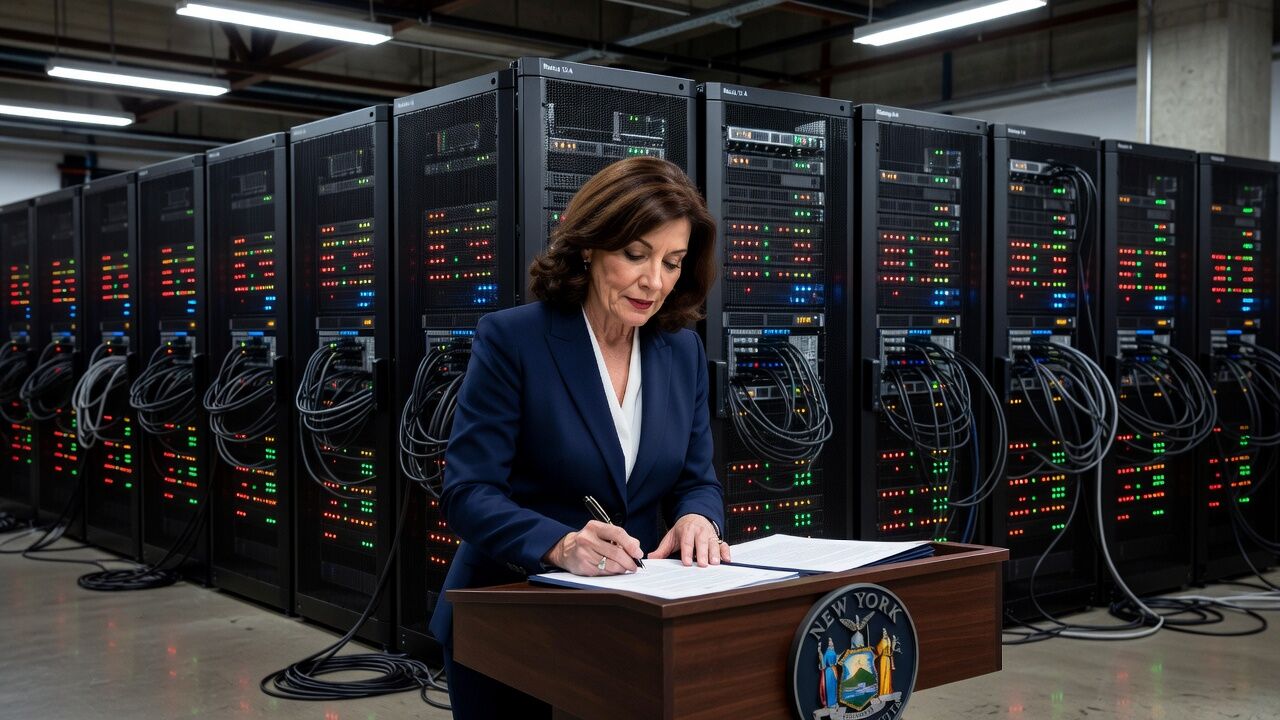
On July 14, New York Governor Kathy Hochul signed an executive order imposing a one-year statewide moratorium on new hyperscale data centers, making the Empire State the first in the nation to slam the brakes on AI infrastructure development. The order halts construction and permitting for any facility requiring at least 50 megawatts of power, effectively freezing a $10 billion pipeline of data center projects already in development across the state.
"Before it goes any further, I need safeguards in place to protect New Yorkers," Hochul said at a signing ceremony in Brooklyn. The governor framed the move as a necessary pause to study the energy and environmental impacts of the power-hungry facilities that underpin the artificial intelligence boom.
The executive order follows the New York Legislature's passage of the Responsible Data Center Development Act on June 4, which cleared the state Senate 44-16 and the Assembly 102-39. That bill provided the legislative framework; Hochul's executive order put the freeze into immediate effect.
What the Moratorium Actually Does
Let's be precise about what this order covers and doesn't cover, because the nuance matters for anyone running infrastructure in or near New York.
The moratorium applies to new "hyperscale" data center projects of at least 50 MW when they require state permits or approvals covered by the order. Facilities below that 50 MW threshold fall completely outside its scope — smaller colocation facilities, enterprise data centers, and edge deployments are not affected. Existing data centers can continue operating normally. Expansions of existing facilities below the 50 MW threshold also appear to be unaffected, though the exact language invites further regulatory interpretation.
The one-year window gives the state Department of Environmental Conservation and the New York State Energy Research and Development Authority time to develop permanent siting standards, environmental review requirements, and grid impact assessments for large-scale data center development. After that year, new rules would take effect and the moratorium would lift — assuming the political winds don't shift.
The Numbers That Matter: $10B, 227,000 Jobs, 50 MW
The economic stakes here are enormous. According to the Associated General Contractors of New York State, data centers supported more than 227,000 jobs across the state in 2024, contributed $49 billion to New York's GDP, and generated $5.1 billion in state and local tax revenue. Those aren't hypothetical projections — those are actual economic output numbers from last year.
The $10 billion pipeline that Bisnow reported includes projects from major hyperscalers and colocation providers who had already secured land, negotiated power agreements, and submitted permitting applications. Some of those projects now sit in regulatory limbo for at least a year.
The 50 MW threshold is worth examining. A typical hyperscale data center campus today draws between 100 and 300 MW. The trend is toward even larger facilities — some individual campus requests have escalated from a typical 30 MW to between 300 MW and "several gigawatts," according to Dominion Energy's recent filings. Setting the threshold at 50 MW means the moratorium catches virtually every new hyperscale project while exempting smaller deployments that make up the bulk of enterprise and colocation activity.
The Political Firestorm: Trump, DSA, and the Re-Election Calculus
Predictably, this move ignited a political firestorm. President Donald Trump slammed the moratorium within 24 hours, calling data centers "money machines" and saying New York was "letting them slip away." In a social media post, Trump demanded Hochul scrap the policy "IMMEDIATELY," warning that the pause would cede AI leadership to China. Hochul responded within hours, defending the moratorium as necessary environmental stewardship.
The New York Post reported that critics see the moratorium as a political calculation by Hochul, who faces a tough re-election campaign and a primary challenge from DSA-backed candidate Zohran Mamdani. The Democratic Socialists of America has made data center opposition a centerpiece of its campaign, framing the facilities as corporate welfare that drives up energy prices for working-class New Yorkers.
On the other side, Senator Bernie Sanders and Representative Alexandria Ocasio-Cortez — who have introduced a federal Data Center Moratorium Act in Congress — praised Hochul's executive order as a model for national action. The Sanders-AOC bill would impose a similar pause at the federal level, targeting data centers "used for the development or operation of artificial intelligence models at scale."
The Data Center Coalition, representing major hyperscalers and colocation providers, pushed back hard. Dan Diorio of the coalition said the moratorium "will ensure that those investments, jobs, and economic activity flow elsewhere rather than to New York — with impacts far beyond the data center industry."
What This Means for AI Infrastructure
This is the big question for anyone in hosting, colocation, or AI infrastructure: is New York a warning shot or an outlier?
Here's the reality check. Data center power demand in the US is projected to more than double between 2026 and 2030, according to S&P Global. The grid connectivity bottleneck — not generation capacity — is the primary constraint. Gartner reports that data center electricity consumption will hit 565 TWh in 2026, with AI-optimized servers alone accounting for 31% of that figure and set to surpass conventional servers by 2027.
New York's moratorium doesn't happen in a vacuum. Eagan, Minnesota, adopted a one-year data center development moratorium in February 2026. Local governments across Virginia, the nation's largest data center market, are pushing back on new developments. The tension between AI infrastructure demand and community resistance is real and growing.
But here's the thing — New York was never a top-tier data center market. It ranks well behind Virginia, Texas, California, and the Pacific Northwest in data center concentration. The state has high energy costs, complex regulatory requirements, and limited available power capacity in key regions like downstate New York. The moratorium may accelerate a trend that was already underway: hyperscalers building in markets with faster permitting, cheaper power, and fewer regulatory hurdles.
Where the Development Will Go Instead
If you're running infrastructure strategy, you're already looking at the alternatives. Virginia's Loudoun County and the broader data center alley remain the dominant market despite local pushback. Texas, led by nearly 8,000 MW of data center power consumption, offers cheap land, deregulated energy markets, and aggressive economic development incentives. The Nordic countries, Spain, and France are attracting massive buildouts thanks to cheap nuclear, hydro, and renewable power.
Ohio, Indiana, and the broader MISO footprint are seeing surging demand as hyperscalers look beyond the traditional markets. Dominion Energy recently noted that individual data center campus requests have escalated from 30 MW to several gigawatts — and those campuses are being built where power is available and permitting is fast.
For New York, the risk is real. A one-year pause in a market that wasn't a top priority for hyperscalers anyway may not matter much for global AI infrastructure buildout. But the precedent matters. If other states follow New York's lead — and the Sanders-AOC federal bill gains traction — we could see a regulatory wave that reshapes where and how AI infrastructure gets built.
The Bottom Line
Hochul's moratorium is genuinely historic — the first statewide pause on data center construction in the country. But it's also a relatively narrow and time-limited action that exempts the vast majority of data center projects (everything under 50 MW) and carries a built-in expiration date.
The real story here isn't New York's $10 billion pipeline freeze. It's the growing national conversation about whether AI infrastructure development needs guardrails — and who gets to set them. The energy demands of AI training and inference are real, the grid constraints are real, and the community pushback is real. How we resolve those tensions will determine the shape of the AI infrastructure map for the next decade.
For now, the hyperscalers will build where they're welcome. That means Texas, Ohio, the Nordics, and any jurisdiction that says "yes" faster than the competition. New York's pause may be a political win for Hochul, but in the race for AI infrastructure, time is the one resource nobody can pause.
— Allan Ali, Sylt.ing
===SUMMARY=== New York's first-in-nation data center moratorium freezes $10B in hyperscale projects for one year. Governor Hochul's executive order targets facilities over 50 MW, sparking a national debate on AI infrastructure regulation, energy constraints, and economic trade-offs that will reshape where data centers get built. French
 English
 Arabic
 Spanish
 Portuguese
 Deutsch
 Turkish
 Dutch
Dutch
 Italiano
 Russian
 Romaian
 Portuguese (Brazil)
 Greek
Greek