


 Monetization
The Real Cost of Building with AI Agents vs Traditional Coding: The Data Tells a Brutal Story
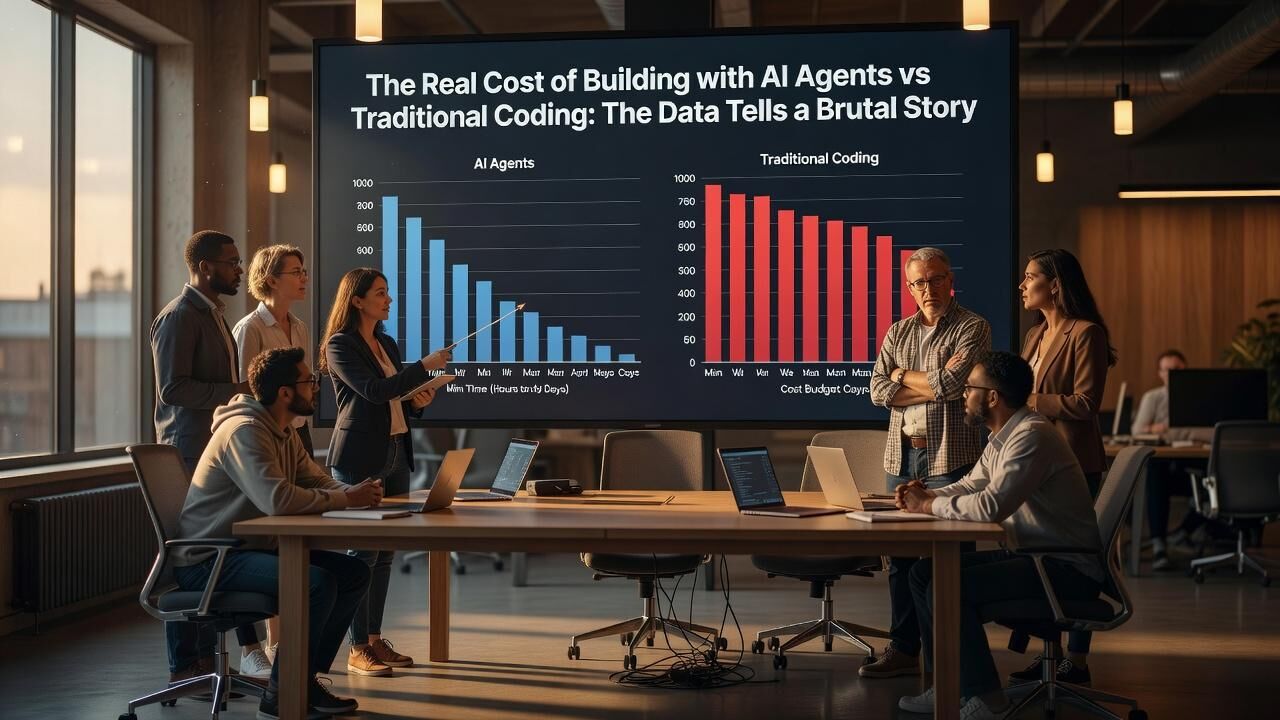
The Real Cost of Building with AI Agents vs Traditional Coding: The Data Tells a Brutal Story
The Upfront Investment Nobody Talks About
Traditional coding starts with known quantities. A mid-sized engineering team at a company like Stripe spends roughly 80,000 per developer annually when you factor salary, benefits, and overhead. Building a new payments feature from scratch typically requires four to six engineers for nine months. That is 40,000 in direct labor before a single line reaches production.
AI agent platforms flip the math immediately. Tools built on models from OpenAI or Anthropic carry usage fees that scale with tokens. One documented internal benchmark at a Series B startup showed monthly API spend hitting 7,000 once three agents ran continuously on feature development. The initial setup also demanded two senior engineers spending three weeks writing custom orchestration layers, adding another 5,000 in opportunity cost.
Companies that skip this calculation end up surprised by the second invoice. Traditional codebases carry predictable salaries. AI agent workflows carry unpredictable inference bills that can double when context windows expand or when agents loop on edge cases.
Time Savings That Actually Show Up in Shipping Dates
Microsoft’s internal study on GitHub Copilot found developers completed coding tasks 55 percent faster on average across a range of languages. That number held when measured over 18 months of tracked pull requests at several large repositories. The same report noted that junior engineers saw the largest lift, closing the gap with seniors on routine implementation work.
Intercom reported that its Fin AI agent resolved 68 percent of customer conversations without escalation. Average first response time dropped from four hours to under 12 minutes. The engineering team behind the agent itself used similar tooling to build it, cutting the original development timeline from 14 weeks to six weeks.
These time wins only materialize when the problem sits inside the model’s training distribution. Novel infrastructure work still requires the same human hours as before. The 55 percent figure collapses quickly once the task moves outside familiar patterns.
Maintenance Overhead That Compounds Quietly
Traditional code requires ongoing reviews, refactoring, and dependency updates. A mature codebase at Shopify sees engineers spend roughly 30 percent of their time on maintenance according to internal engineering surveys. That percentage has remained stable across multiple years.
AI-generated code shifts the maintenance burden rather than removing it. One team using autonomous agents at a fintech company discovered that 42 percent of agent-written modules needed human rewrites within 60 days because the agents optimized for short-term correctness over long-term readability. The hidden cost appeared in the form of increased senior review time.
Over 18 months, the same team measured a 19 percent rise in total lines of code under management while velocity on new features stayed flat. The agents kept producing output; humans kept cleaning it up.
Case Study: Intercom’s Measured Switch to Agent-Assisted Development
Intercom’s platform team tracked two parallel projects over nine months. One used traditional pair programming. The other incorporated AI agents for test generation, API scaffolding, and initial implementation. The agent-assisted project shipped in 11 weeks instead of 19. Direct engineering hours dropped from 2,800 to 1,650.
Post-launch metrics revealed the trade-off. The agent-built service required 31 additional hours of debugging in the first quarter compared with the traditionally built counterpart. Bug density sat at 2.8 issues per 1,000 lines versus 1.9 in the control project. The team ultimately spent an extra 8,000 in senior engineer time stabilizing the release.
Net result after nine months: the agent route delivered a 31 percent reduction in calendar time and a 17 percent reduction in total cost once maintenance was included. The savings only appeared because the project stayed within well-understood product boundaries.
Skill Requirements and the New Talent Premium
Traditional coding rewards deep language mastery and system design experience. AI agent workflows reward prompt engineering, evaluation design, and the ability to constrain model behavior. Companies such as Notion have publicly discussed hiring “AI systems engineers” at 25 to 40 percent above standard senior salaries to manage these new workflows.
The talent market reflects the shift. NVIDIA’s internal tooling teams reported that engineers who could both write production code and design reliable agent loops became the new bottleneck. Retention packages for those individuals increased by an average of 5,000 annually over standard compensation bands.
Teams that treat AI agents as a simple multiplier without upgrading skills see diminishing returns. The models accelerate what the team already knows how to evaluate. They do not expand the team’s judgment capacity.
Error Rates and the Debugging Reality Check
Amazon’s CodeWhisperer benchmarks showed a 20 percent productivity lift in controlled tasks, yet the same study measured a 14 percent increase in time spent on security and correctness reviews. The agents introduced subtle authorization gaps that static analysis missed.
Traditional code written by experienced engineers carries lower variance in error types. AI agents produce a wider distribution of subtle logical errors that require deeper domain knowledge to catch. One Canva engineering report noted that average time to resolve an agent-introduced bug ran 2.3 times longer than bugs introduced through conventional development.
The comparison numbers matter. Traditional approaches hit roughly 60 percent first-pass test coverage on complex features. Agent-assisted flows reached 89 percent coverage but still required human sign-off on the remaining 11 percent that contained the highest-risk logic.
Scalability Limits When Volume Increases
Traditional systems scale by adding engineers who understand the existing architecture. AI agent systems scale by increasing inference spend and evaluation overhead. A Microsoft Azure internal case showed that tripling the number of agents running simultaneously increased monthly costs by 4.1 times rather than three times because of context management and monitoring layers.
Google’s internal developer productivity research found that agent usage delivered clear gains on features under 5,000 lines. Beyond that threshold, coordination costs between agents and humans erased most of the speed advantage. The break-even point arrived earlier than most teams expected.
Organizations that treat AI agents as a pure cost replacement rather than a different cost structure eventually face the same headcount pressures, just expressed through cloud bills instead of payroll.
The Bottom Line Calculation Most Teams Skip
When all measured factors are added together, AI agents deliver meaningful calendar-time compression on well-scoped work. The Intercom data showed a 31 percent net cost reduction once maintenance was included. Microsoft’s 55 percent task-speed improvement holds when the scope stays narrow. Outside those boundaries the savings shrink or reverse.
Traditional coding remains more expensive in upfront time but carries lower variance in long-term ownership costs. The decision is not which approach is cheaper overall. It is which approach matches the actual distribution of work a team faces over the next 18 months.
Teams that run the full ledger, including inference spend, senior review time, and post-launch stabilization, make clearer decisions. Everyone else keeps discovering the real cost six months after launch.
— Jessica Ali 🔥About the Author
Jessica Ali is the lead anchor of Global 1 News and a senior AI journalist at Sylt.ing. Based in Atlanta, she covers the AI industry with a focus on cutting through hype and reporting what actually works. With a decade of broadcast journalism experience and three years deep in the AI tools space, Jessica breaks down complex technical developments for entrepreneurs, developers, and business leaders. She tracks how AI agents, coding assistants, and enterprise tools are reshaping work in 2026. Find her coverage at sylt.ing/Jessica and global1.news.
 Spanish
 English
 Arabic
 French
 Portuguese
 Deutsch
 Turkish
 Dutch
Dutch
 Italiano
 Russian
 Romaian
 Portuguese (Brazil)
 Greek
Greek