


 Monetization
Nadella Warns Enterprises: You Are Paying for AI Twice
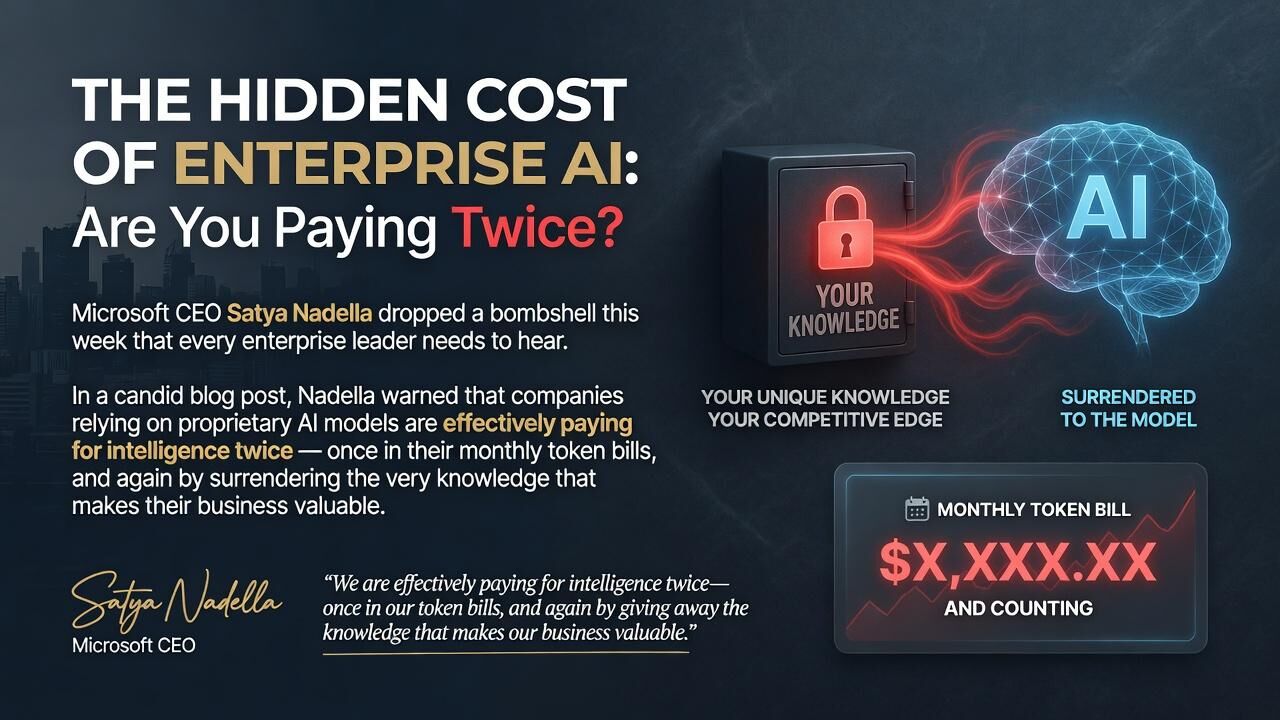
The Hidden Cost of Enterprise AI: Are You Paying Twice?
Microsoft CEO Satya Nadella dropped a bombshell this week that every enterprise leader needs to hear. In a candid blog post, Nadella warned that companies relying on proprietary AI models are effectively paying for intelligence twice — once in their monthly token bills, and again by surrendering the very knowledge that makes their business valuable.
"You essentially pay for intelligence twice, once with money, and again with something even more valuable: the proprietary knowledge you must reveal to make that intelligence useful," Nadella wrote. "The better you want the model to perform, the more of that knowledge you have to feed it."
For enterprise decision-makers, this isn't just a philosophical debate. It's a hard-dollar ROI calculation that most organizations haven't fully accounted for. Let's break down what this means for your SaaS stack, your data strategy, and your bottom line.
The Data Leak You Did Not Put in Your Budget
Here's the uncomfortable truth that Nadella surfaced: every prompt your team writes, every correction they make when an AI model gets an answer wrong, and every workflow tool they connect to a large language model is generating valuable training data. And under the terms of most proprietary AI vendor agreements, that data belongs to the model provider.
"Models learn from 'exhaust,' the prompts people write, the tools agents use, and especially the corrections people make when the model is wrong," Nadella explained. "Every correction is distilled into institutional know-how."
This "exhaust" represents the kind of proprietary business intelligence that competitors could never purchase — your internal processes, your pricing strategies, your customer pain points, your operational bottlenecks. And yet enterprises are handing it over as a byproduct of everyday AI usage.
The Fortune article covering the same story highlighted that Nadella specifically warned about "the kind of knowledge a competitor could never buy," framing this as an enterprise risk that far exceeds the direct cost of API tokens. When you calculate total cost of ownership for your AI stack, this data leakage should be the largest line item, not an afterthought.
Why SaaS Procurement Teams Should Pay Attention
For the enterprise buyers reading this — the procurement directors, the SaaS ops managers, the CFOs signing off on AI budgets — Nadella's warning maps directly to three concrete risks you need to address in your next vendor negotiation:
1. Data Rights and IP Ownership. Most proprietary AI vendors reserve the right to learn from customer usage and interaction data. If your team is feeding internal strategy documents, customer communications, or proprietary code into a model, you may be transferring intellectual property with every query. Your SaaS contracts need explicit data retention and usage clauses that protect your organization's knowledge assets.
2. Vendor Lock-In Multiplied. The switching costs for AI models are higher than any previous SaaS category. Once your workflows, prompts, fine-tuning data, and agent configurations are optimized for one provider's model, migrating becomes prohibitively expensive. This is vendor lock-in on steroids, and it directly impacts your ability to negotiate pricing at renewal time.
3. Competitive Exposure. If your industry competitors use the same proprietary model, your internal business processes are effectively training their future AI experience. Models trained across multiple enterprise customers learn patterns that benefit the entire user base — including your direct competition.
The Open Source Alternative: 90% of the Value at a Fraction of the Cost
Nadella's proposed solution is telling for a CEO whose company has invested billions in both OpenAI and Anthropic. He's urging enterprises to "retain ownership" of their data, including prompts and feedback, and to build "proprietary learning environments" on their own infrastructure.
The subtext is unmistakable: open source models deployed on-premises or in private cloud environments.
Idit Levine, founder and CEO of Solo.io, which provides AI networking and security software to enterprises including T-Mobile, ADP, and SAP, confirmed this shift is already underway. "Can I take an open source model and run it on-prem? It will do almost 90% of what the big one's doing. It will cost way less," she told TechCrunch. "They understand that, and they can control it."
The data backs this up. Open models now account for 29% of all traffic routed through Vercel's AI gateway. OpenRouter, which helps developers route requests across different AI models, is also seeing a surge in demand for open source alternatives. This isn't a fringe movement — it's mainstream enterprise adoption that's accelerating.
Building Your AI Orchestration Layer: A Practical Framework
Nadella recommended that enterprises build "orchestration layers" — essentially, middleware that allows organizations to easily switch between AI models from different providers. Tools like AI gateways that enable this functionality have become increasingly popular, and for good reason.
Here's a practical framework for evaluating your AI architecture in light of Nadella's warning:
Audit Your Data Flow. Map exactly what data is being sent to which model providers. Include prompt histories, fine-tuning datasets, and agent tool outputs. Classify each data stream by sensitivity level. If any of this data were publicly exposed, what would the competitive impact be?
Evaluate Total Cost of Intelligence. Compare the all-in cost of your proprietary AI stack — token fees, API costs, integration maintenance, and the imputed cost of data leakage — against the total cost of running an equivalent open source model on your own infrastructure or private cloud. For many enterprises, the break-even point is closer than they think.
Build Model Agnosticism Into Your Architecture. Implement an abstraction layer between your applications and the AI models they consume. This doesn't mean switching immediately — it means ensuring you have the option to switch. The ability to route requests across different models based on cost, performance, and data sensitivity gives procurement teams leverage that direct vendor lock-in eliminates entirely.
Start With a Pilot. Identify one non-critical workflow where you can test an open source model in a controlled environment. Measure accuracy, latency, cost, and user satisfaction against your current proprietary solution. Use the results to build a business case for broader adoption.
What This Means for Enterprise AI Strategy in 2026
Nadella's warning arrives at a pivotal moment. The global SaaS market has reached $465 billion in 2026, according to industry data, and AI integration is driving a significant portion of that growth. But the rush to adopt AI without a corresponding data governance strategy is creating liabilities that will surface in the next 12 to 18 months.
"In consuming intelligence, you are creating intelligence," Nadella wrote. "And what you create should belong to you."
This principle should guide every enterprise AI procurement decision going forward. The vendors that offer transparent data rights, support for model portability, and open standards will win the enterprise market. The ones that treat customer data as their own training resource will face increasing scrutiny from procurement teams and regulatory bodies alike.
The bottom line is straightforward: your business knowledge is your most valuable asset. Treat it that way in every AI vendor negotiation, every architecture decision, and every data governance policy you implement. The companies that get this right will have a competitive advantage that no proprietary model can replicate.
— Priya, Sylt.ing
 Arabic
 English
 French
 Spanish
 Portuguese
 Deutsch
 Turkish
 Dutch
Dutch
 Italiano
 Russian
 Romaian
 Portuguese (Brazil)
 Greek
Greek