


 Monetization
The Three-Second Theft: Why AI Voice Fraud Is Draining Grandma's Bank Account — and Nobody's Stopping It
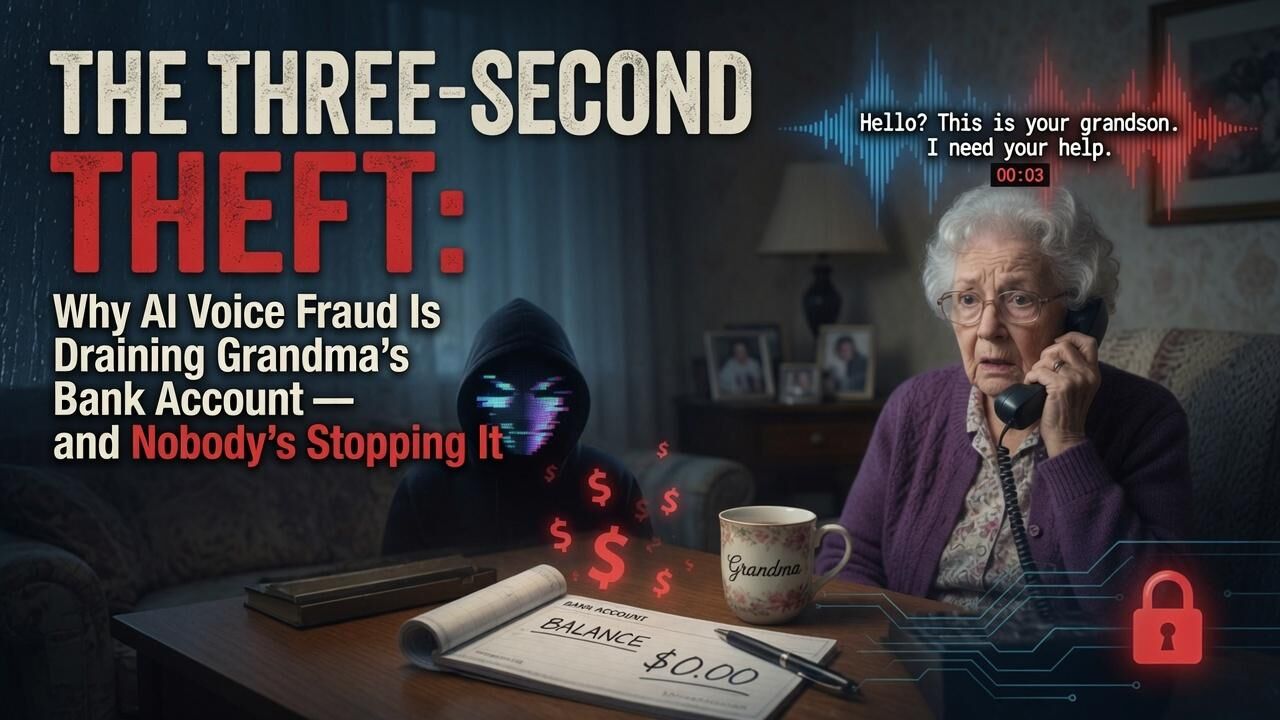
The Three-Second Theft: Why AI Voice Fraud Is Draining Grandma's Bank Account — and Nobody's Stopping It
It Only Takes Three Seconds
Sharon Brightwell answered her phone, heard her daughter April crying, and every protective instinct she'd developed over a lifetime kicked in. The voice was unmistakable — same timbre, same rhythm, same broken cadence of a young woman in distress. April said she'd been texting while driving. She'd hit a pregnant woman. Her phone had been seized by police. A "lawyer" got on the line demanding $15,000 cash for bail. Within the hour, the Dover, Florida retiree had withdrawn the money and handed it to a courier.
Only when she reached the real April — who'd been at work all morning and had never been near an accident — did she understand the truth. That crying voice was not her daughter. It was a machine. Three seconds of audio, pulled from God-knows-where, synthesised into a perfect copy of her child's voice. The girl Sharon thought she was rescuing existed only as patterns of numbers in someone else's computer.
And here's the part that should make you furious: that story, reported across American local news in the summer of 2025, is now one of the most ordinary crimes in the United States. A grandmother in her kitchen, targeted by the absolute frontier of machine learning, at scale, for pennies. And two years later, we're still handing out pamphlets about "safe words" instead of actually stopping it.
$893 Million and Nobody's Counting Right
In April 2026, the FBI's Internet Crime Complaint Center published its annual report. For the first time in 26 years, they had to invent a brand new category: AI-enabled fraud. More than 22,000 complaints. Adjusted losses exceeding $893 million. Of that, $352 million came from victims aged 60 and older — the single most heavily targeted demographic in AI-enabled financial crime.
The FBI was candid that these figures understate the problem. Most victims never even learn a machine was involved. That $893 million is a floor, not a ceiling. The global picture is worse. INTERPOL estimated worldwide losses at $442 billion in 2025 alone — the entire annual economic output of Denmark — and found AI-enhanced scams are roughly four and a half times more profitable than traditional ones.
The World's Top Expert Just Went Blind
In June 2026, the New York Times profiled Hany Farid, the University of California, Berkeley professor who is, by broad consensus, the world's foremost authority on deepfake forensics. For more than two decades, he was the guy who could separate real from synthetic when nobody else could.
Lately? He's been failing his own tests. "I feel like I'm going blind," he told the Times.
Let that land. The single most qualified person on Earth to distinguish a genuine recording from an AI-generated one can no longer reliably do it. In the audio domain, the detection arms race has been lost. A fraud that depends on twenty minutes of panic does not give a victim twenty minutes to run a forensic analysis that even Farid wouldn't trust.
Handed Out Like Candy
Here's where the rage really kicks in. The technology behind this crime wave is not kept in some dark web vault. It's sold commercially, over the counter, with a checkbox.
In March 2025, Consumer Reports assessed six major voice-cloning companies — Descript, ElevenLabs, Lovo, PlayHT, Resemble AI, and Speechify. Their conclusion? A majority lacked any meaningful safeguard against fraud. Four of the six required nothing more than a tick-box affirming you had the legal right to clone the voice. No technical mechanism to confirm consent. Four required nothing more than a name or email to open an account.
A self-attestation checkbox is not a security measure. It's a fig leaf. New York City fire escapes have more regulatory oversight than the tools letting criminals steal your grandmother's life savings.
This Is Not a "Grandma Problem"
I need to address something directly because the framing is wrong. This is not happening because older people are naive. The characteristics that make them targets are features of a life well lived, not deficiencies of intelligence.
They hold higher savings — decades of work accumulated. They operate within trust-based communication where a phone call from a distressed relative is answered as a genuine emergency. And they're exposed to the emotional architecture of a family crisis, where the instinct to protect a child overrides every slower faculty.
Gary Schildhorn — a Philadelphia attorney, a trained advocate paid to interrogate evidence — was himself targeted by a cloned-voice scam. Even with hindsight and professional scepticism, he couldn't shake what he'd heard. "I will go to my grave swearing that it was your voice," he said. If the clone defeated a lawyer whose entire job is to question things, what chance does the rest of us have?
The Safe Word Myth
The most widely circulated advice — repeated by the FBI, the American Bankers Association, and consumer advocates — is to agree on a family "safe word." If the voice can't produce it, hang up.
The advice is sound. It is also, as a systemic defence, hopelessly inadequate. A safe word works only if every family member adopts it, remembers it, and has the presence of mind to demand it in a moment engineered to obliterate presence of mind. It places the entire burden of defeating a billion-dollar criminal apparatus on the cognitive discipline of a frightened individual at the worst moment of their week.
A defence that works only when the target performs flawlessly under maximum stress is not a defence. It's a way of allocating blame to the victim after the fact.
Where the Real Fix Lives
The voice-cloning tools were built by companies. The calls are carried by telecom networks. The money moves through banks. Every single one operates at a chokepoint where this fraud could be interdicted at scale. The grandmother in her kitchen does not.
The UK model for banks: In October 2024, the Payment Systems Regulator made reimbursement for authorised push payment fraud mandatory. Banks split liability 50-50, up to £85,000. The result? 89% of money lost — some £243 million — was reimbursed. More importantly, once banks were liable, they suddenly built the friction — the held payment, the cooling-off period, the human call from the branch — that actually stops fraud before it completes.
Telecoms need to do more. The STIR/SHAKEN framework authenticates numbers, not humans. Against a cloned voice arriving from a spoofed number, it's nearly irrelevant.
Platforms need real regulation. The EU's AI Act and Tennessee's ELVIS Act — requiring written consent to clone a voice — are early gestures. They remain far ahead of enforcement and far behind the threat.
Bottom Line, Folks
The 22,000 complaints and $893 million the FBI logged? That's the visible portion of a crime designed to stay invisible. The shame, the silence, the victims who never come forward — they compound the problem every single day.
The deepest reason the gap between attack and defence is measured in years is simple: cloning a voice takes three seconds and improves monthly. Rewiring a banking system takes years, because it requires overcoming every commercial interest that profits from the status quo.
Here's what you can do tonight:
- Call your grandparents. Set up a family safe word — it's not a cure, but it's a start.
- Ask your bank what fraud detection systems they have for large withdrawals by older customers.
- Share this article. Awareness that this exists is the first defence.
- Call your representatives. Ask why voice-cloning tools are regulated less than toasters.
The $352 million in losses the FBI attributes to older victims — and the far larger sum it cannot see — represents a transfer of wealth from the people least able to lose it to the most efficient criminal enterprise yet devised. Closing the gap won't come from teaching grandmothers to doubt their grandchildren's voices. It will come from deciding that the institutions standing between the clone and the cash are responsible for what passes through their hands. Stay sharp out there, folks. We've got work to do.
AI voice cloning needs just three seconds of audio to drain bank accounts. With $893M in reported losses and the FBI's top forensic expert admitting he can't reliably detect fakes, Jessica Ali exposes why this crisis is only getting worse.
 Greek
Greek
 English
 Arabic
 French
 Spanish
 Portuguese
 Deutsch
 Turkish
 Dutch
Dutch
 Italiano
 Russian
 Romaian
 Portuguese (Brazil)