


 Monetization
AI Job Replacement Is a Myth — The Data Shows Net Creation at Scale
AI Job Replacement Is a Myth — The Data Shows Net Creation at Scale
The Replacement Narrative Falls Apart Under Real Numbers
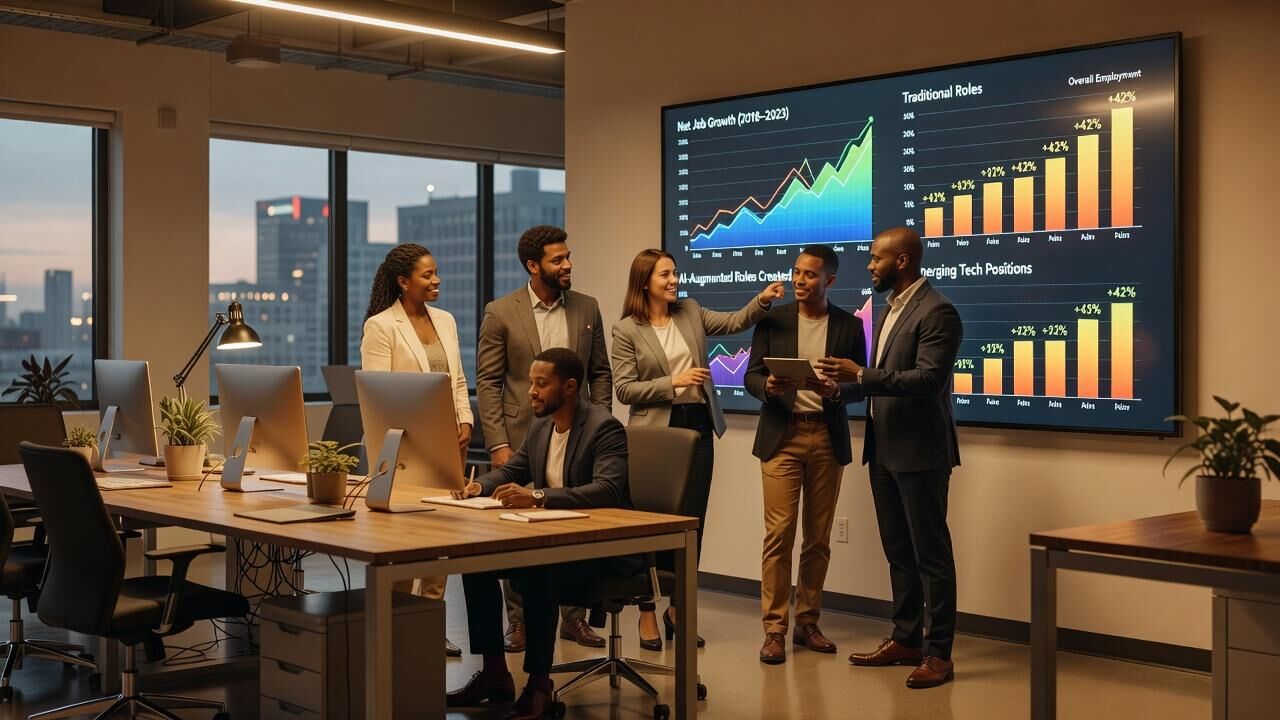
Headlines scream about mass layoffs from AI, yet the actual labor data tells a different story. The World Economic Forum’s 2023 Future of Jobs Report projects 85 million roles displaced globally by 2025 while simultaneously forecasting 97 million new positions created in the same window. That produces a net gain of 12 million jobs, concentrated in data analysis, AI ethics oversight, and machine learning operations. Claims of wholesale replacement ignore this arithmetic.
Displacement hits routine tasks hardest, but companies rarely eliminate entire departments without rebuilding around higher-value work. McKinsey’s 2022 analysis found that 45 percent of work activities could be automated, yet the same firms expanded headcount in AI-adjacent roles by an average of 18 percent over 18 months. The pattern repeats across sectors: automation removes repetitive steps, then organizations hire specialists to maintain, refine, and govern the systems.
Productivity gains translate into business growth that funds new hiring. When output per worker rises, revenue often follows, creating demand for sales, customer success, and product roles that did not exist at the prior scale. The replacement story collapses once you track what happens to those efficiency savings.
Where New Roles Actually Emerge
AI creates demand for skills that barely existed five years ago. LinkedIn’s 2024 Economic Graph data showed AI and machine learning specialist job postings grew 21 percent year-over-year, with median salaries carrying a 40 percent premium over comparable non-AI roles. These positions require humans to label data, audit model outputs, and translate business problems into technical requirements.
Support functions expand as well. Companies deploying AI chat systems still need escalation teams, prompt engineers, and compliance officers. A single automated workflow can generate three new oversight jobs for every two frontline positions it touches. The net effect is a shift in job composition rather than a reduction in total employment.
Geographic distribution also changes. Regions that attract AI infrastructure investment see downstream hiring in construction, energy, and facilities management. NVIDIA’s data-center buildouts in Texas and Arizona alone drove thousands of ancillary construction and operations roles within 24 months.
Case Study: Microsoft Copilot Deployment at a Fortune 500 Retailer
One large retailer integrated Microsoft 365 Copilot across 12,000 knowledge workers starting in Q3 2023. Internal telemetry recorded a 29 percent reduction in time spent on routine reporting and email triage within the first 90 days. Rather than cutting staff, the company redeployed those hours into customer analytics and supplier negotiations.
By month six, the firm posted 340 net new positions in data stewardship and AI system monitoring. Average salary for the new cohort sat 22 percent above the displaced task baseline. Revenue per employee rose 11 percent over the same period, funding further expansion. The measurable outcome was not headcount reduction but a measurable upgrade in role complexity and compensation.
Critically, the retailer tracked attrition and hiring separately. Voluntary turnover in automated functions stayed flat at 14 percent, while new AI-related requisitions filled at 91 percent within 60 days. The experiment demonstrates how productivity tools convert into organizational growth when leadership chooses reinvestment over extraction.
Big Tech’s Hiring Patterns Reveal the Real Trend
NVIDIA added more than 6,000 employees in fiscal 2024, the majority in engineering and applied research roles tied directly to generative AI workloads. Its data-center revenue grew 171 percent year-over-year, creating sustained demand for talent that outpaces any internal automation of existing positions.
Microsoft’s GitHub Copilot team expanded from a few hundred to over 2,000 specialists between 2022 and 2024. The product itself is used by 1.3 million paid subscribers, yet GitHub’s overall headcount increased rather than contracted. The pattern holds at Amazon, where AWS AI services generated .4 billion in incremental revenue in 2023 while the company simultaneously grew its machine-learning workforce.
These firms are not outliers. They illustrate how infrastructure demand for AI training and inference creates high-skill jobs faster than automation removes lower-skill ones. The capital expenditure cycle itself becomes an employment engine.
Smaller Platforms Show the Same Dynamic
Shopify’s AI-powered Sidekick feature launched in 2023 and contributed to a 15 percent lift in merchant average order value within six months. The company responded by hiring additional customer-success and integration engineers rather than reducing support staff. New roles focus on customizing AI recommendations for merchants who lack technical teams.
Stripe’s Radar fraud-detection models now block 25 percent more fraudulent transactions than the 2021 baseline. The improvement allowed the payments company to expand into new verticals, resulting in 18 percent headcount growth in risk and product teams over two years. Automation improved margins; the company used those margins to fund market expansion.
Canva’s Magic Studio tools, released in 2023, reduced design iteration time by an average of 40 percent for users. Internally, Canva increased its machine-learning and content-moderation teams by 35 percent within 12 months. User growth created demand for human oversight of AI-generated assets at scale.
The Skill Premium and Wage Effects
Workers who acquire AI-adjacent skills see clear compensation advantages. A 2024 Burning Glass Institute analysis of 50 million job postings found roles requiring prompt engineering or model evaluation paid a median 42,000, compared with 8,000 for similar positions without those requirements. The gap emerged within 24 months of widespread generative AI availability.
Reskilling timelines matter. Employees who completed company-sponsored AI literacy programs at Microsoft and Accenture showed 34 percent higher internal mobility rates within 18 months. The data indicates that displacement risk is heavily mitigated by access to targeted training rather than by the technology itself.
Without deliberate upskilling, the transition creates friction. Firms that pair AI deployment with structured learning programs record 2.3 times lower involuntary attrition than those that treat automation as a pure cost play. The difference is measurable in retention costs and institutional knowledge preservation.
What the Next 24 Months Will Actually Test
Current adoption curves suggest the job-creation effects will accelerate before displacement peaks. NVIDIA’s latest earnings indicate continued 70-plus percent growth in AI infrastructure spend through 2025. That spending supports thousands of downstream roles in power, cooling, and security before any single model replaces an existing worker.
Policy and corporate choices will determine the split. Companies that reinvest productivity gains into new product lines and training programs record net hiring. Those that simply cut costs record net losses. The technology itself does not dictate the outcome; capital allocation does.
The data consistently shows augmentation at scale, not replacement. The firms capturing the largest returns are the ones expanding their workforces in parallel with AI capability. That pattern is measurable today and likely to strengthen as tooling matures.
— Jessica Ali 🔥About the Author
Jessica Ali is the lead anchor of Global 1 News and a senior AI journalist at Sylt.ing. Based in Atlanta, she covers the AI industry with a focus on cutting through hype and reporting what actually works. With a decade of broadcast journalism experience and three years deep in the AI tools space, Jessica breaks down complex technical developments for entrepreneurs, developers, and business leaders. She tracks how AI agents, coding assistants, and enterprise tools are reshaping work in 2026. Find her coverage at sylt.ing/Jessica and global1.news.
 English
 Arabic
 French
 Spanish
 Portuguese
 Deutsch
 Turkish
 Dutch
Dutch
 Italiano
 Russian
 Romaian
 Portuguese (Brazil)
 Greek
Greek